Ethereum Protocol Update: ACDC #191
Ethereum developers prioritize post-quantum security, defer Quick Slots, advance EIP-8483 for Hegotá, and postpone Glamsterdam payload validation changes.
Ethereum core developers made a significant shift toward post-quantum security during All Core Developers Consensus (ACDC) Call #191 on November 12, 2026. Developers agreed to abandon the BLS-based decoupled consensus direction in favor of post-quantum alternatives, while Hegotá's scope began reflecting the increasing urgency of cryptographic migration.
EIP-8483, which would enable early registration of post-quantum key material, advanced to Proposed for Inclusion (PFI). Meanwhile, EIP-8198 (Quick Slots) moved to Deferred for Inclusion (DFI), with its champion withdrawing the proposal to prioritize post-quantum work. Developers also postponed a final decision on FOCIL's compatibility with future consensus designs.
Post-Quantum Consensus Replaces the BLS-Based Decoupled Consensus Direction
Ethereum developers agreed to abandon the existing BLS-based decoupled consensus direction, concluding that future work should target post-quantum decoupled consensus (PQ-DC) directly. The decision reflects growing concerns about quantum computing and the possibility that cryptographic systems currently protecting Ethereum may need replacement sooner than previously anticipated.
The discussion followed Devcon L1 research workshops, where developers examined the potential impact of advances in quantum computing and artificial intelligence on blockchain security. Participants characterized the perceived threat level as approximately DEFCON 2–3.
According to estimates discussed during the call, Cambridge experts had revised their projected Q-Day timeline from 2032 in 2025 to 2029 in 2026. Q-Day refers to the hypothetical point at which quantum computers become capable of breaking cryptographic systems currently used across digital infrastructure.
These projections remain uncertain, but the possibility of accelerated progress has increased the urgency of preparing Ethereum's cryptographic transition. Justin Drake also shared that the Ethereum Foundation is investigating whether significant cryptographic breakthroughs might already exist without being publicly disclosed.
The Foundation expects to publish findings, regardless of the outcome, within the coming weeks. Rather than investing further in BLS-based decoupled consensus that could eventually require replacement, developers favored designing directly around post-quantum cryptography.
This decision aligns with Ethereum's broader direction described in Ethereum's Roadmap Just Changed: Here's What's Next, where quantum resistance and protocol simplification emerged as major long-term priorities. LeanVM is central to this research effort.
Developers identified January 2027 as its production-readiness target, with formal audits expected to begin February 1, 2027. LeanXMSS and LeanSPHINCS were also discussed as minimal trusted codebases for hash-based cryptographic implementations.
One potential alternative discussed was PQ Gasper, which could provide a faster path toward quantum-resistant consensus. Developers have not committed to this approach because its feasibility requires further investigation.
Quick Slots Deferred as Hegotá's Scope Shifts Toward Post-Quantum Security
Developers moved EIP-8198 (Quick Slots) to Deferred for Inclusion after its champion withdrew the proposal from Hegotá consideration to prioritize post-quantum security. EIP-8198 proposes reducing Ethereum's slot duration from 12 seconds to 10 seconds, potentially improving transaction inclusion times and increasing the frequency of block production.
The proposal had previously advanced to Considered for Inclusion during ACDC #188, demonstrating meaningful interest from client teams. During ACDC #190, developers discussed a phased development strategy in which FOCIL and Frame Transactions would initially progress before Quick Slots integration.
The latest decision changes that trajectory. Rather than continuing parallel development of shorter slots, the proposal's champion chose to redirect attention toward post-quantum priorities.
This does not permanently reject faster slots. Instead, it reflects a decision to reduce competing implementation demands as Ethereum prepares for potentially significant changes to consensus cryptography.
EIP-7805, Fork-Choice Enforced Inclusion Lists, was previously selected as Hegotá's consensus-layer headliner. It aims to strengthen censorship resistance by making it harder for block builders to systematically exclude valid transactions. Its significance has been explored in Hegotá Should Complete the Holy Trinity of Censorship Resistance.
During ACDC #191, developers acknowledged that FOCIL's consensus-layer complexity appeared manageable. However, uncertainty remains about its interaction with post-quantum signatures and future decoupled consensus designs.
As a result, developers deferred resolving these compatibility questions to a future call. The broader challenge is determining how Ethereum's censorship-resistance mechanisms can coexist with a redesigned cryptographic architecture without introducing excessive complexity.
These questions matter because Hegotá already has substantial commitments, including EIP-8141 (Frame Transactions), selected as the execution-layer headliner during ACDE #245. Ethereum's earlier evaluation of 62 Hegotá EIPs ranked FOCIL and Frames among the upgrade's highest-priority proposals.
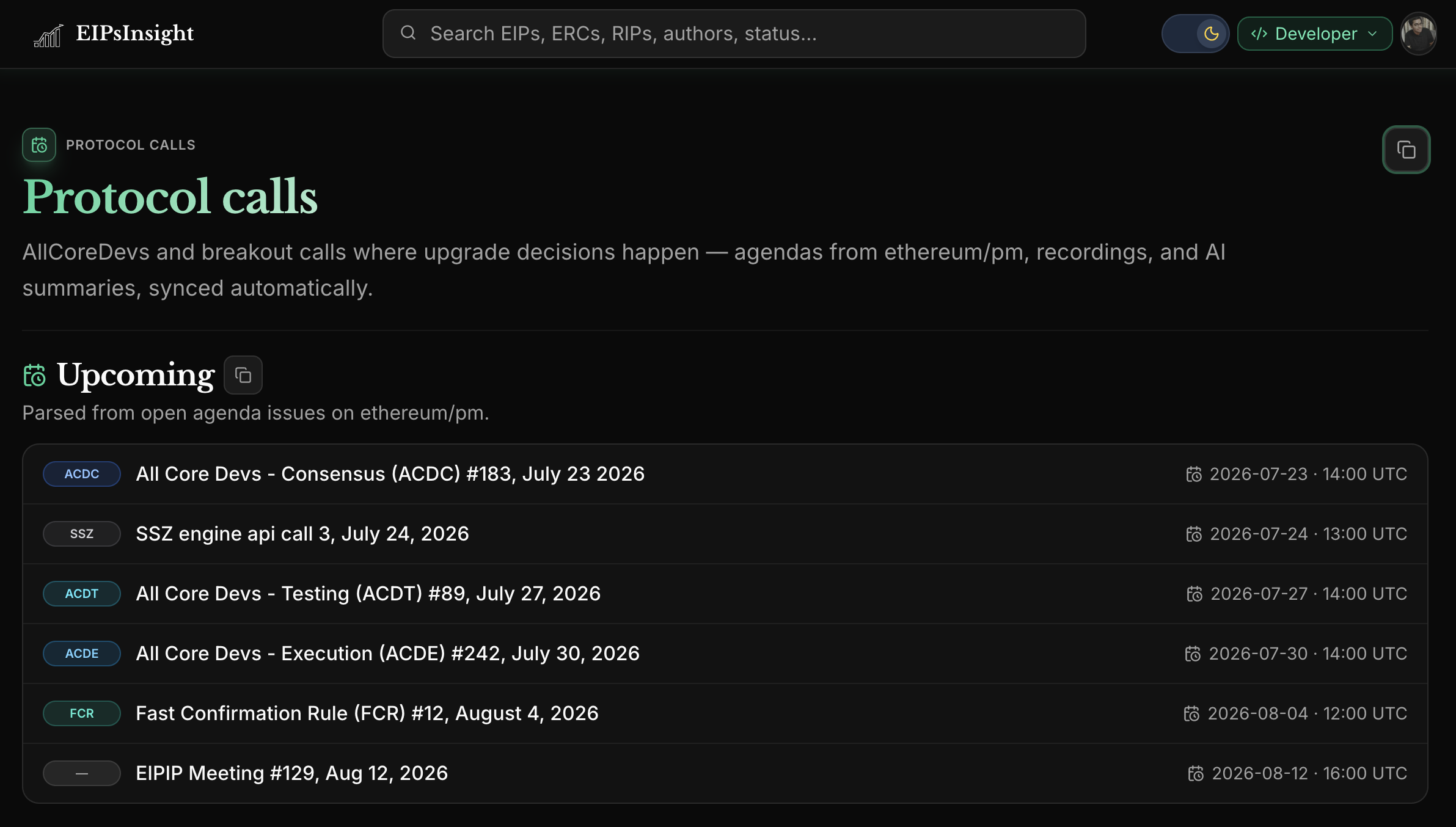
Follow all Ethereum protocol calls and updates here.
EIP-8483 Advances to Prepare Ethereum for Post-Quantum Migration
Developers advanced EIP-8483, Post-Quantum Material Registration, to Proposed for Inclusion for Hegotá, creating a potential pathway for validators and builders to prepare their cryptographic credentials before a future hard fork. Validators, staking providers, infrastructure operators, and other ecosystem participants must have sufficient time to generate, register, and manage new cryptographic material.
EIP-8483 proposes allowing post-quantum keys to be registered through execution requests before the network activates the corresponding consensus changes. According to the discussion, a system contract could be deployed once the post-quantum signature scheme is finalized.
A later hard fork would then be necessary to transfer the registered information into Beacon Chain state. This separation could enable infrastructure preparation before post-quantum signatures become consensus-critical.
Potuz emphasized that publicly committing to a preferred post-quantum signature scheme should be a priority so that staking pools, hardware wallet manufacturers, and users can begin migration planning. The discussion also extended beyond validator signatures.
Developers reported that approximately 80% of Ethereum's consensus-layer network already uses hybrid post-quantum key exchange through go-libp2p. However, execution-layer networking requires additional work involving node identity and peer discovery.
The advancement of EIP-8483 is an initial scoping decision, not confirmation that it will ship in Hegotá. Final inclusion will depend on technical readiness, client support, and agreement on the underlying cryptographic scheme.
Glamsterdam Payload Validation Decision Deferred Pending Further Testing
Developers deferred consensus-specifications PR #5770, which proposes additional block-hash validation during execution payload gossip, pending execution-layer clarification and further testing. The decision follows ongoing uncertainty around EIP-8037 and EIP-8038, whose repricing changes remain under review.
Additional audit findings are expected to be discussed during Monday's All Core Developers Testing (ACDT) meeting. The urgency of coordinating execution and consensus behavior became clearer following adversarial testing by Toni on Glamsterdam Devnet 8.
Testing demonstrated that oversized or invalid ePBS execution payloads could cause execution clients to spend up to 12 seconds processing them. Given Ethereum's 12-second slot duration, such behavior presents a potential risk to timely block processing.
Besu has already addressed the identified issue in its implementation. However, developers acknowledged that a broader cross-client approach is needed to handle malformed or malicious payloads consistently.
This continues the adversarial-testing concerns documented in ACDC #187, where developers reviewed execution-client stability and builder-related risks ahead of public-testnet deployment. PR #5770 would align execution payload gossip validation more closely with fork-choice requirements.
However, its proposed implementation introduces execution-layer RLP handling into consensus specifications. Rather than immediately adopting that approach, Cayman from Lodestar will prepare an alternative proposal that includes the payload root in the builder bid.
Developers will revisit the decision after receiving greater clarity on EIP-8037 and EIP-8038, Sepolia-related findings, and cross-layer payload handling. The discussion also builds on ACDC #184 and ACDC #186, which documented Glamsterdam's development-network testing and the coordination required for execution-layer changes.
For now, the priority remains ensuring that ePBS payload validation is robust across clients without introducing unnecessary complexity into consensus specifications. The next ACDC meeting, ACDC #192, is scheduled for November 26, 2026, despite the Thanksgiving holiday.
If you find any issues in this blog or notice any missing information, please feel free to reach out at yash@etherworld.co for clarifications or updates.
To promote your Web3 articles, events, and projects, you may reach out anytime via EtherWorld PR for submissions and collaboration.
Related Articles
- Ethereum Protocol Update: ACDC #189
- Ethereum Protocol Update: ACDC #188
- Ethereum Protocol Update: ACDC #187
- Ethereum Protocol Update: ACDC #186
- Ethereum Protocol Update: ACDC #185
To follow blockchain news, track Ethereum protocol progress, and read our latest stories, subscribe to our weekly today.
Join the EtherWorld & Avarch Internship Program and build your career in blockchain, content, social media, video, podcast editing, or operations. Send your resume and brief introduction to contact@etherworld.co.
Disclaimer: The information contained in this website is for general informational purposes only. The content provided on this website, including articles, blog posts, opinions, & analysis related to blockchain technology & cryptocurrencies, is not intended as financial or investment advice. The website & its content should not be relied upon for making financial decisions. Read full disclaimer & privacy policy.
To stay updated on blockchain news, Ethereum protocol progress, and our latest stories, subscribe to our weekly digest and YouTube channel for ELI5 content.
To promote your Web3 articles, events, project updates, and Press Releases, reach out anytime via EtherWorld PR for submissions and collaboration. For other queries, email contact@etherworld.co.
If you’d like to support our work, share the content and consider donating at avarch.eth.
Join our community on Discord and follow us on Twitter, Facebook, LinkedIn & Instagram.

 ×

Author

Yash Kamal Chaturvedi is a Blockchain Content & Ops Specialist at Avarch LLC, writing on Ethereum & governance since 2021. Covers ACD/ACDE calls, EIPs, upgrades, staking, security & ecosystem trends.