Ethereum Security QF Round Closes With Record 637 ETH Matching Pool
Ethereum’s largest security-focused QF round closed with a 637 ETH matching pool, funding 134 projects through expert-weighted & sybil-resistant public goods allocation.
The Ethereum Security Quadratic Funding Round has closed with one of the most significant public goods funding outcomes in Ethereum’s history. Organized by TheDAO Security Fund in collaboration with Giveth, the round ran from April 23 to May 14, 2026, bringing together security researchers, auditors, wallet safety teams, monitoring projects, education initiatives, infrastructure builders, donors, badge holders, & institutional supporters under one funding framework.
At the center of the round was a massive 637.4 ETH matching pool, supported by a 500 ETH anchor contribution from TheDAO Security Fund. The round also received additional backing from Wintermute, Quantstamp, CredShields, & community contributors. Across 21 days, the initiative supported 134 eligible Ethereum security projects, attracted 3,934 unique donors, processed 13,805 donations, & generated more than $315,000 in direct community contributions.
- A Record-Setting Round for Ethereum Security
- How the Matching Pool Was Built
- Top Projects Funded by the Round
- What is Cluster-Oriented Cluster Matching (COCM)
- What Donor Participation Reveals
- Why This Round Matters for Ethereum
A Record-Setting Round for Ethereum Security
The Ethereum Security QF Round was designed to fund projects that directly contribute to Ethereum’s safety, resilience, & long-term trust layer. Security is one of the most important but often underfunded parts of the ecosystem. Many security contributors work quietly in the background, building monitoring systems, educating developers, responding to exploits, reviewing vulnerabilities, improving wallet safety, & helping users avoid irreversible losses.
Special appreciation to the incredible people across the Giveth ecosystem including Griff Green, Ashley, Lauren Luz, & the wider Giveth operations, governance, review, developer, partnerships, communications, & community teams for the smooth coordination & execution of one of Ethereum’s largest security focused quadratic funding rounds.
🛡️ The results for the @thedaofund’s Ethereum Security QF Round are LIVE!
— Giveth (@Giveth) May 27, 2026
This historic round is closing with a HUGE last minute contribution:@wintermute_t has added $200K to the matching pool 🔥
Wintermute is a well known liquidity provider, and one of the leading supporters… pic.twitter.com/CRzj8oOY0o
The round reviewed more than 250 applications, of which 134 projects were accepted as eligible. This roughly 53% acceptance rate shows that the Ethereum security ecosystem has a deep pipeline of builders, but also that the review process was selective. The goal was not simply to distribute funds broadly, but to identify projects that meaningfully support Ethereum’s security infrastructure.
The final numbers show the scale of participation. The round recorded 3,934 unique donors & 13,805 total donations. Direct donations crossed $315,000, while the matching pool reached 637.4 ETH. This created a powerful multiplier effect, where smaller community contributions could help unlock much larger matching allocations for eligible projects.
The round also benefited from strong expert participation. Out of 200 ETHSecurity Badge holders, 172 participated in donations, representing 86% engagement. This is important because ETHSecurity Badge holders received a 4× multiplier in the matching calculation. In practice, this meant verified security professionals had greater influence over how matching funds were allocated.
This structure made the round more than a fundraising campaign. It became a large-scale experiment in expert-weighted public goods funding. Ethereum security is a specialist domain, where informed judgment matters. By giving additional weight to verified security contributors, the round tried to balance open community participation with domain expertise.
The result was a funding round that combined broad community signaling, expert validation, institutional sponsorship, & algorithmic allocation. That combination may become a model for future ecosystem funding rounds, especially in areas where technical expertise is critical.
How the Matching Pool Was Built
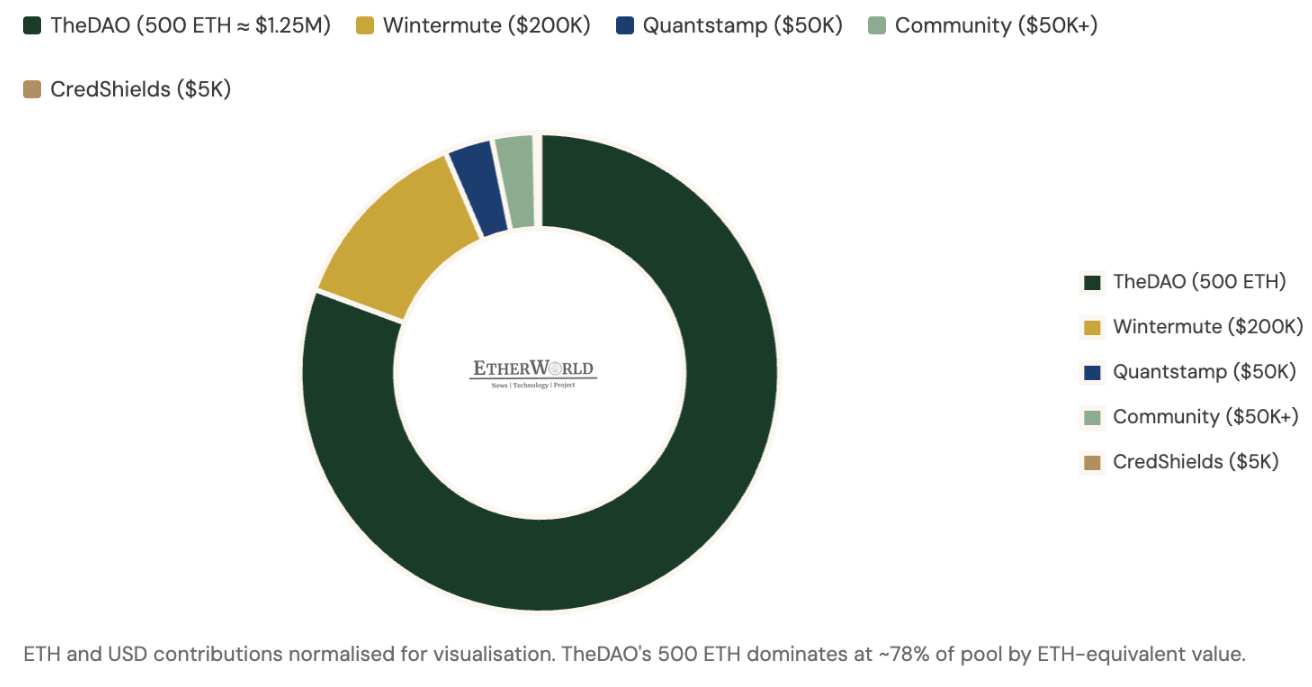
The round’s headline figure was its 637.4 ETH matching pool. TheDAO Security Fund provided the largest share through a 500 ETH anchor contribution. This represented the foundation of the round & made it possible to create one of the largest security-focused QF pools in Ethereum history.
However, the round became more interesting because of the additional contributors that joined around the anchor pool. Wintermute added a major $200,000 contribution after the round had already closed. Quantstamp contributed $50,000, which helped catalyze a broader community pool that raised more than $50,000. CredShields also contributed $5,000.
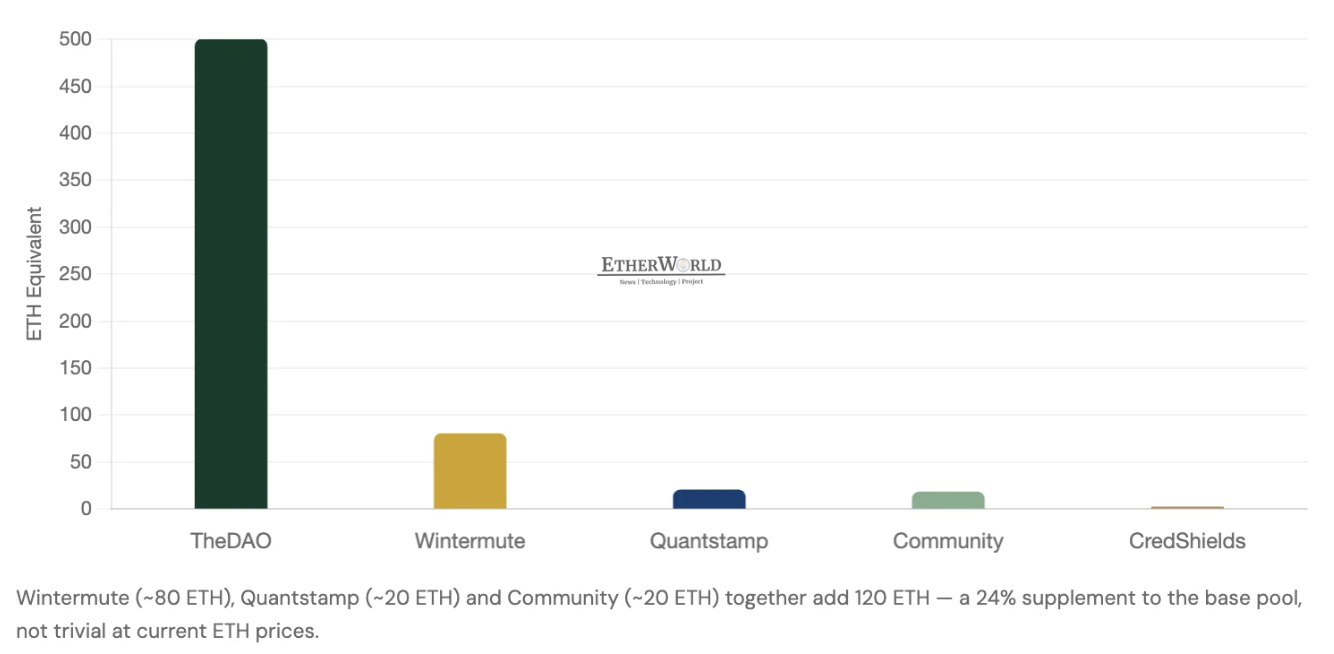
This structure matters because it shows how institutional capital can create a trust flywheel in public goods funding. When one credible funder provides an anchor, other contributors are more likely to join. When the allocation process is transparent, community donors are more willing to participate. When expert participation is visible, sponsors can trust that funds are going toward meaningful work.
TheDAO’s 500 ETH contribution dominated the pool, representing roughly 78% of the matching pool by ETH-equivalent value. This means the round still had a high level of anchor-sponsor concentration. But the additional support from Wintermute, Quantstamp, CredShields, & community donors showed a path toward future diversification.
For future rounds, this is one of the most important lessons. Ethereum security funding should not rely permanently on a single major sponsor. A healthier long-term model would include multiple institutional backers, recurring community participation, & perhaps dedicated funding commitments from protocols, wallets, exchanges, bridges, & infrastructure providers that directly depend on Ethereum security.
Wintermute’s late $200,000 addition was especially notable. It signaled that the round had built enough credibility to attract new capital even after the official donation period had ended. In public goods funding, this is a powerful sign. It suggests that well-designed funding rounds can create momentum beyond their initial campaign window.
The matching pool did not simply reward the projects with the largest donations. Instead, it used a more careful allocation system designed to identify broad, credible, independent support. That makes the pool not only large, but strategically allocated.
Top Projects Funded by the Round
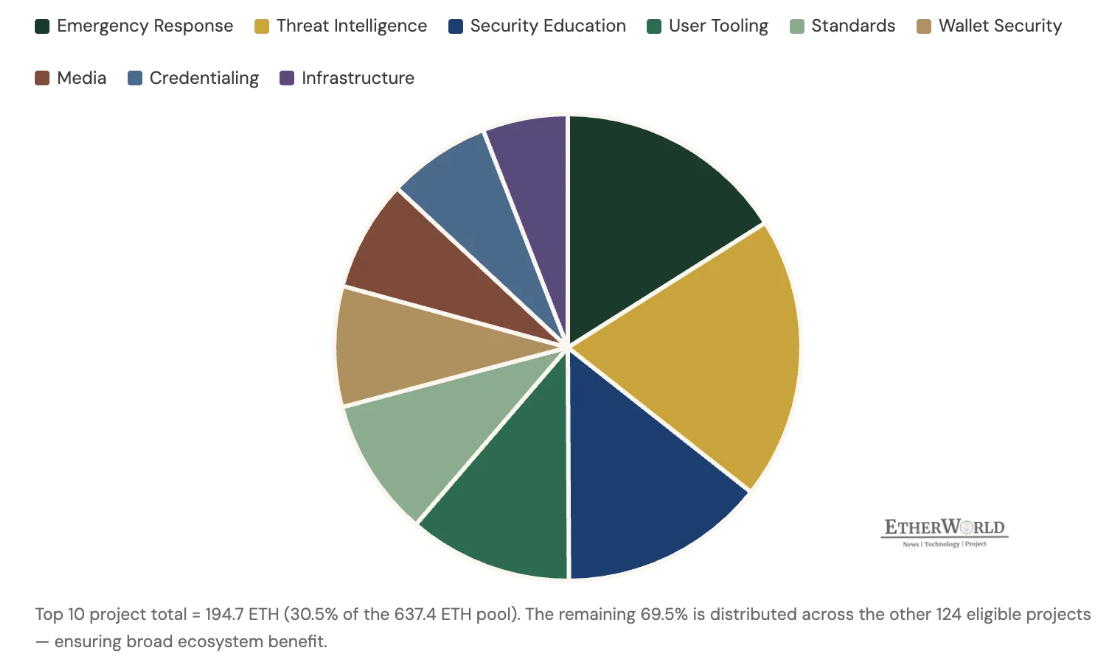
The top-funded projects reveal what the Ethereum community currently sees as high-priority security infrastructure. SEAL 911 led the round, reaching around 31.2 ETH in matching funds, close to the 5% maximum cap. SEAL 911’s strong performance shows that emergency response infrastructure is seen as a core Ethereum public good.
The Red Guild followed with 27.8 ETH, reflecting strong support for security education & research. ZachXBT received 25.4 ETH, highlighting the importance of independent threat intelligence, investigations, & public accountability in the crypto ecosystem. Revoke.cash received 22.1 ETH, showing continued demand for user-facing security tools that help people manage wallet approvals & reduce risk.
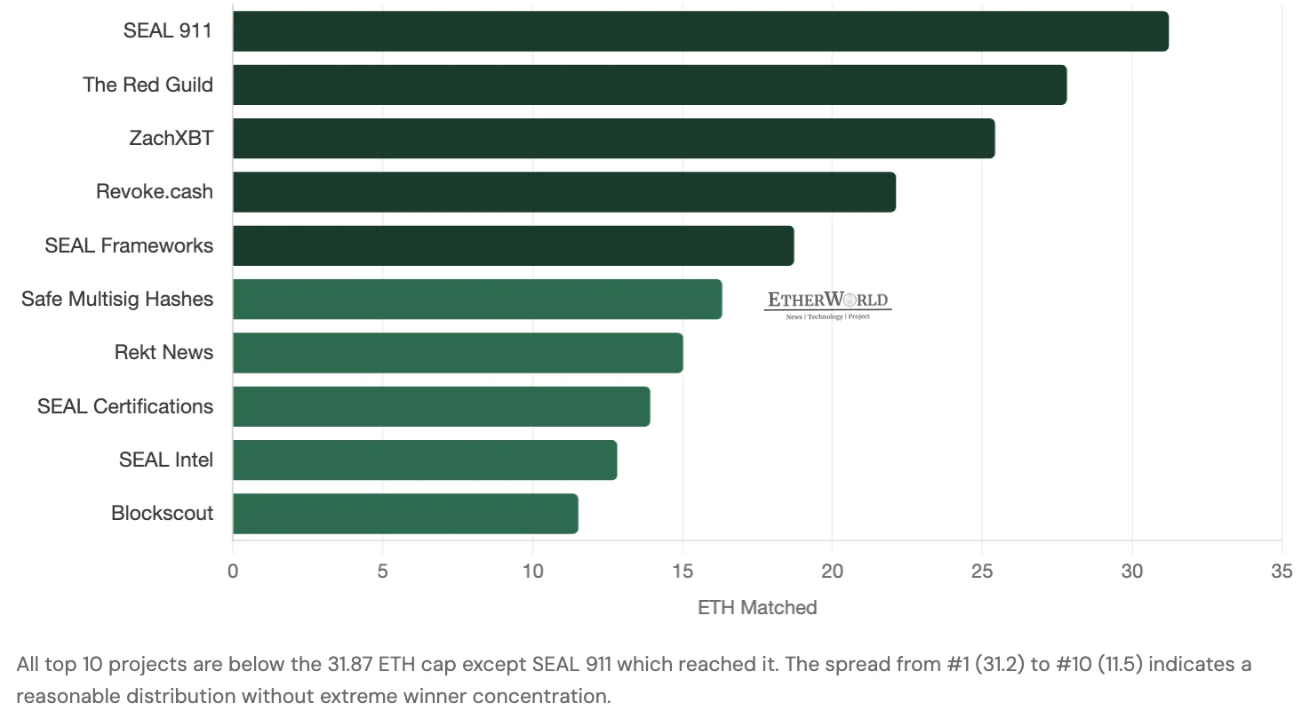
Other top projects included SEAL Frameworks, Safe Multisig Transaction Hashes, Rekt News, SEAL Certifications, SEAL Intel, & Blockscout Explorer. Together, these projects covered emergency response, user tooling, wallet safety, standards, security media, credentialing, threat intelligence, & infrastructure transparency.
This diversity is important. Ethereum security is not one single category. It includes prevention, response, education, tooling, monitoring, standards, investigation, & transparency. A strong security ecosystem needs all of these layers working together.
SEAL-branded projects appeared multiple times in the top 10. This indicates strong community trust in the SEAL ecosystem’s role across emergency response, frameworks, certifications, & intelligence. However, it also raises an important point for future rounds: funding mechanisms should continue ensuring that trusted organizations are supported without allowing any single ecosystem cluster to dominate too much of the pool.
The 5% cap helped prevent extreme concentration. No single project could receive more than roughly 31.87 ETH. This ensured that even the strongest projects could not absorb a disproportionate share of the matching pool. As a result, the top 10 projects received meaningful support, while the remaining funds still reached a wide base of other eligible teams.
Blockscout’s presence in the top 10 is also worth noting. As an explorer & transparency infrastructure project, Blockscout represents foundational tooling rather than direct incident response. Its lower allocation compared to emergency response & threat intelligence projects may indicate that infrastructure projects still struggle to attract the same emotional urgency as exploit response systems. This could be an important design question for future rounds.
What is Cluster-Oriented Cluster Matching (COCM)
The round used Cluster-Oriented Cluster Matching, or COCM, instead of a simple standard QF formula. This decision was central to the credibility of the round.
Traditional quadratic funding rewards the number of contributors more than the size of individual contributions. This makes it powerful for public goods, because many small donors can collectively unlock significant matching funds. However, standard QF can be vulnerable to coordinated donation clusters, sybil attacks, & groups that try to simulate broad support.
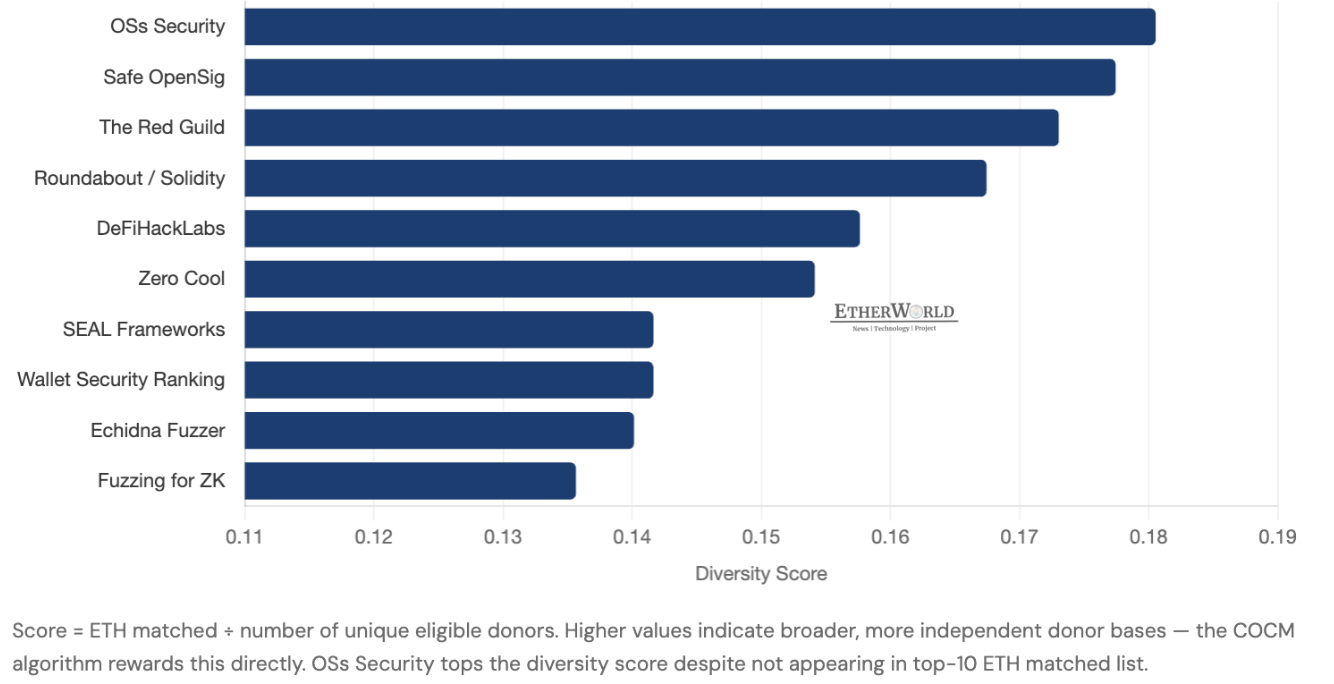
COCM addresses this by examining donor clusters. If a group of donors appears tightly connected or unusually coordinated, the matching weight can be adjusted. Projects with broad, independent donor bases are rewarded more strongly. In simple terms, COCM tries to distinguish genuine ecosystem-wide support from organized voting blocs.
This was particularly important for an Ethereum security round because the matching pool was large. When more than 637 ETH is being allocated, the incentive to manipulate outcomes becomes stronger. A better matching algorithm reduces this risk & improves trust in the final distribution.
The round also applied other safeguards. Donor eligibility required either an ETHSecurity Voting Badge, a Human Passport model score of 50+, or a Human Passport Stamps score of 15+. On-chain sybil clusters & fund-recirculation patterns were identified & excluded from matching calculations, although those donations still reached projects directly.
Congratulations to the @Giveth & @thedaofund Security teams on successfully closing the biggest Security QF Round 🎉
— Pooja Ranjan | ranjan.eth (@poojaranjan19) May 28, 2026
Grateful to @griffgreen for the opportunity and responsibility to serve as a TheDAO Security badge holder and contribute my 2 cents to the project selection… https://t.co/Cf5M3A4HBP
The round also included a 0.3333 ETH minimum floor for eligible projects. Projects below this threshold were raised to the floor, with funds drawn proportionally from projects above the floor. This ensured that smaller but eligible projects still received meaningful support.
Together, these rules created a layered allocation model. The round combined identity verification, expert weighting, sybil resistance, donor-cluster analysis, a maximum cap, & a minimum floor. This made the funding process more sophisticated than simple popularity voting.
For Ethereum governance & public goods funding, this is a major development. As funding rounds become larger, the design of allocation mechanisms becomes just as important as the size of the pool. Without credible allocation, large pools can be captured. With credible allocation, large pools can become ecosystem infrastructure.
What Donor Participation Reveals
The donor data shows that the round had both broad community participation & meaningful conviction giving. The report identified a bimodal donor pattern, with strong participation at the $1 to $2 micro-donation level & another peak at the $100 to $500 range.
This is an important signal. The $1 to $2 group reflects mass participation. In QF systems, small donations matter because they help signal broad support. A project supported by many small donors can receive more matching than a project backed by only a few large donors.
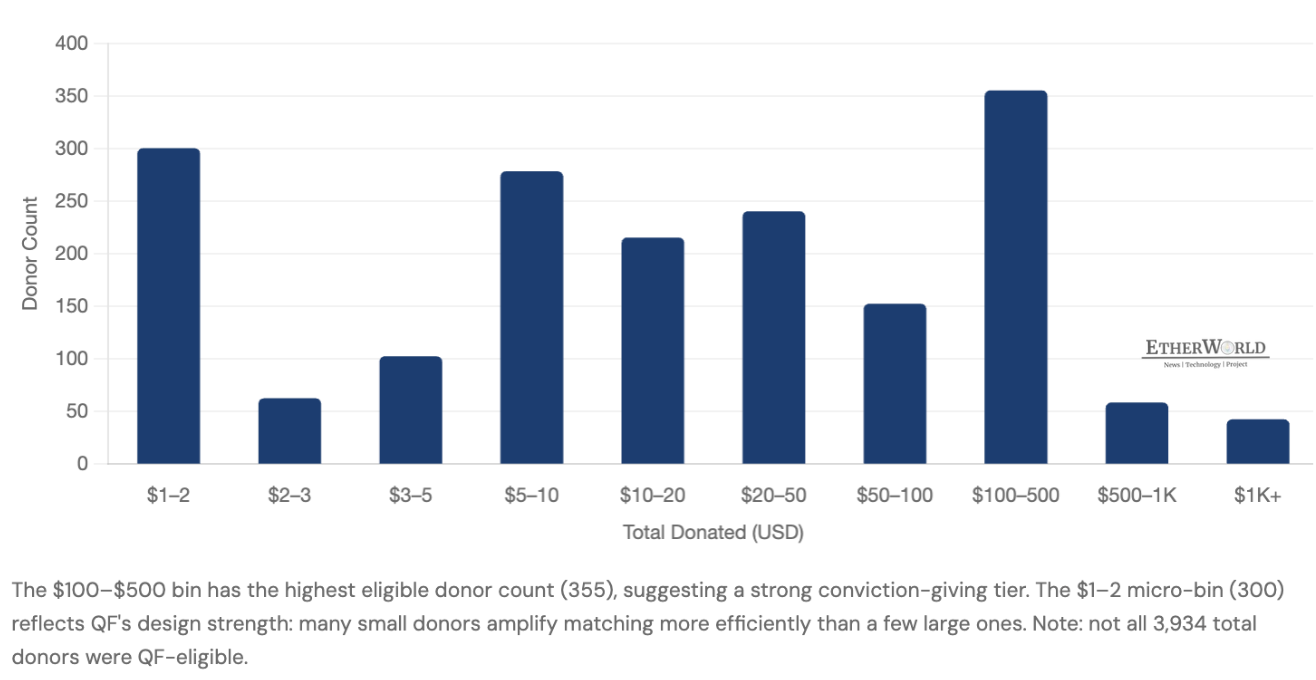
The $100 to $500 group reflects conviction donors. These are likely more engaged participants, including security professionals, ecosystem contributors, protocol teams, or users with a strong interest in Ethereum security. The fact that this was one of the largest donor bins shows that the round was not only driven by symbolic micro-donations.
Roughly half of eligible donors gave $20 or less. This confirms that the round remained accessible. People did not need to contribute large sums to participate meaningfully. At the same time, only a relatively small number of donors gave $1,000 or more, meaning the round was not dominated by very large donors.
This balance matters for Ethereum. Public goods funding should not become a system where only wealthy actors decide what gets built. At the same time, it should not ignore larger donors who want to contribute serious capital. COCM helped balance these forces by decoupling donation size from matching influence.
The 3,934 unique donor count is also important because security funding is often difficult to mobilize. Users usually notice security only when something goes wrong. Funding security before disaster requires education, trust, & shared urgency. This round succeeded in creating that urgency.
The high participation of ETHSecurity Badge holders adds another layer to the donor story. Expert engagement gave the round greater credibility. It also created useful data about what security professionals believe should be funded. Future retrospectives should study how badge-holder preferences differed from general donor preferences.
Why This Round Matters for Ethereum
The Ethereum Security QF Round matters because it shows that security can be treated as a permanent public goods category, not just an emergency expense. Ethereum depends on wallets, bridges, smart contracts, clients, explorers, monitoring systems, standards, auditors, researchers, educators, & response teams. If these systems are underfunded, the entire ecosystem becomes more fragile.
For years, crypto security funding has often been reactive. Teams receive attention after hacks, exploits, disclosures, or emergency incidents. But sustainable security requires proactive funding. The best security work often prevents incidents that never become headlines.
This round showed that Ethereum can coordinate around that problem. A large matching pool, thousands of donors, verified expert participation, & a credible allocation algorithm all came together to support 134 projects. That is not a small experiment. It is a serious funding mechanism.
The round also provides a template for other specialized public goods categories. Ethereum could use similar models for client diversity, staking infrastructure, privacy tooling, developer education, protocol research, wallet UX, data availability tooling, or governance infrastructure. The key is matching the funding design to the domain.
For security, expert weighting made sense. For other domains, different credentials or review systems may be needed. The broader lesson is that public goods funding should become more context-aware. Not every QF round should use the same rules.
The success of the Ethereum Security QF Round was ultimately powered by a much broader ecosystem effort that extended far beyond the core organizers themselves. Additional support, participation, amplification, & ecosystem coordination came from teams across the Ethereum security landscape including CertiK, Sigma Prime, Certora, ChainSecurity, Open Source Security, Pashov Audit Group, CredShields, OpenSea, Yearn Finance, Coinspect, The Red Guild, Dedaub, Opsek, RektHQ, Hexens, Perimeter Security, Ethereum Community Hub Institute, rv_inc, Tellor, & Tenderly, alongside thousands of independent donors, researchers, developers, auditors, protocol contributors, wallet teams, investigators, & security advocates who directly supported the projects they believe are strengthening Ethereum’s long term security infrastructure.
From ETHSecurity Badge holder support packages & direct matching contributions to community donations, ecosystem outreach, & operational coordination, the round demonstrated how funding Ethereum security is increasingly becoming a shared responsibility embraced collectively by the broader ecosystem.
The next challenge is continuity. One successful round does not solve Ethereum security funding forever. The ecosystem needs recurring rounds, better sponsor diversification, deeper analytics, stronger impact measurement, & clearer feedback loops between funded projects & contributors.
As proud media partners of Giveth, EtherWorld has been closely covering the Ethereum Security QF Round throughout its journey, publishing the latest updates, ecosystem insights, funding analysis, project highlights, & key developments around one of Ethereum’s most important public goods funding initiatives focused on security infrastructure.
To promote your Web3 articles, events, and projects, you may reach out anytime via EtherWorld PR for submissions and collaboration.
Related Articles
- TheDAO Security Fund’s First Funding Round Goes Live with Over $1M for Ethereum Security
- TheDAO Security Fund Deploys Its First $1M
- Securing Ethereum Together: Giveth & TheDAO’s QF Approach
- Vitalik Buterin’s 2026 Vision for Ethereum Foundation
- Ethereum Introduces Clear Signing for Safer Crypto Transactions
To follow blockchain news, track Ethereum protocol progress, and read our latest stories, subscribe to our weekly today.
Disclaimer: The information contained in this website is for general informational purposes only. The content provided on this website, including articles, blog posts, opinions, & analysis related to blockchain technology & cryptocurrencies, is not intended as financial or investment advice. The website & its content should not be relied upon for making financial decisions. Read full disclaimer & privacy policy.
To stay updated on blockchain news, Ethereum protocol progress, and our latest stories, subscribe to our weekly digest and YouTube channel for ELI5 content.
To promote your Web3 articles, events, project updates, and Press Releases, reach out anytime via EtherWorld PR for submissions and collaboration. For other queries, email contact@etherworld.co.
If you’d like to support our work, share the content and consider donating at avarch.eth.
Join our community on Discord and follow us on Twitter, Facebook, LinkedIn & Instagram.

 ×
×

Author

Yash Kamal Chaturvedi is a Blockchain Content & Ops Specialist at Avarch LLC, writing on Ethereum & governance since 2021. Covers ACD/ACDE calls, EIPs, upgrades, staking, security & ecosystem trends.