Why Enterprises Prefer Ethereum Over Private Chains?
Discover why global enterprises are choosing Ethereum over private blockchains, exploring interoperability, security, tokenization, cost efficiency, and real-world institutional adoption.

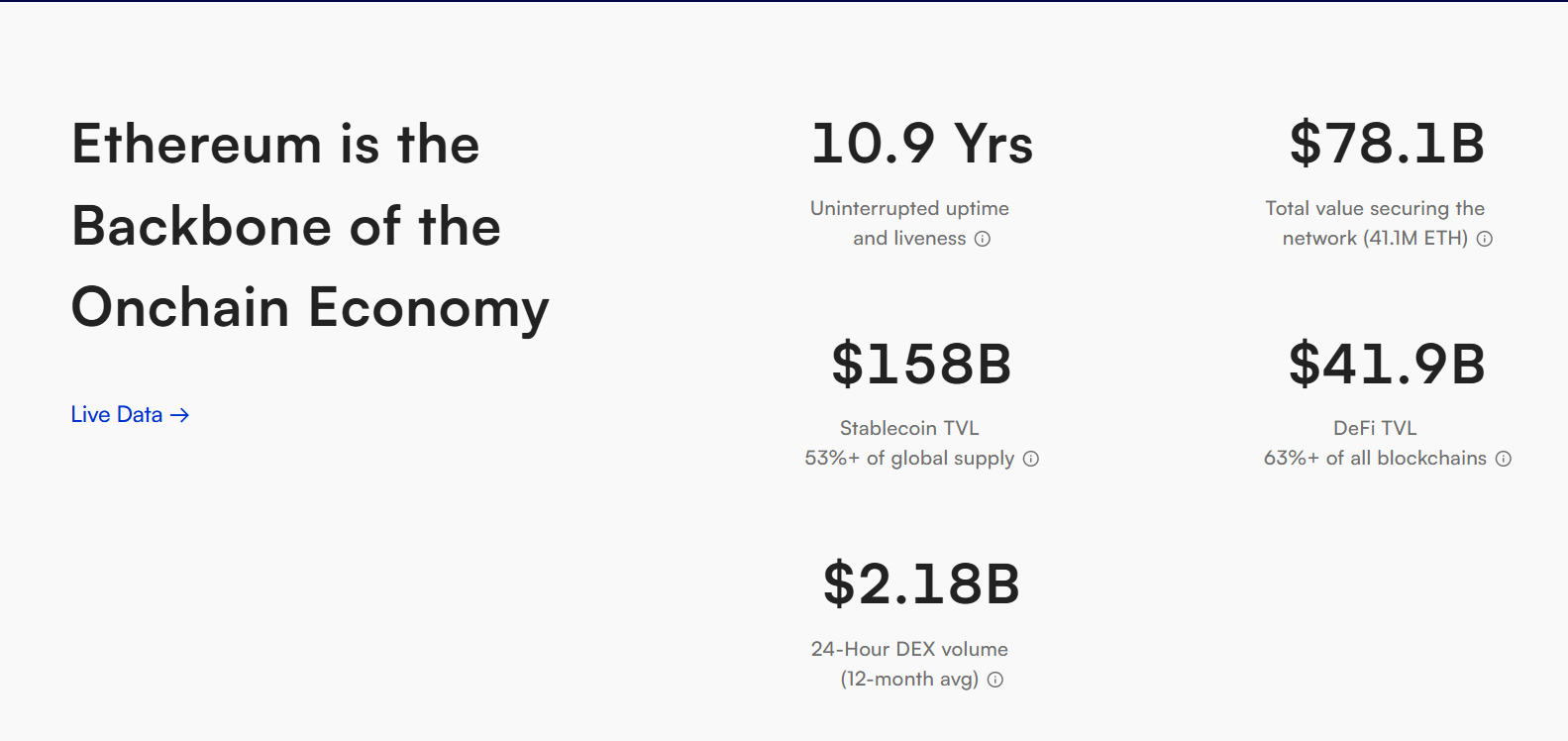
For many years, businesses assumed that implementing blockchain technology meant creating private networks. Permissioned systems appeared to provide more control, limited involvement, and simpler governance. However, while an increasing number of financial institutions, asset managers, payment providers, and even governments have started building on Ethereum, the majority of these ventures never made it past the prototype phase. As of March 2026, Ethereum secured around $159 billion in stablecoins and more than $15.2 billion in tokenized real-world assets (RWAs), while institutions including BlackRock, JPMorgan, Visa, and Franklin Templeton have chosen to build on its public infrastructure.
This development is more than just a shift in the way people prefer technology. It represents a wider understanding that shared, interoperable, and economically secure digital infrastructure increases its worth. The question is now why businesses are choosing Ethereum over private alternatives rather than whether they will use blockchain.
Why Private Blockchains Failed to Become the Enterprise Standard?
Permissioned blockchains were extensively used by businesses in the late 2010s to profit from distributed ledgers while maintaining centralised control. Banking, trade finance, insurance, and supply chain management all use platforms like Hyperledger Fabric, Corda, Quorum, and other proprietary networks.
Although these platforms improved collaboration within certain organisations or consortia, they continued to operate independently of one another, each with its own technical standards, members, and governance model.
Private blockchains produced fragmented ecosystems where assets and data could not freely flow between networks, in contrast to the internet, which unites everyone through shared protocols. Organisations had to deal with growing integration costs as additional corporate blockchains appeared, depending on trusted middlemen or custom bridges to link otherwise incompatible systems.
Source: Ethereum
Ethereum Basics for Governments and Institutions, published by the Ethereum Foundation, presents the argument that neutral, shared infrastructure is more necessary for the contemporary digital economy than separate networks under the authority of distinct entities. Interoperability is becoming more important than exclusive control due to the growing interconnectedness of financial services, digital identification, and international transactions.
Adoption of private blockchain technology was further constrained by governance. Permissioned networks rely on consortium members to oversee operations and approve upgrades, which slows down decision-making and fosters a long-term dependence on a small number of operators.
Ethereum operates on a distinct model, in which various independent client teams create Ethereum Improvement Proposals (EIPs), which are then accepted voluntarily by validators. Ethereum is a more robust and future-proof foundation for corporate applications because of its decentralised governance, which guarantees that no one entity, including the Ethereum Foundation, can control the network.
Why Ethereum Became the Preferred Enterprise Infrastructure?
Today, enterprise adoption is more dependent on interoperability, security, and reliability than transaction speed. Over the course of more than 10 years of existence, Ethereum has solidified its position by continuously providing these attributes.
While most significant Layer 1 networks have seen failures, Ethereum has maintained continuous uptime since its introduction, according to the Ethereum Foundation's Ethereum Basics for Governments and Institutions. Continuous availability is not just a technical standard but a crucial economic need for organisations that hold assets worth billions of dollars.
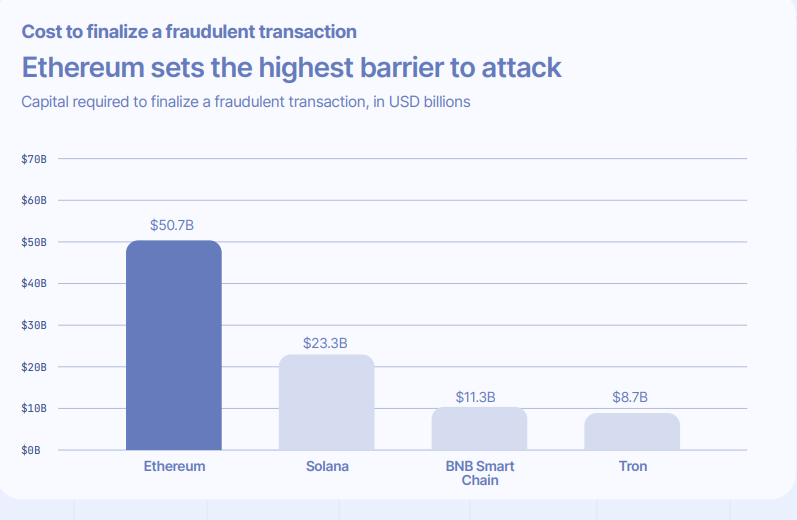
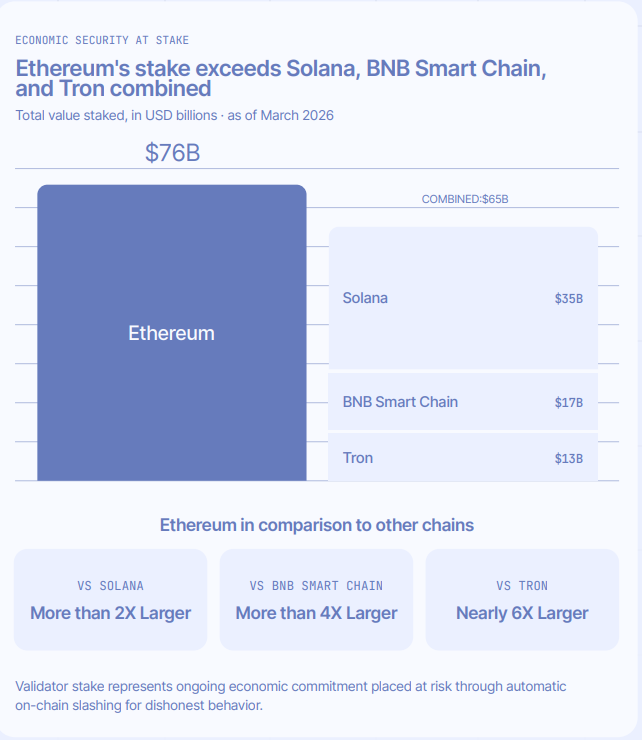
Strong economic incentives also support Ethereum's security. To safeguard the network, about $76 billion worth of ETH was earmarked as of March 2026. According to the analysis, holding approximately $50.7 billion worth of ETH would be enough to effectively complete a fraudulent transaction, and doing so would expose those funds to automatic slicing fines, rendering such attacks economically impractical.
Source: Ethereum
The software design of Ethereum is another significant benefit. The network is maintained by 5 or more independent execution and consensus clients rather than a single software client, which lowers the possibility that a single software error may cause the entire ecosystem to fail. Many other blockchain networks lack the durability that this degree of client variety offers.
Another characteristic that sets them apart is interoperability. Ethereum has developed from a stand-alone blockchain to the cornerstone of a larger ecosystem centred on the ERC token standards and Ethereum Virtual Machine (EVM). Instead of being restricted to proprietary networks, these universal standards allow wallets, apps, infrastructure providers, and Layer 2 networks to collaborate effortlessly, enabling businesses to develop products that interface with an already-existing global ecosystem.
What Global Companies Are Actually Building on Ethereum?
Real-world deployments are being used to gauge enterprise blockchain acceptance instead of pilot projects. Tokenised money market funds, digital bonds, stablecoins, settlement systems, and tokenised real-world assets (RWAs) are just a few of the institutional applications that Ethereum is now supporting.
As of March 2026, Ethereum hosted about $159 billion in stablecoins and more than $15.2 billion in tokenised real-world assets, significantly surpassing other public blockchain ecosystems and demonstrating the increasing concentration of institutional capital, according to the Ethereum Foundation's Ethereum Basics for Governments and Institutions.
The companies using Ethereum are a reflection of this change. BlackRock, Franklin Templeton, JPMorgan, Deutsche Bank, UBS, Société Générale-Forge, Visa, PayPal, SWIFT, DTCC, Fidelity, the European Investment Bank, ChinaAMC, EY, and Ant Group are among the organisations listed in the report that use Ethereum for a variety of purposes, including tokenisation, payments, custody, settlement, and more general financial market infrastructure.

Source: Ethereum
The use of Ethereum goes beyond the financial sector. The book covers public-sector initiatives, such as land registry projects in India, digital identification programs in Bhutan and Buenos Aires, and humanitarian payment systems created by UNICEF and UNHCR. These implementations show that Ethereum is no longer just a financial network but is now being utilised as digital public infrastructure.
Applications developed on Ethereum become a part of a shared global ecosystem where developers, institutions, users, assets, and service providers interact through common standards, in contrast to private blockchain deployments that function within closed consortia.
Why Building on Ethereum Costs Less Than Maintaining a Private Network?
Control was the primary focus of early enterprise blockchain operations. Permissioned networks allow enterprises to specify governance, choose users, and modify infrastructure. But with each additional participant, this strategy also resulted in ongoing operating expenses.
Consortium networks became more costly to administer over time as private blockchains necessitated ongoing investments in validator infrastructure, software upkeep, governance committees, security monitoring, interoperability solutions, and participant onboarding.
By keeping the underlying infrastructure and the applications that are built upon it apart, Ethereum adopts a different model. Thousands of independent validators and developers manage the network, freeing up businesses to concentrate on product development rather than running the settlement layer. This is comparable to how companies use shared internet protocols like TCP/IP instead of developing proprietary internet infrastructure before introducing digital services, as the Ethereum Foundation points out.
Source: Ethereum
Additionally, this shared ecosystem speeds up innovation. Instead of starting from scratch, businesses can take advantage of already-existing wallets, developer tools, custody providers, stablecoins, identity solutions, ERC token standards, and Layer 2 networks. Access to shared liquidity is arguably the largest benefit.
Ethereum-based assets function within a global ecosystem, which lowers integration costs while increasing market access, in contrast to assets on isolated private networks. Ethereum is a more affordable platform for business applications because of these network effects, which reduce development and operating costs.
Security, Compliance & Network Effects That Private Chains Cannot Replicate
Security for companies includes more than simply preventing cyberattacks. It also encompasses long-term sustainability, regulatory confidence, operational resilience, and stable governance. Instead of using a small number of predetermined operators, Ethereum uses a decentralised security mechanism supported by financial incentives to meet these needs. In order to safeguard the network, almost $76 billion worth of ETH was staked as of March 2026. This made attacks economically unfeasible and automatically penalised malicious validators through slashing.
Another significant benefit is operational resiliency. The Ethereum Foundation claims that since its inception, Ethereum has had no network outages and is backed by numerous separate execution and consensus clients. The possibility that a single software glitch may bring down the entire network is decreased by this client variety.
Ethereum provides governance neutrality as well. Developers, validators, researchers, client teams, and node operators participate in an open process that proposes and adopts protocol improvements rather than depending on a single body. Ethereum is less reliant on any one organisation because even the Ethereum Foundation declares that it neither runs nor manages the network.
Alongside the protocol, compliance capabilities have developed. Institutions can verify legal requirements while protecting sensitive data via technologies like fully homomorphic encryption (FHE), multi-party computation (MPC), and zero-knowledge proofs (ZKPs).
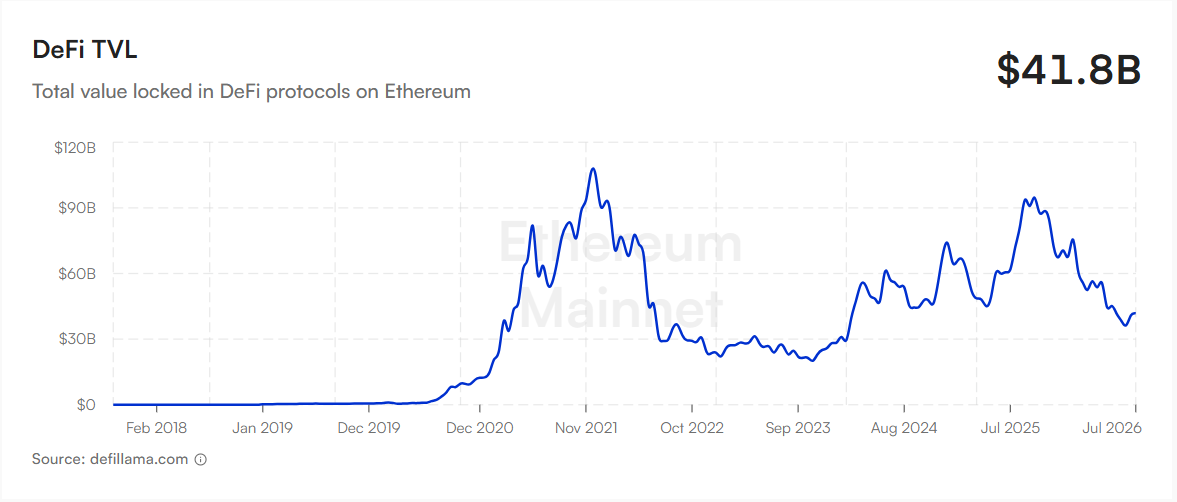
Ethereum has strong network effects that go beyond security and compliance. The ecosystem continues to be the top platform for ERC token standards and EVM-compatible applications, supports almost 11,000 developers, and secures about $56 billion in DeFi total value locked (TVL). Ethereum's value keeps rising as more developers, organisations, and apps join the network, a benefit that isolated private blockchains find difficult to match.
The Next Enterprise Shift: Public Ethereum as Shared Financial Infrastructure
The discussion over enterprise blockchain is moving from private versus public to shared versus isolated infrastructure. In the past, companies concentrated on using private distributed ledgers to replicate current systems. Nowadays, the more important question is whether it is strategically and financially advantageous to keep separate blockchain infrastructure when there is already a common public network.
Ethereum is now much more than just a cryptocurrency blockchain. Stablecoins, tokenised securities, digital identification solutions, decentralised finance (DeFi), and other programmable financial applications now use it as a common settlement layer. Ethereum provides shared infrastructure that enables rival companies to create independent services without running separate networks, much like the internet offers common standards for digital communication.
Institutional adoption reflects this change. Companies including BlackRock, Franklin Templeton, JPMorgan, Visa, SWIFT, DTCC, Deutsche Bank, and UBS are developing products on Ethereum or Ethereum-compatible infrastructure rather than introducing proprietary blockchains. They want to gain from an ecosystem with established liquidity, open standards, developer communities, and developed infrastructure, not only to adopt blockchain technology.
The Ethereum Foundation claims that instead of centralised ownership, future digital infrastructure would rely on neutrality, interoperability, transparency, and resilience. Shared infrastructure is projected to provide more long-term value than separate company networks as financial systems, digital identification, artificial intelligence, and cross-border services become more integrated.
The past decade has demonstrated that successful blockchain adoption depends not only on technology but also on network effects, open standards, and collaboration, areas where Ethereum has become the go-to enterprise platform.
If you find any issues in this article or notice missing information, please feel free to reach out at team@etherworld.co for clarifications or updates.
To promote your Web3 articles, events, and projects, you may reach out anytime via EtherWorld PR for submissions and collaboration.
Related Articles
- Ethereum Institutional Secures Funding From 100+ Ecosystem Supporters
- Ethereum Foundation Adds Security Expert pcaversaccio to Its Board
- Former EF Privacy Team Launches EthSystems for Institutional Ethereum
- Robinhood Fees Expose Ethereum’s Revenue Dilemma
- Who's Building for Ethereum's AI Agents?
To follow blockchain news, track Ethereum protocol progress, and read our latest stories, subscribe to our weekly today.
Join the EtherWorld & Avarch Internship Program and build your career in blockchain, content, social media, video, podcast editing, or operations. Send your resume and brief introduction to contact@etherworld.co.
Disclaimer: The information contained in this website is for general informational purposes only. The content provided on this website, including articles, blog posts, opinions, & analysis related to blockchain technology & cryptocurrencies, is not intended as financial or investment advice. The website & its content should not be relied upon for making financial decisions. Read full disclaimer & privacy policy.
To stay updated on blockchain news, Ethereum protocol progress, and our latest stories, subscribe to our weekly digest and YouTube channel for ELI5 content.
To promote your Web3 articles, events, project updates, and Press Releases, reach out anytime via EtherWorld PR for submissions and collaboration. For other queries, email contact@etherworld.co.
If you’d like to support our work, share the content and consider donating at avarch.eth.
Join our community on Discord and follow us on Twitter, Facebook, LinkedIn & Instagram.

 ×
×

Author

Nidhi Kumari is a Web3 content writer at EtherWorld.co, tracking ecosystem developments, funding activity, and market trends shaping the crypto space.