India Is Crypto’s Largest Market, Says Coinbase CEO
Coinbase CEO Brian Armstrong says India is the world’s largest crypto market by users, reigniting debate over adoption, regulation and the exchange’s growing push into the country.
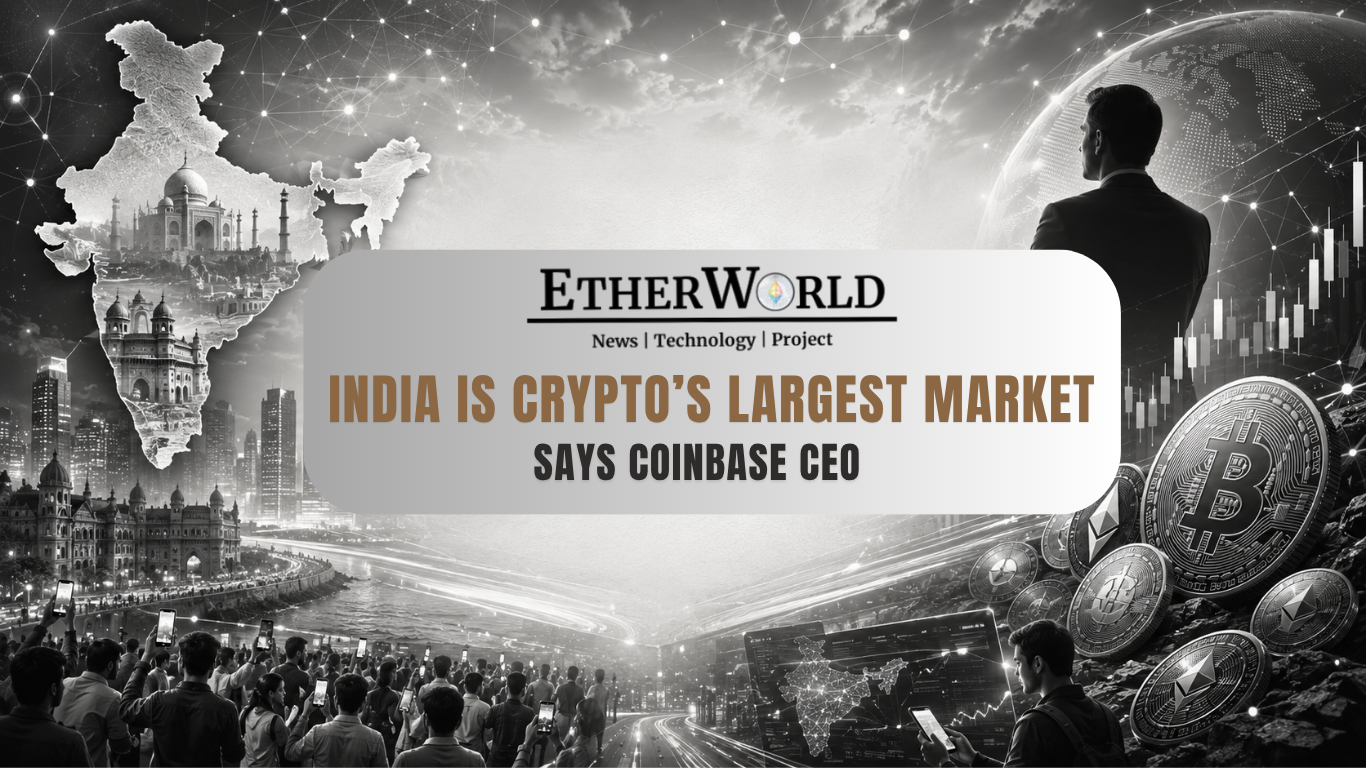
Coinbase CEO Brian Armstrong has described India as the world’s largest cryptocurrency country based on the number of people using digital assets, setting up a debate with Zerodha co-founder Nikhil Kamath over whether that adoption is visible in everyday life.
The discussion arrives at a strategically important moment for Coinbase. After years of uncertainty surrounding its Indian operations, the exchange has been rebuilding its presence through local trading pairs, direct banking integrations and a compliance-focused market strategy. Its return has already included BTC-INR trading support, USDC-INR trading and direct Indian rupee deposits and withdrawals.
Armstrong and Kamath Debate India’s Crypto Leadership
The exchange between Armstrong and Kamath reflects two different ways of measuring cryptocurrency adoption.
Armstrong’s argument focuses on the absolute number of users. India’s large population, technology-oriented workforce, active retail trading community and extensive developer base make it possible for the country to lead global rankings even when crypto is not regularly used for ordinary purchases.
Kamath’s scepticism focuses on visibility. Despite the number of people holding or trading digital assets, cryptocurrencies are not commonly used for daily retail payments across India. Most stores continue to rely on cash, cards and the Unified Payments Interface, while crypto activity remains concentrated around investment, trading, stablecoins, remittances and blockchain development.
This distinction is crucial. A country may have tens of millions of crypto participants without digital assets becoming a mainstream unit of account. Ownership, trading, development activity, onchain participation and merchant payments are separate measurements, yet they are often combined under the broad term “adoption.”
EtherWorld’s earlier analysis of the state of crypto adoption in India similarly showed that the market cannot be understood through a single indicator. India combines substantial public interest with uncertainty around regulation, taxation and consumer protection.
The full Armstrong-Kamath episode is expected to extend beyond adoption figures. The trailer also points toward conversations about fractional-reserve banking, artificial intelligence, Bitcoin, Coinbase’s Base network and the company’s confrontations with American regulators.
Armstrong argues in the preview that Coinbase’s decision to challenge the US Securities and Exchange Commission was important for the survival of the American crypto industry. His comments fit a broader pattern in which Coinbase has attempted to influence policy rather than simply adapt to it. That approach was also visible when the company pushed back against proposed US crypto legislation.
Coinbase Builds a Bigger India Strategy
Armstrong’s comments are more than a general observation about India. They also support Coinbase’s renewed effort to establish itself as a major platform in the country.
Coinbase previously struggled to maintain reliable banking access in India and later discontinued most local services. Its return has followed registration with India’s Financial Intelligence Unit and a more compliance-led operating model.
The most significant development came when Coinbase launched direct INR rails in India. The integration allows users to deposit and withdraw rupees through IMPS rather than relying entirely on peer-to-peer markets or external payment intermediaries.
It also connects Indian users with Coinbase’s international liquidity and trading infrastructure. For a global exchange, direct access to the domestic banking system represents a major improvement over simply allowing Indian residents to create accounts.
However, the rollout has not been free from controversy. Coinbase’s promotion of the service led to debate among Indian crypto exchanges, particularly over suggestions that it was the first platform to offer rupee deposits and withdrawals.
Domestic exchanges clarified that INR rails have existed in India for years. Coinbase’s distinction was that it became the first major foreign exchange to introduce direct IMPS-based rails under its renewed market strategy.
Questions have also emerged around asset withdrawals and self-custody. As examined in Coinbase India INR Rails Comes With a Catch, some users raised concerns about whether moving crypto to an external wallet could affect continued access to INR banking services.
These restrictions highlight the difficult balance exchanges face. Users expect ownership of crypto to include the freedom to withdraw assets, while platforms must satisfy banks and regulators concerned about money laundering, capital movement and transaction monitoring.
Coinbase’s return should therefore be understood as part of a broader effort to localise its platform. INR order books, banking rails, FIU registration and India-specific compliance controls allow the company to compete more directly with CoinDCX, CoinSwitch, ZebPay and other domestic platforms.
The strategy builds on Coinbase’s earlier attempt at a comeback in India’s evolving crypto market, but this phase is more deeply connected to local financial infrastructure.
No country uses crypto more than India.
— Coinbase 🛡️ (@coinbase) July 16, 2026
Now, users from across the country have more access than ever to the future of finance on Coinbase.pic.twitter.com/0bm4BQ7SMF
High Adoption Meets Regulatory Uncertainty
India’s crypto market continues to expand despite one of the world’s most complicated policy environments for digital assets.
Income from virtual digital assets is taxed at 30%, while a 1% tax deducted at source applies to many transactions. Industry participants have repeatedly argued that the structure reduces liquidity, pushes trading activity offshore and makes frequent trading economically difficult.
India also lacks a comprehensive law defining the legal status of cryptocurrencies, exchanges, stablecoins and decentralised finance. The government taxes digital assets and regulates service providers through anti-money-laundering rules, but it has not recognised privately issued cryptocurrencies as legal tender.
This unresolved position was reinforced when the Reserve Bank of India rejected legal status for crypto during discussions with Parliament’s Standing Committee on Finance.
At the same time, regulators are increasing oversight rather than attempting to eliminate the sector entirely. The Financial Intelligence Unit has expanded reporting obligations, including tighter supervision of large over-the-counter transactions. EtherWorld recently reported that the FIU targeted crypto OTC trades above $10,000, requiring stronger record-keeping and beneficial ownership disclosures.
This produces an unusual market structure. Crypto is neither prohibited nor fully integrated into the financial system. It exists within a framework of taxation, registration, anti-money-laundering compliance and banking caution.
The tension can also affect liquidity. In June, the USDT premium in India rose above 8.5% as stablecoin availability tightened and regulatory uncertainty affected domestic markets.
Such developments help explain why Armstrong’s adoption claim may appear surprising. Indian users remain active even when transaction costs, taxes and regulatory restrictions make participation more difficult. Adoption has persisted not because the environment is frictionless, but despite the friction.
The possibility of harsher regulation remains a major concern. EtherWorld’s analysis of what would happen if India banned crypto noted that such a move could affect investors, exchanges, developers, startups and India’s position in the global Web3 economy.
What Armstrong’s Claim Means for India
Whether India is definitively the world’s largest crypto country depends on how adoption is measured. Nevertheless, Armstrong’s statement captures a reality that global platforms increasingly recognise: India is too large and strategically important for the crypto industry to ignore.
The country offers a combination of retail participation, software talent, digital payment familiarity and interest in alternative financial assets. India is also becoming more important to the wider Ethereum ecosystem, with Mumbai selected to host Devcon 8 and Indian developers contributing across infrastructure, applications and protocol research.
For Coinbase, India represents both an opportunity and a test. The exchange must prove that it can provide global liquidity and sophisticated products while working within domestic banking and compliance requirements.
For Indian exchanges, Coinbase’s expansion introduces additional competition. Global platforms may pressure domestic companies to improve execution, pricing, security, product design and customer service. At the same time, local exchanges retain advantages in market knowledge, customer support and familiarity with India’s changing regulatory expectations.
For policymakers, the scale of adoption strengthens the case for clearer rules. A large user population cannot be effectively protected through ambiguity alone. Exchanges need consistent licensing standards, investors need transparent consumer safeguards and developers need confidence that legitimate blockchain activity will not suddenly become legally uncertain.
Armstrong and Kamath’s disagreement therefore represents the central contradiction of India’s crypto story. The country may have one of the world’s largest populations of users, yet digital assets remain largely absent from everyday commercial life. It may be a leading source of blockchain talent, yet the industry continues to operate without a complete regulatory framework.
Coinbase’s renewed investment suggests that major international companies believe those contradictions will eventually be resolved in favour of broader participation. Direct INR rails, local trading pairs and compliance registration are long-term infrastructure decisions rather than temporary marketing campaigns.
India’s answer may ultimately determine not only Coinbase’s regional strategy, but also the country’s position in the next phase of the global crypto economy.
To promote your Web3 articles, events, and projects, you may reach out anytime via EtherWorld PR for submissions and collaboration.
Related Articles
- Coinbase Direct INR Rails Now Live in India
- Coinbase India INR Rails Comes With a Catch
- Coinbase INR Rails Claim Sparks Debate Among Indian Crypto Exchanges
- Coinbase Adds BTC-INR Trading Support for Indian Users
- Coinbase Introduces USDC-INR Trading for India
To follow blockchain news, track Ethereum protocol progress, and read our latest stories, subscribe to our weekly today.
Join the EtherWorld & Avarch Internship Program and build your career in blockchain, content, social media, video, podcast editing, or operations. Send your resume and brief introduction to contact@etherworld.co.
Disclaimer: The information contained in this website is for general informational purposes only. The content provided on this website, including articles, blog posts, opinions, & analysis related to blockchain technology & cryptocurrencies, is not intended as financial or investment advice. The website & its content should not be relied upon for making financial decisions. Read full disclaimer & privacy policy.
To stay updated on blockchain news, Ethereum protocol progress, and our latest stories, subscribe to our weekly digest and YouTube channel for ELI5 content.
To promote your Web3 articles, events, project updates, and Press Releases, reach out anytime via EtherWorld PR for submissions and collaboration. For other queries, email contact@etherworld.co.
If you’d like to support our work, share the content and consider donating at avarch.eth.
Join our community on Discord and follow us on Twitter, Facebook, LinkedIn & Instagram.

 ×
×

Author

Yash Kamal Chaturvedi is a Blockchain Content & Ops Specialist at Avarch LLC, writing on Ethereum & governance since 2021. Covers ACD/ACDE calls, EIPs, upgrades, staking, security & ecosystem trends.