India to Ban Bitchat: Jack Dorsey Pushes Back
India has ordered GitHub to restrict Bitchat repositories, triggering a wider debate over national security, privacy and decentralised communication.
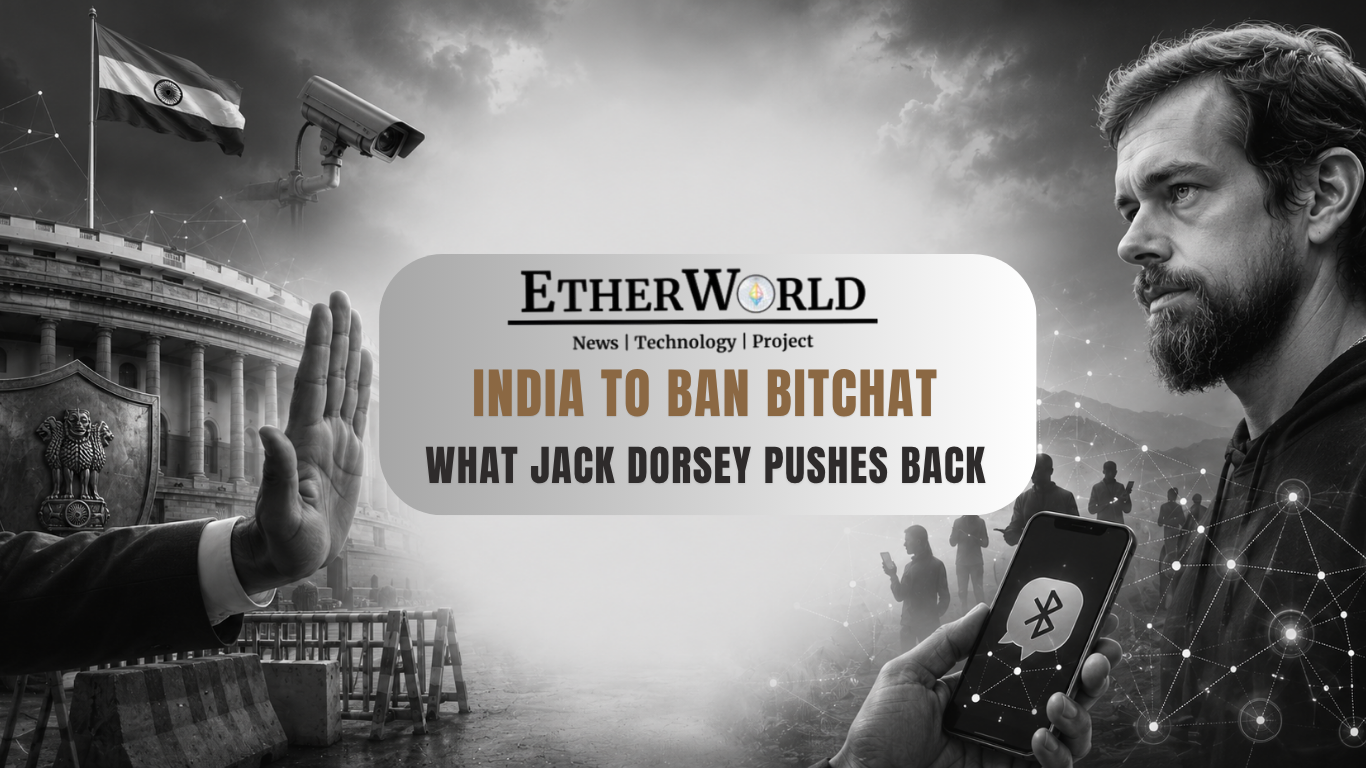
India has directed GitHub to remove or disable access to repositories connected to Bitchat, the decentralised, internet-independent messaging application developed by Twitter co-founder Jack Dorsey. The order was issued by the Indian Cyber Crime Coordination Centre, or I4C, under the Ministry of Home Affairs. It targets Bitchat’s principal GitHub repository, its Android repository and the page through which Android releases are distributed.
Authorities argue that Bitchat’s anonymous, serverless architecture could be exploited by terrorist organisations, organised criminal groups, cybercriminals and other actors seeking to evade lawful interception. GitHub was reportedly instructed to restrict the listed URLs within three hours.
What the Indian Government Ordered GitHub to Remove
The notice, dated July 23, 2026, was issued under Section 79(3)(b) of the Information Technology Act, 2000, read with India’s Information Technology Rules governing intermediary liability. According to the order shared publicly by Dorsey, the government believes these resources either contain prohibited information or are being used to facilitate unlawful activity. GitHub was consequently directed to remove or disable access to them within three hours.
Section 79 ordinarily provides intermediaries with conditional protection from liability for third-party content. However, that protection may be lost when a platform receives legally valid notice of unlawful material and fails to act expeditiously.
the government of india does not like technologies like bitchat and wants it taken down pic.twitter.com/gjzMg1NGCi
— jack (@jack) July 24, 2026
The order also references provisions related to sovereignty, national security, public order, criminal conspiracy and unlawful communications. Its reasoning focuses heavily on Bitchat’s ability to operate without traditional telecommunications infrastructure.
Dorsey responded by posting the order on X and claiming that the Indian government did not like technologies such as Bitchat and wanted the application taken down. His characterisation frames the dispute as a confrontation between governments and decentralised communication systems. The government’s position, by contrast, presents the intervention as a preventive national-security measure.
The development arrives while India is already reassessing its wider approach towards digital assets and decentralised technologies. As EtherWorld reported in India’s Crypto Rulebook Is Under Review, policymakers are balancing innovation, financial oversight, consumer protection and national-security concerns without having introduced one comprehensive framework covering the entire sector.
Why Bitchat’s Architecture Concerns Authorities
Bitchat is a decentralised, peer-to-peer messaging application that allows nearby devices to communicate through Bluetooth mesh networks. Messages can move between nearby devices, with participating phones effectively helping extend the local network. Bitchat also supports broader internet-based communication through the Nostr protocol, giving it both offline and online functionality.
This architecture makes Bitchat useful when mobile networks are unavailable, overloaded or intentionally disabled. Potential applications include natural disasters, crowded events, remote locations, emergency response and periods of political unrest.
However, the same features complicate conventional law-enforcement practices. Centralised platforms can generally be approached for account details, server logs, device information or other records when legally required. A local Bluetooth mesh may have no equivalent central organisation capable of producing complete subscriber data or terminating communication across every participating device.
The government order argues that Bitchat’s architecture impedes lawful interception, attribution and investigation. It says anonymous communication without mandatory user registration, telephone verification or centralised logging could be exploited to coordinate unlawful assemblies, violence, terrorism, organised crime and cybercrime.
This is not an entirely new policy conflict. Privacy tools, encryption systems and decentralised networks have frequently been criticised because they can serve legitimate users and malicious actors simultaneously.
India’s recent actions in the digital-asset sector show a similar preference for greater traceability. The Financial Intelligence Unit has strengthened reporting and identity requirements for crypto platforms, including enhanced scrutiny of high-value over-the-counter transactions, as explained in India FIU Targets Crypto OTC Trades Above $10K.
The FIU has also restricted support for privacy-focused cryptocurrencies such as Monero and Zcash on regulated exchanges. EtherWorld examined that shift in India’s FIU Bans Privacy Coins Like Monero & Zcash.
Security, Enforcement & the Open-Source Dilemma
The central policy question is not whether Bitchat could be misused. Almost every communication technology, from telephones and email to encrypted messaging applications, can facilitate both lawful and unlawful activity. The more difficult question is whether access to software code should be restricted primarily because of its technical capabilities and potential misuse.
The order shared by Dorsey provides broad categories of possible harm. It does not appear to identify a specific message, repository contribution or confirmed criminal incident directly demonstrating that the code itself violated Indian law.
Statement : The blocking of BitChat's code on GitHub is unconstitutional and authoritarian.
— Internet Freedom Foundation (IFF) (@internetfreedom) July 24, 2026
New Delhi, 24 July 2026
The Internet Freedom Foundation (IFF) condemns the order issued by the Indian Cyber Crime Coordination Centre (I4C), Ministry of Home Affairs, directing GitHub… pic.twitter.com/s3wdJEOPK7
Civil-liberties advocates may therefore question whether the intervention is sufficiently specific and proportionate. Restricting a complete open-source project could affect researchers, developers, disaster-response organisations and ordinary users who rely on offline communications for legitimate purposes.
Removing an application from a central app store can significantly reduce access. Removing public-domain source code is more complicated. Once a repository has been cloned or forked, developers can reproduce it elsewhere, distribute installation files independently or compile their own versions.
This is one reason decentralisation matters. A network or application that does not depend on one operator is harder to regulate through traditional intermediary-based enforcement.
Censorship resistance also remains central to Ethereum’s technical roadmap. How Solo Stakers & FOCIL Strengthen Censorship Resistance on Ethereum explains how protocol-level inclusion mechanisms could prevent powerful intermediaries from indefinitely excluding valid transactions.
Similarly, the Ethereum Foundation’s New Playbook places privacy, open-source infrastructure, self-sovereignty and resistance to state or institutional capture among Ethereum’s long-term priorities. The Bitchat dispute demonstrates why those properties are politically consequential rather than merely technical.
What the Bitchat Order Could Mean for Crypto & Web3 in India
Many decentralised applications deliberately minimise the role of central intermediaries. Self-custodial wallets allow users to hold assets without a bank or exchange. Peer-to-peer networks distribute information across independent nodes. Privacy protocols reduce the ability of central entities to reconstruct user activity.
If the absence of mandatory identity verification, central logging or direct interception becomes sufficient grounds for restriction, a wide range of open-source projects could face greater regulatory uncertainty.
India already has one of the world’s largest crypto user populations, even as its regulatory environment remains cautious. EtherWorld covered the scale of that opportunity in India Is Crypto’s Largest Market, Says Coinbase CEO.
At the same time, authorities continue tightening compliance requirements around exchanges, offshore platforms, high-value transfers and privacy-focused assets. As discussed in India Studies Global Crypto Regulation Models Amid Growing Capital Outflow, policymakers are examining international approaches ranging from licensing and taxation to stronger containment measures.
The RBI has also maintained a cautious position on granting cryptocurrency formal legal status. India’s RBI Rejects Crypto Legal Status Before Finance Panel highlights the central bank’s continuing concerns around monetary sovereignty, financial stability and illicit finance.
The country wants to attract developers, blockchain companies, artificial-intelligence investment and global technology infrastructure. Yet projects that reduce central visibility or enforcement control may face heightened scrutiny.
Legal researchers have argued that clearer rules would be more effective than policy through fragmented enforcement. India Needs Clear Crypto Rules, Says GNLU Report outlines the case for a structured framework that separates legitimate technological innovation from fraud and unlawful activity.
These questions also matter for developers choosing where to build. India’s crypto market continues growing, but regulatory uncertainty can push builders, infrastructure providers and capital towards jurisdictions with clearer rules. The risks of this uncertainty were examined in Binance’s India Withdrawal Debate Reignites Crypto Policy Questions.
For users, the Bitchat order is unlikely to end offline messaging. Existing installations, source-code copies and alternative distribution methods may continue functioning. The greater impact may be symbolic: it signals that decentralised communication systems operating beyond central surveillance could become a significant regulatory priority.
India’s order may restrict the most visible Bitchat repositories, but it cannot easily remove the underlying idea. Once open-source code is publicly distributed, enforcement moves from taking down one platform to controlling a protocol that can be copied, modified and relaunched almost anywhere.
To promote your Web3 articles, events, and projects, you may reach out anytime via EtherWorld PR for submissions and collaboration.
Related Articles
- India Intensifies Crypto Oversight as ED Freezes ₹4,190 Crore and Sends 44,057 Tax Notices
- India’s RBI Rejects Crypto Legal Status Before Finance Panel
- Parliament Finance Panel to Meet RBI Over Crypto Regulations
- India Needs Clear Crypto Rules, Says GNLU Report
- What Happens If India Bans Crypto?
To follow blockchain news, track Ethereum protocol progress, and read our latest stories, subscribe to our weekly today.
Join the EtherWorld & Avarch Internship Program and build your career in blockchain, content, social media, video, podcast editing, or operations. Send your resume and brief introduction to contact@etherworld.co.
Disclaimer: The information contained in this website is for general informational purposes only. The content provided on this website, including articles, blog posts, opinions, & analysis related to blockchain technology & cryptocurrencies, is not intended as financial or investment advice. The website & its content should not be relied upon for making financial decisions. Read full disclaimer & privacy policy.
To stay updated on blockchain news, Ethereum protocol progress, and our latest stories, subscribe to our weekly digest and YouTube channel for ELI5 content.
To promote your Web3 articles, events, project updates, and Press Releases, reach out anytime via EtherWorld PR for submissions and collaboration. For other queries, email contact@etherworld.co.
If you’d like to support our work, share the content and consider donating at avarch.eth.
Join our community on Discord and follow us on Twitter, Facebook, LinkedIn & Instagram.

 ×
×

Author

Yash Kamal Chaturvedi is a Blockchain Content & Ops Specialist at Avarch LLC, writing on Ethereum & governance since 2021. Covers ACD/ACDE calls, EIPs, upgrades, staking, security & ecosystem trends.