Are Gift Cards Quietly Normalizing Crypto in India?
Are gift cards becoming a bridge between crypto and everyday spending in India? Explore the regulatory grey area, enforcement challenges and what this reveals about crypto adoption.
India's citizens are discovering ways to spend their crypto even though the country does not officially have a crypto-spending economy. Stablecoins and other cryptocurrency assets can reportedly be converted by users of overseas gift-card platforms into vouchers that can be used for common Indian expenses like food, fuel, and gold. The discovery poses a more important question than whether this is a loophole, i.e., may gift cards be silently acting as a link between bitcoin ownership and actual spending, given that direct cryptocurrency transfers are still difficult under India's regulatory and tax system?
Crypto Spending Is Already Happening Indirectly
The gift card itself is not what makes this development fascinating. Although gift cards have been around for a while, their function changes dramatically when they are used as the last stage in transforming cryptocurrency into something that Indian consumers can really spend.
An Economic Times article says that Indian cryptocurrency users are using foreign sites to exchange stablecoins and other virtual digital assets for Indian gift cards and vouchers via middlemen. According to reports, the vouchers can then be used for purchases like fuel, groceries, and gold, enabling the customer to spend the value of cryptocurrency without having to pay the merchant directly in cryptocurrency.
This is a crucial distinction since the merchant does not always need to be aware that cryptocurrency was used in the transaction. From the merchant's point of view, the cryptocurrency transaction has already occurred somewhere else in the chain, and the client is merely redeeming a gift card or voucher.

Source: Is Central & Southern Asia the Future of Crypto? - Chainalysis
For customers who wish to spend cryptocurrency, this makes gift cards more appealing than a straightforward workaround. They enable cryptocurrency to be concealed behind a typical-looking retail transaction by successfully separating the money source from the payment method.
This, in my opinion, is where the narrative expands far beyond gift cards. Even though the shop never takes it directly, cryptocurrency has a useful spending function if a customer can convert stablecoins into a voucher and use that voucher to buy food or petrol.
Additionally, the model draws attention to a contradiction in the Indian cryptocurrency industry. Despite the country's strict tax and compliance regulations pertaining to virtual digital assets, individuals are nevertheless able to make useful use of the assets they already own.
This does not imply that customers are giving up on using traditional payment methods. For everyday purchases, UPI is still considerably more convenient, and there is little reason for someone with rupees to exchange them for cryptocurrency just to buy groceries.
The prospective demand is coming from the opposite direction. Gift cards provide a comparatively easy option for people who already own cryptocurrency to convert their digital assets into something valuable in the real world.
Source: TRM Labs
Why Gift Cards Create a Regulatory Grey Area
By the time the transaction reaches the customer's ultimate purchase, it no longer seems to be a traditional cryptocurrency payment, which is where the regulatory challenge starts.
Virtual digital assets are explicitly covered by India's tax system, which includes TDS rules for VDA transactions and a 30% tax on some VDA revenue under Section 115BBH. In the meantime, pertinent VDA service providers must adhere to reporting and other requirements under India's anti-money-laundering system.
An additional layer is added by the gift-card model between the cryptocurrency transaction and the final purchase. A consumer can send stablecoins to a foreign site, get or buy a voucher, and then spend that voucher with an Indian retailer who isn't directly involved with cryptocurrency.

Source: Is Central & Southern Asia the Future of Crypto? - Chainalysis
The regulatory question becomes much more complex as a result. Authorities are dealing with a chain in which the cryptocurrency component and the retail payment component can appear to be entirely distinct, rather than just a cryptocurrency exchange or a retailer taking Bitcoin or stablecoins.
Therefore, characterising every gift card transaction as unlawful or every offshore site as inherently breaking Indian regulations would be oversimplified. Whether the specific transaction conforms with applicable tax, foreign exchange, AML, and reporting laws is the most pertinent question.
Because technology has separated the source of value from the final mode of payment, there is a grey area. While the final transaction provided to the shop appears to be a typical voucher redemption, the consumer may really spend the economic worth of cryptocurrency.
If stablecoins gain popularity among Indian cryptocurrency users, that distinction might become more significant. Because their value is more steady than that of highly volatile assets, stablecoins are especially well-suited to this type of paradigm.

Source: Is Central & Southern Asia the Future of Crypto? - Chainalysis
However, this presents an unusual difficulty from a regulatory standpoint. The authorities may have clear regulations for the cryptocurrency asset itself, but when offshore services and vouchers are involved, it becomes more challenging to track what occurs once the asset departs a regulated platform.
Can India Actually Control This Model?
India can monitor suspicious financial activity, enforce reporting requirements on authorised VDA service providers, and regulate domestic cryptocurrency exchanges, but it is considerably more difficult to manage an ecosystem that is partially based on foreign platforms.
This concept requires a rather simple infrastructure. A cryptocurrency wallet, access to a foreign service, a way to buy a voucher, and a retailer that takes the resulting gift card are all necessary for the user. The end store is not required to deal with cryptocurrency in any of those separate processes.
Because of this, enforcement differs significantly from closing a domestic exchange that openly accepts cryptocurrency payments. Instead of just identifying a cryptocurrency transaction at the time of purchase, authorities could have to track the money throughout several businesses and jurisdictions.
Additionally, the extent to which enforcement may be implemented without interfering with lawful financial activities has a practical limit. Determining whether a portion of the transaction comes within Indian jurisdiction might become much more difficult if an international platform serves Indian customers, yet the final product is a traditional gift card.
This does not imply that regulations cannot be applied to the model. International collaboration can facilitate the investigation of offshore activity, and exchanges, banks, payment intermediaries, and other identifiable nodes in the transaction chain can still be targets for compliance actions.
The more important question is whether trying to completely eradicate the model would truly remove the need for it. If someone already has cryptocurrency and wants to spend it, barring one path might just make them look for another that is more difficult for authorities to find.
In this situation, regulations must differentiate between various types of activity. Customers who use cryptocurrency-derived value to buy legal items may not be at the same risk as those who use the same infrastructure for illegal cross-border transfers, tax avoidance, or money laundering.
If both scenarios are handled the same way, more regular cryptocurrency activity may be forced into less open channels. In the end, a regulatory framework that comprehends the true operation of these payment bridges might be more successful than attempting to close down each workaround separately.
What This Means for Crypto Adoption in India
The most intriguing aspect of gift-card spending is that it casts doubt on the notion that trade volumes or the quantity of digital assets held by individuals should be the primary indicators of crypto adoption.
If Indians are figuring out how to turn cryptocurrency into commonplace products and services, there may be another kind of adoption going on underneath the surface. Economically, the cryptocurrency asset is still being used to buy something in the real world even though users may not refer to the transaction as a cryptocurrency payment.
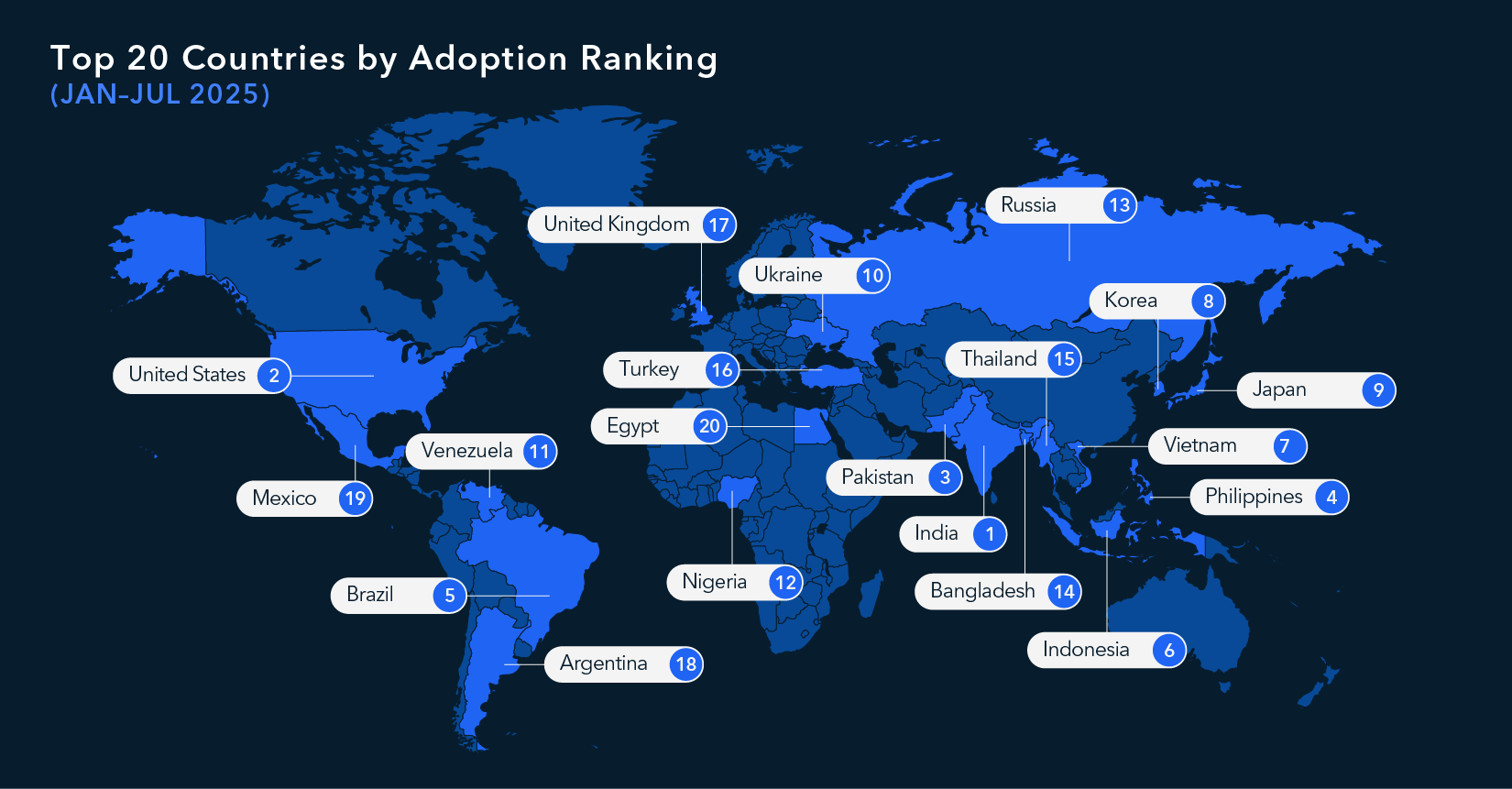
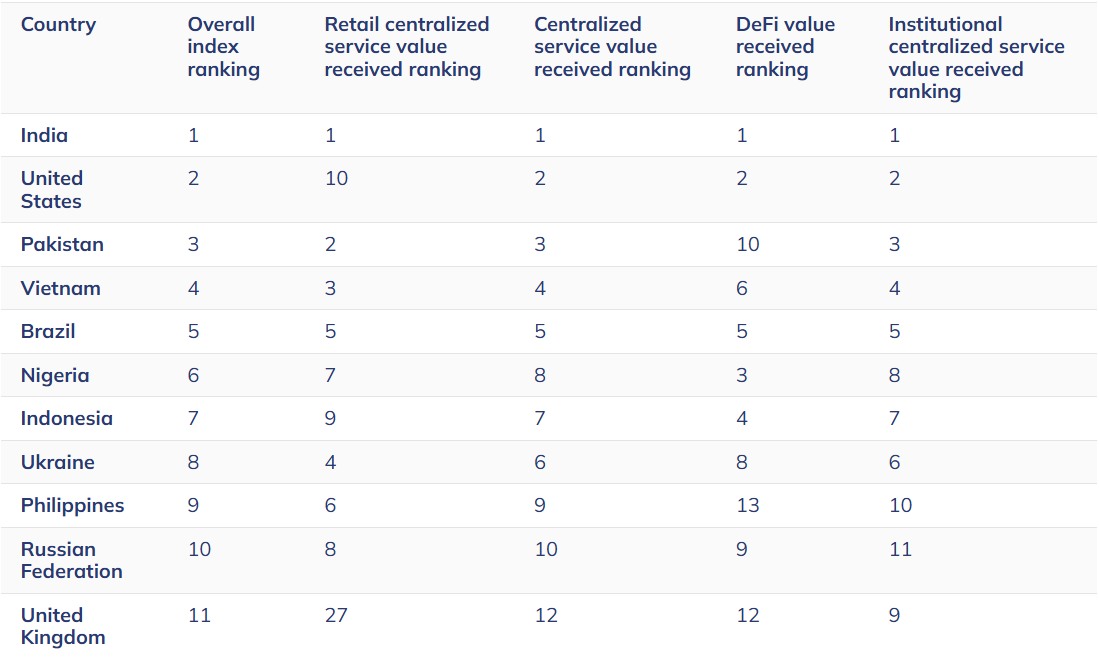
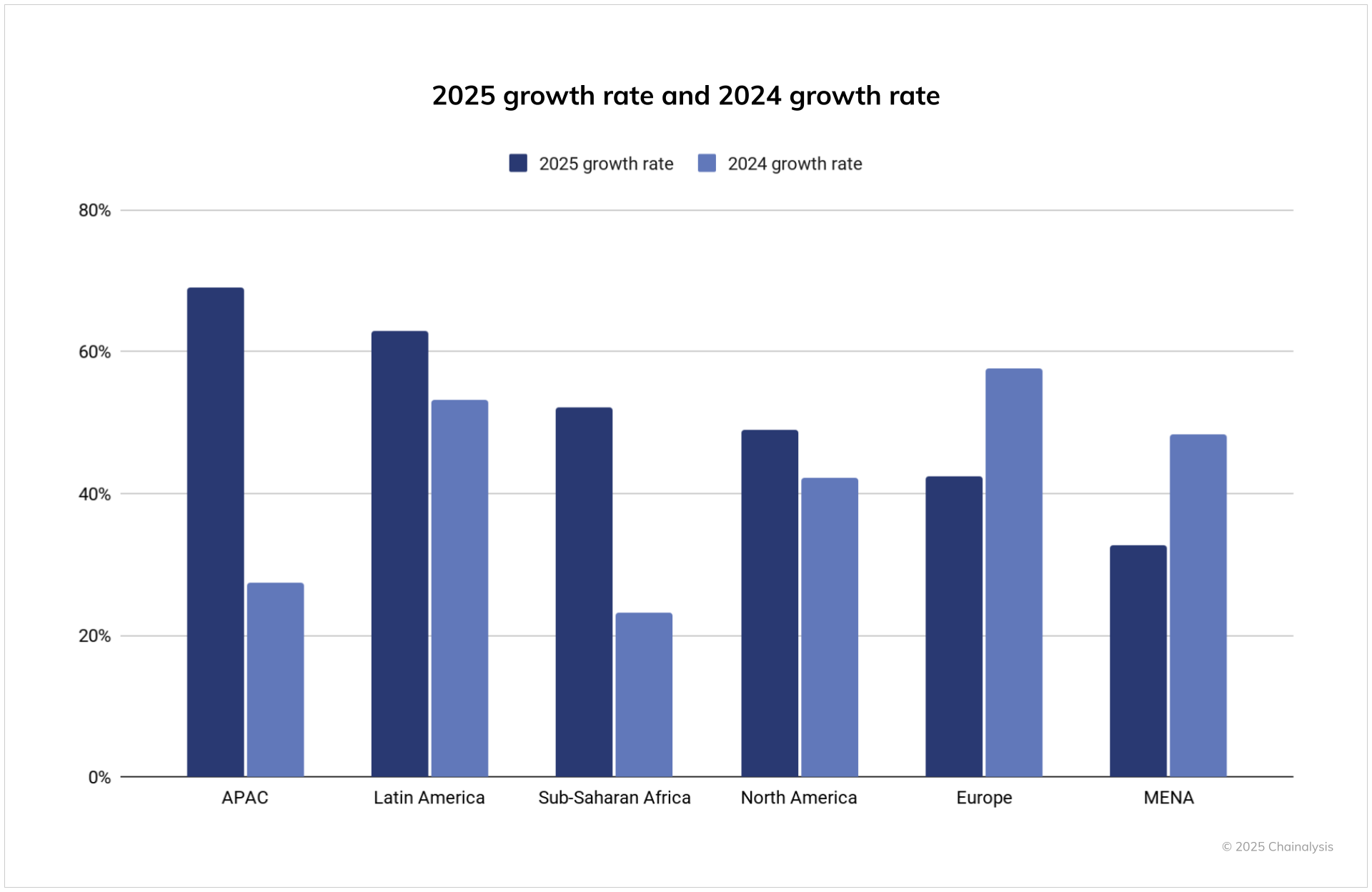
The claim that interest in digital assets is not restricted to a select few speculative traders is supported by India's ranking in the world's crypto adoption rankings. In its 2025 Global Crypto Adoption Index, Chainalysis placed India at the top, indicating substantial grassroots activity throughout the nation's cryptocurrency ecosystem.
Source: 2025 Global Adoption Index - Chainalysis
That does not imply that stablecoins are taking the place of UPI in India. Since UPI is already thoroughly ingrained in daily business and provides customers with a far simpler experience, the opposite is really more plausible for mainstream domestic payments.
Gift cards have several meanings. For those who already own cryptocurrency and find it difficult to use it directly at Indian retailers, they might offer an extra layer of spending.
Because of this, I believe the gift-card movement merits careful consideration. It implies that consumers are successfully building their own bridge between digital assets and conventional trade, and that demand for cryptocurrency utilities may be growing independently of the official payment system.
The model also highlights a flaw in India's existing strategy. Regulation cannot always stop people from experimenting with alternative infrastructure outside of the conventional financial system, even as strict taxation and compliance requirements can make direct cryptocurrency activity more difficult.
Source: 2025 Global Adoption Index - Chainalysis
Authorities may eventually have to address a more fundamental question if gift cards emerge as a significant channel for cryptocurrency-funded consumption, i.e., is it preferable to keep cryptocurrency spending outside of the visible payment system or establish clearer regulations that permit legitimate forms of crypto-funded commerce to function within it?
As of right now, gift cards seem to be in a unique position between traditional and cryptocurrency payments. They do not automatically make every transaction compatible; they are not a substitute for UPI, and they are not always proof of large-scale cryptocurrency payments.
However, they do highlight a significant aspect of the Indian market. Gift cards could be one of the easiest bridges to utilise when people wish to use an asset that the formal system does not readily accept.
If you find any issues in this article or notice missing information, please feel free to reach out at team@etherworld.co for clarifications or updates.
To promote your Web3 articles, events, and projects, you may reach out anytime via EtherWorld PR for submissions and collaboration.
Related Articles
- India Records $19B in Taxable Crypto Activity
- India Parliament Panel Cancels August 27 Crypto Hearing
- India Issues New Crypto Tax Rules From 2026
- India to Ban Bitchat: Jack Dorsey Pushes Back
- India Is Crypto’s Largest Market, Says Coinbase CEO
To follow blockchain news, track Ethereum protocol progress, and read our latest stories, subscribe to our weekly today.
Join the EtherWorld & Avarch Internship Program and build your career in blockchain, content, social media, video, podcast editing, or operations. Send your resume and brief introduction to contact@etherworld.co.
Disclaimer: The information contained in this website is for general informational purposes only. The content provided on this website, including articles, blog posts, opinions, & analysis related to blockchain technology & cryptocurrencies, is not intended as financial or investment advice. The website & its content should not be relied upon for making financial decisions. Read full disclaimer & privacy policy.
To stay updated on blockchain news, Ethereum protocol progress, and our latest stories, subscribe to our weekly digest and YouTube channel for ELI5 content.
To promote your Web3 articles, events, project updates, and Press Releases, reach out anytime via EtherWorld PR for submissions and collaboration. For other queries, email contact@etherworld.co.
If you’d like to support our work, share the content and consider donating at avarch.eth.
Join our community on Discord and follow us on Twitter, Facebook, LinkedIn & Instagram.

 ×
×

Author

Nidhi Kumari is a Web3 content writer at EtherWorld.co, tracking ecosystem developments, funding activity, and market trends shaping the crypto space.