OCC Finalizes GENIUS Act Stablecoin Rules
The OCC finalizes GENIUS Act stablecoin rules covering reserves, redemptions, custody, audits and risk management, effective January 18, 2027.

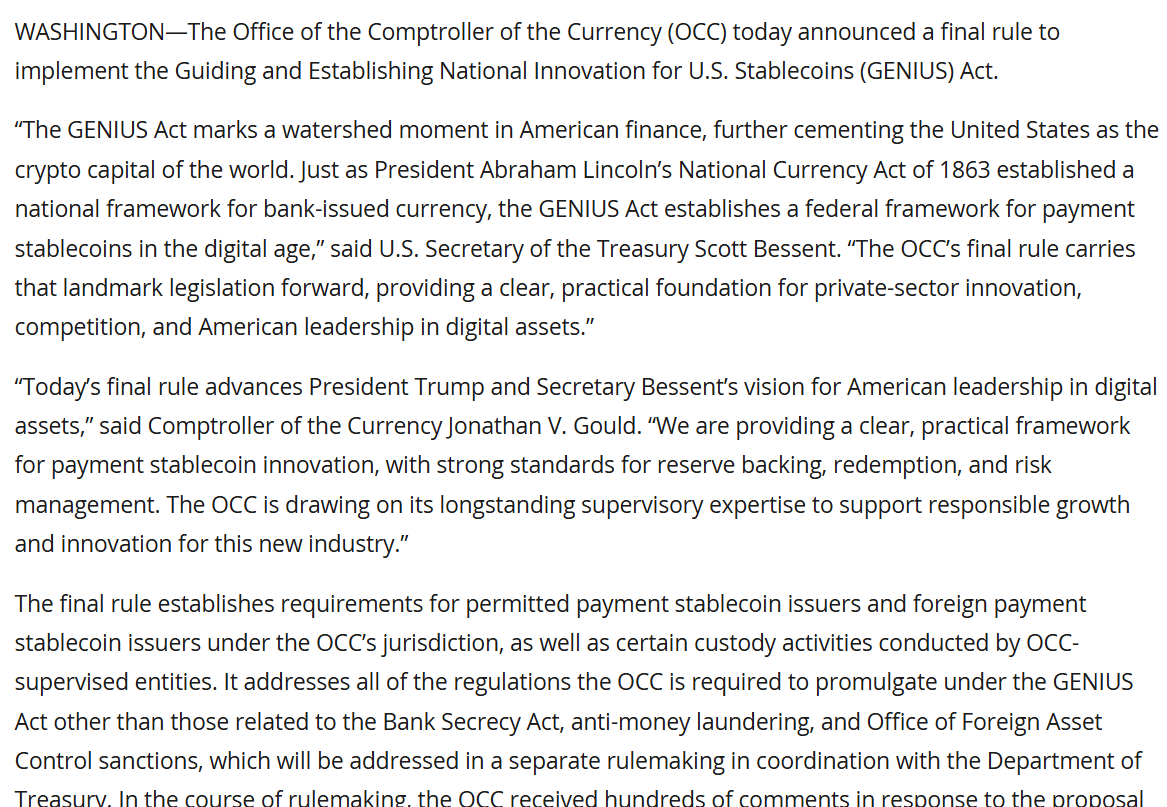
The GENIUS Act's first major rule, which sets federal requirements for payment stablecoin issuers under its supervision, has been finalised by the Office of the Comptroller of the Currency.
The rule, which was released on October 21, 2026, establishes rules for reserve backing, redemptions, custody, risk management, and audits. As the US seeks to formalise control of its stablecoin market, it is set to go into force on January 18, 2027, providing licensed issuers with a specified framework.
OCC Sets Federal Standards for Stablecoin Issuers
President Donald Trump signed the Guiding and Establishing National Innovation for US Stablecoins Act (GENIUS Act) into law on July 18, 2025, and the final rule puts it into effect. It covers issuers of payment stablecoins as well as some associated operations that fall under the purview of the OCC.
Subsidiaries of national banks and federal savings associations, federally qualified payment stablecoin issuers, some state-qualified issuers under OCC supervision, and overseas payment stablecoin issuers under its jurisdiction are among the covered companies. Certain custodial operations carried out by organisations under OCC supervision are also covered by the rule.
The regulator moved forward beyond its February 2026 schedule, which solicited public input, by completing the requirements. Before finishing the rule, the OCC claimed to have received hundreds of comments from academics, trade associations, community bankers, cryptocurrency firms, and other stakeholders.
Reserve Requirements, Redemptions & Audits Take Priority
Reserve assets, redemption procedures, custody agreements, risk management, audits, reporting, and supervisory monitoring are all covered under the regulation's provisions. Additionally, it covers applications for issuer approval, capital requirements, operational safeguards, and the transfer of some state-qualified issuers into the federal regulatory framework.
The OCC has a clear foundation for determining whether covered issuers fulfil their duties due to these regulations. While redemption requirements control how holders can exchange their tokens for the promised monetary value, reserve standards deal with the assets supporting payment stablecoins. Rules for custody and risk management deal with the protection of assets and the control of operational hazards.
Provisions for reviewing foreign issuers and withdrawing approval under specific conditions are also included in the final framework. Capital adequacy, corrective action, regulatory fees, and supervisory procedures are all covered by separate amendments to current banking regulations.
There is still one major restriction. This final rule does not address requirements pertaining to the Bank Secrecy Act, anti-money laundering, or sanctions enforced by the Office of Foreign Assets Control; these will be handled through separate rulemaking that is coordinated with the Treasury Department.
.@USComptroller Jonathan V. Gould: Today’s final rule advances @POTUS Trump’s and @SecScottBessent’s vision for American leadership in digital assets. We are providing a clear, practical framework for payment stablecoin innovation, with strong standards for reserve backing, redemption, and risk management. The OCC is drawing on its longstanding supervisory expertise to support responsible growth and innovation for this new industry. https://t.co/IWuIHnQQ0f
— OCC (@USOCC) October 21, 2026
Stablecoin Interest Payments Face Restrictions
According to the GENIUS Act framework, issuers of covered stablecoins are not allowed to offer holders interest or yield just for keeping, using, or holding their payment stablecoins. Whether the prize is given in cash, tokens, or another type of consideration, the restriction still holds true.
The rule also covers agreements with third parties and affiliates. By using a different company to route rewards, an issuer may not be able to circumvent the restriction. Issuers may provide written evidence to refute the OCC's presumption that some third-party arrangements breach the restriction.
For platforms such as Coinbase, PayPal and Kraken, the distinction between rewards paid simply for holding stablecoins and rewards linked to other activities will matter. Their individual programs require case-by-case assessment rather than an assumption that every rewards arrangement is automatically prohibited.
Gould & Bessent Emphasize US Crypto Leadership
Comptroller of the Currency Jonathan V. Gould said the agency had delivered the final rule ahead of schedule, advancing the administration's goal of supporting economic growth and strengthening American leadership in digital assets. He emphasised clear requirements for reserve backing, redemptions and risk management as central elements of the framework.
Treasury Secretary Scott Bessent described the GENIUS Act as a milestone in establishing the United States as the world's crypto capital. He said the OCC rule would carry the legislation forward by providing a practical foundation for private sector innovation and competition.
The January 18, 2027 effective date gives covered issuers a firm regulatory deadline. The OCC has also said it will announce separately when it begins accepting and processing applications and waiver requests from prospective permitted payment stablecoin issuers.
If you find any issues in this article or notice missing information, please feel free to reach out at team@etherworld.co for clarifications or updates.
To promote your Web3 articles, events, and projects, you may reach out anytime via EtherWorld PR for submissions and collaboration.
Related Articles
- Ledger Wallet Spy Implant Triggers Karpelès Feud
- Unagi Assets for Sale After Court Ordered Liquidation
- Jio’s $106B IPO Hits Bitget With 20x Pre-IPO Perps
- South Korea Blocks 27 Unregistered Crypto Exchanges
- 95% of India’s Crypto Offshore, ₹57,147 Crore Lost?
To follow blockchain news, track Ethereum protocol progress, and read our latest stories, subscribe to our weekly today.
Join the EtherWorld & Avarch Internship Program and build your career in blockchain, content, social media, video, podcast editing, or operations. Send your resume and brief introduction to contact@etherworld.co.
Disclaimer: The information contained in this website is for general informational purposes only. The content provided on this website, including articles, blog posts, opinions, & analysis related to blockchain technology & cryptocurrencies, is not intended as financial or investment advice. The website & its content should not be relied upon for making financial decisions. Read full disclaimer & privacy policy.
To stay updated on blockchain news, Ethereum protocol progress, and our latest stories, subscribe to our weekly digest and YouTube channel for ELI5 content.
To promote your Web3 articles, events, project updates, and Press Releases, reach out anytime via EtherWorld PR for submissions and collaboration. For other queries, email contact@etherworld.co.
If you’d like to support our work, share the content and consider donating at avarch.eth.
Join our community on Discord and follow us on Twitter, Facebook, LinkedIn & Instagram.

 ×

Author

Nidhi Kumari is a Web3 content writer at EtherWorld.co, tracking ecosystem developments, funding activity, and market trends shaping the crypto space.

