OpenAI’s Dots Need a Wallet. Is Ethereum Ready?
OpenAI’s Dots are pushing AI agents toward autonomous work. Here’s how Ethereum, stablecoins, x402 and agent wallets could power machine payments.
OpenAI’s Dots could make AI agents far more economically active than today’s chatbots. They can run continuously, use their own computers and browsers, connect to thousands of apps and work toward goals without requiring a user to direct every step. That raises a question beyond AI productivity. If agents eventually need to purchase data, APIs, computing power or services from other agents, they will need a way to identify themselves, hold money and make payments. Ethereum is already building several pieces of that infrastructure.
What Are OpenAI Dots?
OpenAI introduced Dots at DevDay 2026 as always-on agents designed to take responsibility for ongoing work. Powered by GPT-6 Astra, a Dot has its own cloud computer and browser and can connect to more than 4,000 apps through OpenAI’s plugin ecosystem. Users can interact with Dots through ChatGPT, Slack and Teams, while the system learns preferences and working patterns through feedback.
That makes Dots different from a conventional chatbot. A chatbot generally waits for a prompt. A Dot can take a project and continue working on it, including while its user is away. OpenAI gives examples of Dots investigating a bug in Slack, turning a new design into a working application and preparing an invoice after noticing that one had been forgotten.
The financial question appears when that autonomy extends beyond the applications already connected to an agent. A Dot that can independently find a service may eventually need to pay for that service without asking its owner to complete a checkout process each time.
Why Autonomous AI Agents Need Money
An autonomous agent does not only consume information. It can eventually become a buyer.
Consider an agent researching a company that needs a paid data query, a coding agent that requires additional compute or an AI system purchasing an API call from another service. If these transactions happen thousands of times, requiring a human to enter card details or approve every payment removes much of the value of autonomy.
This is where stablecoins comes into action. They can be transferred programmatically and can support small, machine-triggered payments without requiring the two parties to maintain the same banking relationship.
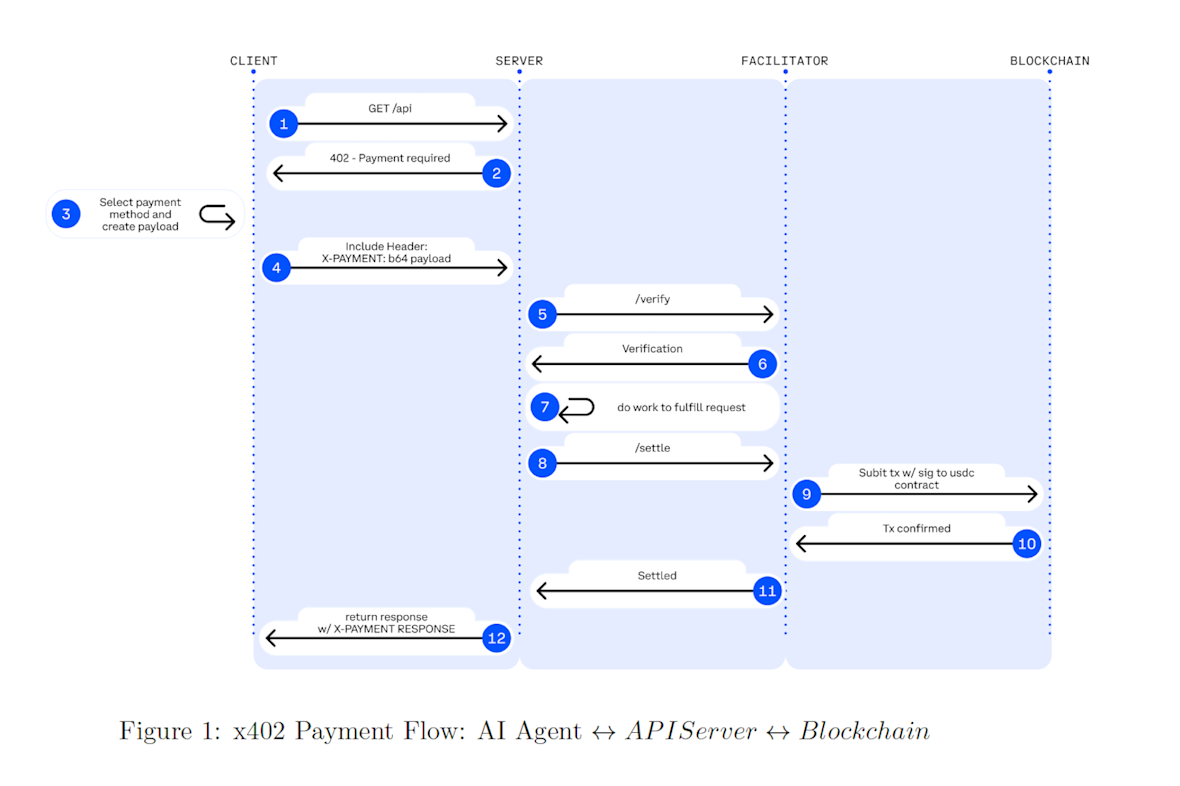
Coinbase’s x402 is one of the clearest examples. It adds payments to the HTTP request cycle. A service can respond with a payment requirement, an agent can make a stablecoin payment and the request can continue after payment is verified. Coinbase specifically positions x402 for APIs, applications and AI agents.
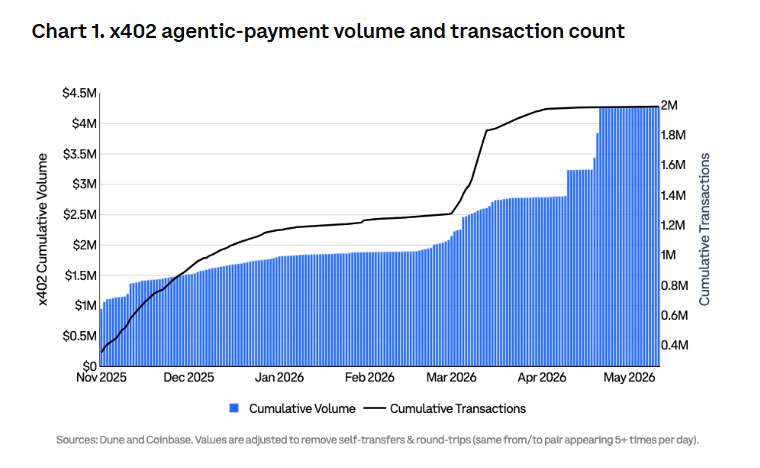
The early numbers show that developers are already testing this model. Coinbase reported more than 165 million x402 transactions and around $50 million in volume in April 2026, with hundreds of thousands of agents participating in the ecosystem. That is still small beside traditional payments, but it gives machine-to-machine payments something they previously lacked: measurable economic activity.
Where Ethereum Fits In
Ethereum’s potential role is broader than simply providing ETH for an agent to spend.
ERC-4337 gives developers account abstraction, allowing smart accounts to define their own transaction validation and payment logic. An agent wallet can therefore be built with rules that differ from a normal private-key account, including custom validation and paymaster arrangements.
ERC-8004 addresses another problem that autonomous commerce creates; who is the agent on the other side? The proposal creates onchain registries for agent identity, reputation and validation. Its specification also allows an agent to associate a verified wallet with its identity.
ERC-8196 moves directly into controlled agent wallets. It proposes wallets that execute transactions only when cryptographic proof shows that an action complies with an owner-defined policy. Those policies can specify permitted actions, approved contracts, transaction limits and daily spending limits.
That creates a possible Ethereum stack for autonomous commerce. ERC-8004 can identify the agent, ERC-4337 can provide the programmable account structure, ERC-8196 can enforce spending policies and stablecoins can provide the payment asset. x402 then provides a mechanism for connecting those payments to internet requests.
AI x Web3 Is Already Growing
The infrastructure is not being developed in isolation. Ethereum’s own AI-agent ecosystem page now identifies agents that can control onchain wallets, transact independently and even hire humans or other agents for work. It also identifies x402 as a mechanism for agents to pay for compute, data and API calls with stablecoins.
There is also evidence outside Ethereum that agent commerce is becoming a real development category. In March 2026, a16z reported that an agent-focused marketplace had more than 60 services available to AI agents. During its first week, 894 agents executed more than 31,000 transactions, with services priced between $0.003 and $35. The marketplace used Stripe and Tempo’s Machine Payments Protocol, showing that machine commerce does not automatically require a blockchain. AI agent adoption does not equal Ethereum adoption.
The more interesting trend is the convergence of several technologies. Stablecoins make programmable value transfer possible, agent protocols allow software to discover and communicate with other software, and blockchain standards are beginning to address identity, reputation and controlled wallets.
Ethereum therefore has a growing set of relevant components, but it is competing with other networks and payment systems for the role.
Could Ethereum Become the Financial Layer for AI Agents?
The strongest Ethereum case emerges if autonomous agents start operating across organisational boundaries.
An agent working entirely inside OpenAI’s ecosystem may never need an onchain wallet. OpenAI can control permissions, maintain an internal balance and settle payments through conventional financial infrastructure.
The situation changes when one agent needs to buy something from an unrelated company or another autonomous agent. There may be no shared account system, no common bank and no human available to establish a commercial relationship. An open financial layer could solve that coordination problem.
Identity becomes important because the buyer needs to be recognised. Reputation matters because the seller needs some basis for trusting an unfamiliar agent. Permissions matter because the human owner cannot manually approve every transaction. Settlement matters because the two systems need a common way to transfer value.
Ethereum’s emerging standards address each of those requirements, but none guarantees that Ethereum will capture the market.
The counterargument is strong. Centralised systems can be faster and cheaper for transactions that remain within one platform. Stripe and Tempo’s MPP already demonstrates an alternative architecture in which agents can pay with cards, stablecoins or Lightning through a common payment protocol.
Ethereum's opportunity is therefore less about replacing every existing payment system and more about becoming useful where agents need open identity, programmable permissions and settlement between parties that do not share the same platform.
What Could Go Wrong?
Giving an AI access to money introduces risks that do not exist when an agent is only producing text.
A compromised agent could make transactions at machine speed. A poorly defined policy could allow legitimate but unwanted spending. A malicious service could exploit an agent into approving an unsafe transaction. Even without an attack, an agent could misunderstand its objective and use its permitted funds in a way the owner did not anticipate.
ERC-8196 is designed around some of these problems by requiring policy-bound execution and specifying limits such as maximum value per transaction, maximum daily spending and approved or blocked contracts.
Privacy is another unresolved issue. Public blockchain transactions can reveal which services an agent pays, how frequently it interacts with them and potentially what kind of work it is performing.
There is also a simpler question. Do agents actually need blockchains?
For many applications, the answer may be no. A company can give its agents an internal account, enforce spending limits and settle transactions offchain. That approach can avoid blockchain fees, public transaction histories and much of the complexity associated with wallets.
The case for Ethereum becomes stronger only if autonomous agents need to transact across independent systems without relying on a central intermediary.
That is why Dots are interesting for Ethereum even though OpenAI has not built them around crypto. Dots demonstrate the direction in which software is moving; from systems that respond to people toward systems that continuously act for them. If those agents eventually become buyers as well as workers, identity, money and permissions will have to become programmable. Ethereum is building those components, but the market has not yet decided whether it will be the system that puts them together.
If you find any issues in this article or notice missing information, please feel free to reach out at team@etherworld.co for clarifications or updates.
To promote your Web3 articles, events, and projects, you may reach out anytime via EtherWorld PR for submissions and collaboration.
Related Articles
- S&P Global to Acquire OpenZeppelin
- Derive.xyz Bets Big on On-Chain Options Trading
- CoinEx Shuts Down After Nine Years
- Bitcoin ETFs Lose $463M, Ethereum ETFs Gain $197M
- Revolut Shares Customer Data After Fake Government Email
To follow blockchain news, track Ethereum protocol progress, and read our latest stories, subscribe to our weekly today.
Join the EtherWorld & Avarch Internship Program and build your career in blockchain, content, social media, video, podcast editing, or operations. Send your resume and brief introduction to contact@etherworld.co.
Disclaimer: The information contained in this website is for general informational purposes only. The content provided on this website, including articles, blog posts, opinions, & analysis related to blockchain technology & cryptocurrencies, is not intended as financial or investment advice. The website & its content should not be relied upon for making financial decisions. Read full disclaimer & privacy policy.
To stay updated on blockchain news, Ethereum protocol progress, and our latest stories, subscribe to our weekly digest and YouTube channel for ELI5 content.
To promote your Web3 articles, events, project updates, and Press Releases, reach out anytime via EtherWorld PR for submissions and collaboration. For other queries, email contact@etherworld.co.
If you’d like to support our work, share the content and consider donating at avarch.eth.
Join our community on Discord and follow us on Twitter, Facebook, LinkedIn & Instagram.

 ×
×

Author

Nidhi Kumari is a Web3 content writer at EtherWorld.co, tracking ecosystem developments, funding activity, and market trends shaping the crypto space.