Putin Signs Russia's Landmark Crypto Regulation Law
Russia has signed a comprehensive crypto law regulating mining, exchanges, investors, digital assets, and market participants, with phased implementation beginning September 1, 2026.
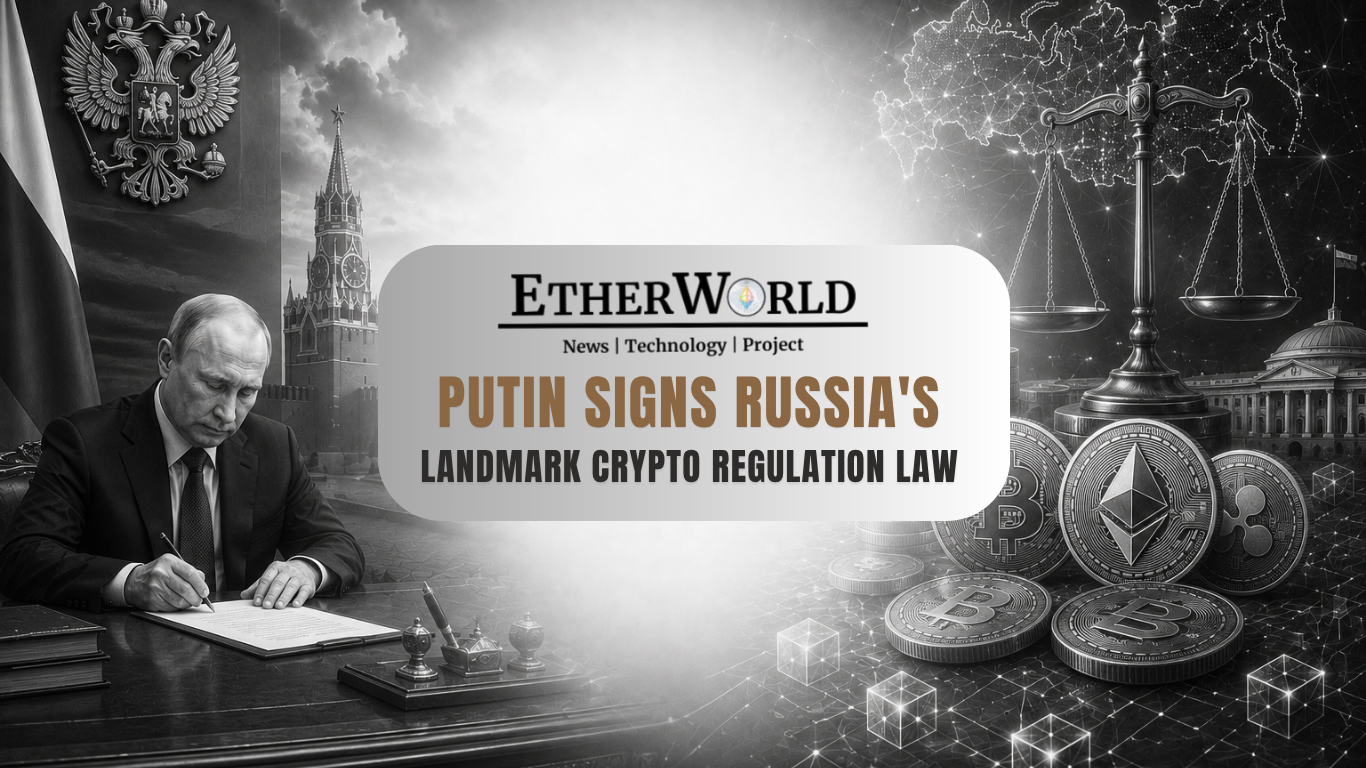
President Vladimir Putin signed the Federal Law on Amendments to Certain Legislative Acts of the Russian Federation, establishing the country's comprehensive legal framework for digital currencies. The law lays out specific rules for digital financial assets (DFAs), mining, exchanges, digital rights, investors, and market infrastructure. Additionally, it presents operating standards, investor safeguards, licensing requirements, and staggered implementation schedules. While a number of technical and transitional elements will be implemented over the course of the next year, the majority of the law will go into force on September 1, 2026.
Russia Establishes Rules for Crypto Mining & Digital Asset Circulation
The new law establishes a legal framework for mining digital currencies in Russia. In order to guarantee adherence to Russian law, it establishes protocols for tracking the flow of digital money and specifies the circumstances in which mining operations may take place.
Additionally, the law grants the Russian Federation's government the power to forbid cryptocurrency mining, including participation in mining pools, in particular areas or territories as needed.
In addition to mining, the law governs the dissemination of obligations issued via non-compliant information systems. Additionally, it specifies the protocols and requirements for the exchange of Russian digital financial assets (DFAs) via international information networks.
A thorough regulatory framework for the issuance, accounting, circulation, and custody of digital currencies and foreign digital instruments is also provided under the law. Additionally, it establishes operational guidelines for information system operators who are in charge of issuing digital financial assets.
New Registration Rules for Crypto Exchanges & Market Participants
For cryptocurrency exchange companies operating in Russia, the law establishes a formal regulatory structure.
Organizations who are part of a special state registry will be the only ones permitted to exchange digital currency. However, until July 1, 2027, current market participants may carry on without registering during the changeover period.
Exchange providers must keep a minimum equity capital of 15 million rubles (about $187,339) in order to be eligible.
The systematic buying and selling of cryptocurrencies in an entity's name and for its own account outside of regulated trading platforms is defined by law as digital currency exchange activity. When two or more transactions totalling more than 3.5 million rubles (about $43,712) are completed in a single month, the activity is deemed systemic.
Additionally, registered exchange providers are required to join a financial market self-regulatory organisation (SRO).
Additionally, the law establishes operating guidelines for clearing houses, digital depositories, brokers, management firms, trade organisers, and other market players. In order to meet clearing obligations or settle participant defaults, clearing houses are allowed to carry out cryptocurrency transactions without registering or using brokers.
Payment Restrictions, Bank Oversight, & Investor Rules
The bill upholds Russia's current ban on utilising digital rights and cryptocurrencies as legal tender or forms of payment for goods and services within the nation. Additionally, it prohibits promoting bitcoin payments for goods, services, information, or intellectual property through advertising or information distribution.
There are, however, a few exceptions. Digital currencies can be used for transactions involving cryptocurrencies obtained through mining, settlements involving securities, digital currencies, or digital rights, and settlements under foreign trade contracts between residents and non-residents. They can also be used to pay fees required by pertinent information systems.
The legislation imposes extra supervisory duties on banks. A foreign bank branch or credit institution must stop the transfer of money if it believes that transactions include an unapproved cryptocurrency exchange.
Additionally, regardless of whether the digital assets were previously reported, the law provides holders of digital currency with judicial protection.
The law separates qualified participants from retail investors. With an annual investment cap of 300,000 rubles (about $3,700) per intermediary, only the most liquid cryptocurrencies are available for purchase by retail investors. There are no restrictions on the number of cryptocurrencies that qualified investors can buy.
Before investing, both qualified and retail investors must complete the required suitability testing. Based on their experience trading cryptocurrencies, people may also be eligible for professional investor status.
Implementation Timeline & Transitional Period
Russia's new legal framework for digital currencies and digital financial assets will start on September 1, 2026, when the majority of the legislation will go into effect.
Later on, some provisions will be presented. On July 1, 2027, regulations governing the operational framework for non-resident digital depositories and limitations on money transfers will go into effect.
On September 1, 2027, technical regulations controlling the issuance and distribution of digital financial assets will go into effect, together with specifications for nominal holders of depositories and DFAs.
Additionally, the bill allows current operators of digital financial asset exchanges to continue operating until March 1, 2027, at which point they will have to comply with the new regulatory framework. In addition to unifying Russia's digital asset ecosystem under a single regulatory framework, this gradual deployment aims to provide market players enough time to comply with the new operational, legal, and registration requirements.
If you find any issues in this article or notice missing information, please feel free to reach out at team@etherworld.co for clarifications or updates.
To promote your Web3 articles, events, and projects, you may reach out anytime via EtherWorld PR for submissions and collaboration.
Related Articles
- BitMart Is Shutting Down, Trading Ends August 26
- Coinbase Wins $150K SEC Settlement Over Missing Gensler Texts
- BitMEX to Shut Down After 11 Years
- Why did Malaysia Shut Down Balaji Network School Hub?
- Telegram Launches Gram Wallet for 1 Billion Users
To follow blockchain news, track Ethereum protocol progress, and read our latest stories, subscribe to our weekly today.
Join the EtherWorld & Avarch Internship Program and build your career in blockchain, content, social media, video, podcast editing, or operations. Send your resume and brief introduction to contact@etherworld.co.
Disclaimer: The information contained in this website is for general informational purposes only. The content provided on this website, including articles, blog posts, opinions, & analysis related to blockchain technology & cryptocurrencies, is not intended as financial or investment advice. The website & its content should not be relied upon for making financial decisions. Read full disclaimer & privacy policy.
To stay updated on blockchain news, Ethereum protocol progress, and our latest stories, subscribe to our weekly digest and YouTube channel for ELI5 content.
To promote your Web3 articles, events, project updates, and Press Releases, reach out anytime via EtherWorld PR for submissions and collaboration. For other queries, email contact@etherworld.co.
If you’d like to support our work, share the content and consider donating at avarch.eth.
Join our community on Discord and follow us on Twitter, Facebook, LinkedIn & Instagram.

 ×
×

Author

Nidhi Kumari is a Web3 content writer at EtherWorld.co, tracking ecosystem developments, funding activity, and market trends shaping the crypto space.