Lagarde Reportedly Blocks Binance's EU Crypto License
Christine Lagarde reportedly urged Greece to halt Binance’s EU-wide MiCA license, raising questions over crypto regulation and the digital euro.

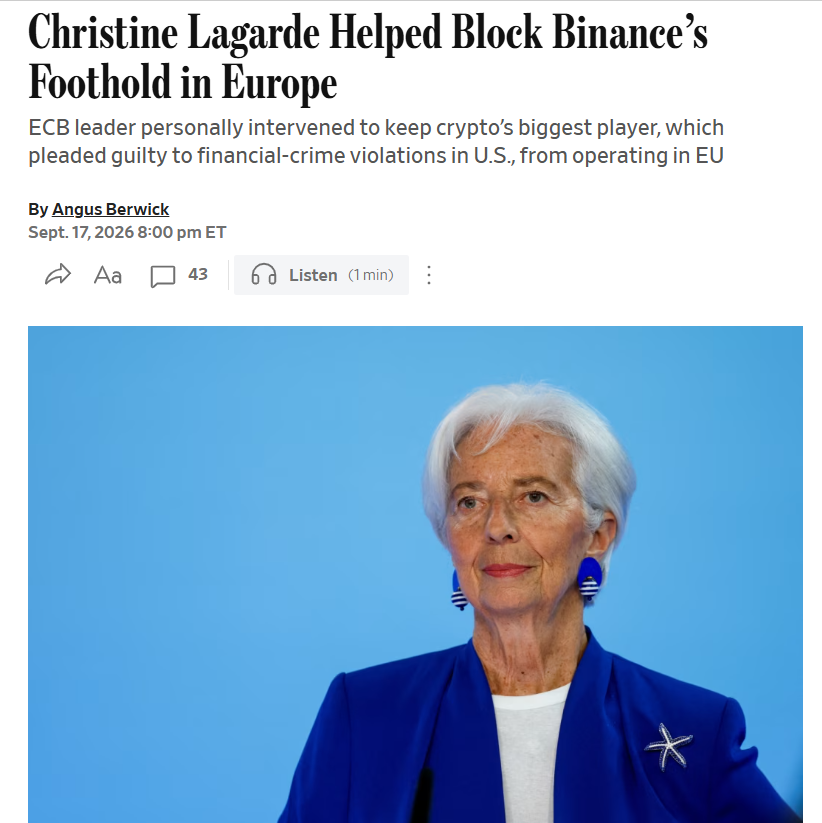
The attempt by Binance to obtain an EU-wide cryptocurrency license through Greece faced an unexpected obstacle. A Wall Street Journal article from September 18 says that Christine Lagarde, the president of the European Central Bank, personally spoke with Greek Prime Minister Kyriakos Mitsotakis and convinced him to reject Binance's application.
Concerns over Binance's US financial crime case and the broader function of dollar-backed stablecoins became part of the dispute, even though Greek officials had apparently considered the application complete. In June, Binance finally withdrew the application before Greece made an official decision.
Binance Was Close to a Greek MiCA Approval
The Greek application was important because, if approved under the EU's Markets in Crypto-Assets (MiCA) framework, Binance could have used the licensing system to offer covered services across the bloc. The Hellenic Capital Market Commission (HCMC) in Greece, with whom Binance had been collaborating, reportedly completed reviewing the application and found it to be compliant with MiCA regulations. Additionally, Binance stated that it was aware that the European Securities and Markets Authority had assessed the application.
The company seemed to believe permission was on the way. According to reports, it had prepared a "Major Milestone" announcement, and CEO Richard Teng planned to show up in Athens. Before the Greek regulator concluded, that proposal was changed.
Binance withdrew the application on June 24 and stated that it will seek a license in another EU member state. The withdrawal was confirmed by Binance's own June 29 announcement, which also stated that the company was still dedicated to getting MiCA authorisation in other parts of the bloc.
Why Lagarde Reportedly Raised Concerns
According to the Wall Street Journal, Lagarde's reported criticism stems from two primary issues.
One was Binance's US regulatory background. In 2023, Binance agreed to a settlement for over $4 billion after entering a guilty plea to US violations related to anti-money-laundering, money transmission, and sanctions rules. It is said that this background influenced concerns about the exchange's growth into Europe.
The other problem was stablecoins denominated in dollars. In particular, Lagarde has spoken about the potential for digital dollarisation to erode monetary sovereignty as the usage of foreign-currency stablecoins in Europe grows. Although the WSJ article does not prove that Binance's license will directly affect the ECB's efforts to create a digital euro, the concern coexists with those initiatives.
ECB Does Not Grant MiCA Licenses
The ECB does not explicitly grant MiCA licenses to crypto-asset service providers, which is a major point in the story.
Under the current system, national competent agencies make licensing decisions. Greece's HCMC was that authority in this case. As a result, Lagarde's apparent position falls outside of the official licensing system outlined by MiCA. The supposed participation has not been publicly verified by Lagarde, the ECB, or Greek authorities.
The incident has also coincided with a larger European discussion over whether or not the biggest crypto companies should eventually be subject to more centralised oversight. One suggestion being discussed would give ESMA a more direct role, rather than letting national regulators make key licensing decisions.
Binance Still Plans to Pursue Europe
The failure in Greece does not imply that Binance has given up on its goals in Europe. The exchange stated that it planned to apply for authorisation in another EU member state after withdrawing its application.
Although Binance has not disclosed a substitute MiCA authorisation there, France has been identified as a potential route. The business maintains that it wants to operate within the European regulatory system.
Whether the supposed Lagarde participation was crucial in the Greek issue is currently the main unresolved topic. The Wall Street Journal is the source of the story, which the relevant institutions continue to challenge or reject. Binance reiterated that it is still dedicated to obtaining MiCA accreditation in Europe and that its Greek application passed the necessary regulatory evaluation.
If you find any issues in this article or notice missing information, please feel free to reach out at team@etherworld.co for clarifications or updates.
To promote your Web3 articles, events, and projects, you may reach out anytime via EtherWorld PR for submissions and collaboration.
Related Articles
- Vitalik Buterin on Adversarial Governance & AI Safety
- SEBI Launches Demat 2.0 for Tokenised Corporate Bonds
- $7.73M rsETH Lost in Ethereum Safe Exploit
- ZKsync Open-Sources Prividium Engine for Institutions
- Osmosis Freezes $1.79M After nBTC Exploit
To follow blockchain news, track Ethereum protocol progress, and read our latest stories, subscribe to our weekly today.
Join the EtherWorld & Avarch Internship Program and build your career in blockchain, content, social media, video, podcast editing, or operations. Send your resume and brief introduction to contact@etherworld.co.
Disclaimer: The information contained in this website is for general informational purposes only. The content provided on this website, including articles, blog posts, opinions, & analysis related to blockchain technology & cryptocurrencies, is not intended as financial or investment advice. The website & its content should not be relied upon for making financial decisions. Read full disclaimer & privacy policy.
To stay updated on blockchain news, Ethereum protocol progress, and our latest stories, subscribe to our weekly digest and YouTube channel for ELI5 content.
To promote your Web3 articles, events, project updates, and Press Releases, reach out anytime via EtherWorld PR for submissions and collaboration. For other queries, email contact@etherworld.co.
If you’d like to support our work, share the content and consider donating at avarch.eth.
Join our community on Discord and follow us on Twitter, Facebook, LinkedIn & Instagram.

 ×
×

Author

Nidhi Kumari is a Web3 content writer at EtherWorld.co, tracking ecosystem developments, funding activity, and market trends shaping the crypto space.