Top ENS Contributor Exits Amid Governance Rift
Brantly Milligan steps away from ENS as EthID and related projects wind down, following major DAO governance disputes over Security Council renewal and Foundation authority.
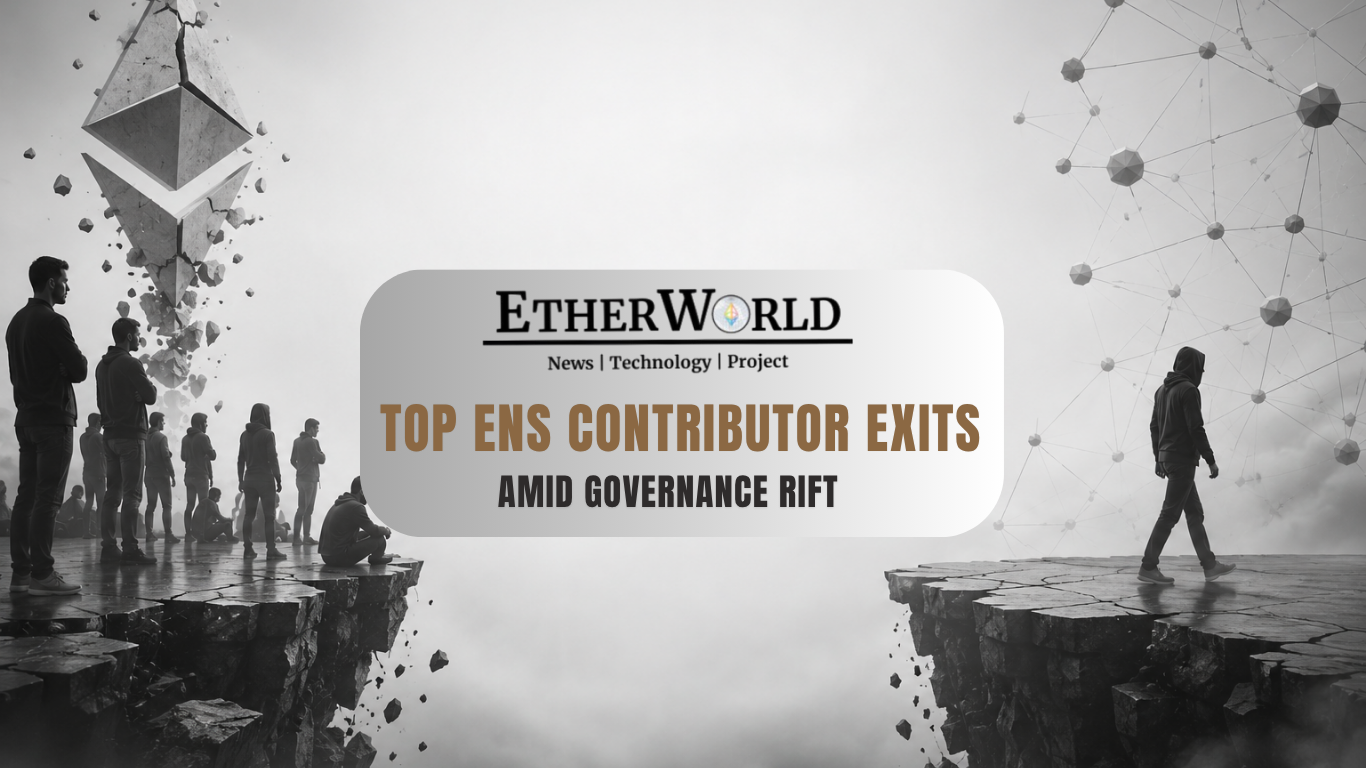
Brantly Milligan, one of the most visible and long-time contributors in the Ethereum Name Service (ENS) ecosystem, has announced that he is moving on from ENS. In a post on X, Milligan said that “the .eth comes off,” describing the decision as the end of a chapter for him. He cited “recent events and other reasons” behind the move, while also confirming that EthID and several related ecosystem projects would begin winding down over the coming weeks.
The announcement comes at a sensitive moment for ENS governance. In recent days, ENS DAO voters rejected the renewal of the DAO’s Security Council in a whale-driven vote, raising fresh concerns about governance capture, accountability, and tokenholder concentration. Soon after, ENS DAO also began considering a major governance restructuring proposal that would give the ENS Foundation greater authority over operations, treasury management, grants, and long-term capital allocation.
- Brantly Milligan Leaves ENS After “Recent Events”
- EthID, Grails Market & ENS Tools to Wind Down
- Security Council Vote Exposed DAO Governance Risks
- ENS Foundation Proposal Could Reshape the DAO’s Future
Brantly Milligan Leaves ENS After “Recent Events”
Milligan’s announcement was direct and emotional. He said he had decided to move on from ENS, adding that he was grateful for his time with the project and wished everyone well going forward. The removal of “.eth” from his identity was framed as a symbolic break from a community where he had been deeply involved for years.
His post did not describe one single reason for the exit. Instead, he referred broadly to recent events and other reasons. However, the timing makes the announcement difficult to separate from the ongoing ENS governance dispute. The DAO has recently been dealing with two major questions: whether its Security Council should continue, and whether more authority should be transferred to the ENS Foundation.
ENS has always occupied a unique position in Ethereum. It makes blockchain addresses human-readable and gives users a portable identity across the ecosystem. EtherWorld previously covered ENS’s growth in ENS celebrates 5th anniversary with a million registered .eth addresses, where ENS was described as a DNS-like system for Web3 that allows users to replace long wallet addresses with simple names.
That simplicity is what made ENS so powerful. But the current moment shows that governance around identity infrastructure can become complex. When a protocol becomes deeply embedded across Ethereum, disagreements over authority, voting power, and institutional structure become more consequential.
This is also why ENS is often discussed alongside Ethereum’s broader identity stack. EtherWorld previously covered this relationship in ERC-4361 Finalized: What Sign-In with Ethereum Means for Ethereum, where Sign-In with Ethereum was presented as a major step toward wallet-based authentication and self-custodial identity. ENS sits naturally inside that identity layer, making names, profiles, and addresses easier to use.
EthID, Grails Market & ENS Tools to Wind Down
Milligan also confirmed that EthID would be wound down. He said he and his teammates are now open to new opportunities, while publicly praising team members and encouraging others to hire them. The announcement also mentioned projects such as Grails Market, ENS Market Bot, EFP, and other related tools.
According to Milligan, most of these projects will sunset over the next few weeks, although the code will remain open source. This is an important detail. While the services may stop operating in their current form, open-source code allows other builders to fork, maintain, or revive parts of the infrastructure if the community sees value in them.
For ENS users, this could still create short-term disruption. Community tools often serve important roles that are not always obvious until they disappear. Market bots, identity tools, dashboards, and discovery interfaces help users understand activity around names, registrations, ownership, and secondary markets.
The winding down of these projects also highlights a larger issue in Ethereum public goods: many useful tools depend on small teams, individual contributors, or community grants. When those teams leave, the ecosystem may retain the code but lose the human maintenance layer behind it.
EtherWorld recently discussed similar questions around long-term Ethereum infrastructure funding in Ethereum Foundation Completes Five-Year Argot Funding Deal, where support for Solidity and developer infrastructure was tied to independent governance and sustainable funding. ENS now faces a related challenge at the application and identity layer: how to keep valuable public tools alive without depending too heavily on a few individuals.
The issue also connects with broader Web3 usability. In Uniswap Founder Pays $29K to Reclaim ENS, EtherWorld covered how a missed ENS renewal created a costly and public example of the gap between decentralized ownership and user-friendly systems. ENS tools and reminders are not just convenience features; they help users avoid expensive mistakes.
the .eth comes off, the end of a chapter for me
— brantly (@BrantlyMillegan) July 3, 2026
I have decided to move on from ENS, given recent events and other reasons. I'm grateful for my time with ENS and I wish everyone well going forward
This includes winding down @ethidorg. I and my incredible teammates are open to…
Security Council Vote Exposed DAO Governance Risks
The immediate governance backdrop is the DAO’s rejection of the Security Council renewal. As EtherWorld reported in ENS DAO Voters Reject Security Council Renewal in Whale-Driven Vote, ENS tokenholders voted against renewing the council, with the final outcome shaped heavily by large voting power.
The Security Council was intended to provide oversight and emergency response capacity. In many DAOs, councils act as safeguards when fast decisions are needed or when governance processes are too slow to respond to urgent risks. However, such councils also raise questions about trust, legitimacy, and the boundary between decentralization and delegation.
The controversy here was not simply that the council failed to renew. The deeper concern was that concentrated token voting could override broader community sentiment. This is one of the oldest problems in token governance: one-token-one-vote systems can become vulnerable when voting power is heavily concentrated among large holders.
That does not automatically mean every whale vote is bad. Large holders may be active, informed, and aligned with protocol success. But when a few votes can decide major governance outcomes, smaller participants may feel that the DAO’s democratic process is weaker than it appears.
Ethereum has been dealing with similar governance questions at many levels. EtherWorld has covered the Ethereum Foundation’s evolving role in Ethereum Foundation Reveals Its New Playbook for Ethereum's Future, where EF positioned itself as a steward of Ethereum’s defensive priorities, including privacy, censorship resistance, anti-MEV infrastructure, and self-sovereignty.
That debate is relevant because ENS now faces its own version of the same tension: how much should be handled by decentralized token voting, and how much should be handled by a more structured foundation with operational responsibility?
ENS Foundation Proposal Could Reshape the DAO’s Future
The second major event is the new proposal to empower the ENS Foundation. As EtherWorld reported in ENS DAO Weighs Major Governance Shift to Empower ENS Foundation, the proposal would move operational, treasury, grants, and long-term capital responsibilities into a stronger foundation structure, while keeping core protocol governance under tokenholder control.
Supporters of this approach may argue that ENS needs better execution, clearer accountability, and a more durable institution to manage resources. A foundation can hire teams, manage budgets, negotiate partnerships, and execute long-term strategy more efficiently than a large DAO vote on every operational matter.
Critics, however, may worry that this reduces the practical power of tokenholders. Even if protocol-level governance remains with the DAO, moving treasury and operational authority to the Foundation could shift the center of gravity away from direct community voting.
This is the key governance trade-off now facing ENS. Too much tokenholder control can lead to slow execution, voter fatigue, whale influence, and unpredictable outcomes. Too much foundation control can lead to centralization concerns, reduced community trust, and weaker DAO participation.
EtherWorld previously covered a similar institutional question in EF President Aya Miyaguchi Outlines New EF Direction, where Ethereum Foundation leadership emphasized that Ethereum has grown beyond any single organization. ENS may now be entering a comparable phase, where the protocol must decide how to balance community control with professional execution.
The timing of Milligan’s departure gives this debate a human dimension. Governance arguments often sound abstract, but they affect teams, contributors, users, and long-time community members. When contributors exit and tools sunset, governance debates become more than forum posts and token votes; they become turning points in the life of an ecosystem.
ENS still remains one of Ethereum’s most important identity protocols. Its role across wallets, apps, and user profiles means the protocol’s governance will continue to matter. But the current moment shows that even mature Ethereum projects must constantly revisit their governance assumptions.
To promote your Web3 articles, events, and projects, you may reach out anytime via EtherWorld PR for submissions and collaboration.
Related Articles
- ENS DAO Voters Reject Security Council Renewal in Whale-Driven Vote
- ENS DAO Weighs Major Governance Shift to Empower ENS Foundation
- ENS celebrates 5th anniversary with a million registered .eth addresses
- ERC-4361 Finalized: What Sign-In with Ethereum Means for Ethereum
- Uniswap Founder Pays $29K to Reclaim ENS
To follow blockchain news, track Ethereum protocol progress, and read our latest stories, subscribe to our weekly today.
Disclaimer: The information contained in this website is for general informational purposes only. The content provided on this website, including articles, blog posts, opinions, & analysis related to blockchain technology & cryptocurrencies, is not intended as financial or investment advice. The website & its content should not be relied upon for making financial decisions. Read full disclaimer & privacy policy.
To stay updated on blockchain news, Ethereum protocol progress, and our latest stories, subscribe to our weekly digest and YouTube channel for ELI5 content.
To promote your Web3 articles, events, project updates, and Press Releases, reach out anytime via EtherWorld PR for submissions and collaboration. For other queries, email contact@etherworld.co.
If you’d like to support our work, share the content and consider donating at avarch.eth.
Join our community on Discord and follow us on Twitter, Facebook, LinkedIn & Instagram.
Author

Yash Kamal Chaturvedi is a Blockchain Content & Ops Specialist at Avarch LLC, writing on Ethereum & governance since 2021. Covers ACD/ACDE calls, EIPs, upgrades, staking, security & ecosystem trends.