Will India Regulate Crypto? What to Expect From Monsoon Session
India’s 2026 Monsoon Session could mark a turning point for crypto, with Parliament considering an interim SRO framework, stronger oversight and clearer investor protections.
India’s 2026 Monsoon Session has opened with the country’s cryptocurrency industry facing an unusual combination of regulatory opportunity and enforcement pressure. On one side, the Parliamentary Standing Committee on Finance has formally acknowledged that India’s current treatment of Virtual Digital Assets, or VDAs, leaves a significant regulatory grey area.
On the other side, enforcement agencies are intensifying investigations into over-the-counter crypto transactions, private token allocations, personal wallets, social-media promotions and alleged investment fraud. A recent Enforcement Directorate investigation in Bengaluru alleged that an OTC token-allocation scheme may have involved approximately $35 million, while searches resulted in the seizure of digital assets amounting to 8,700 USDT.
Crypto’s Regulatory Grey Area Is Now Official
The Standing Committee on Finance’s Thirty-Sixth Report examines the Securities Markets Code, 2025, a proposed law intended to consolidate the SEBI Act, the Securities Contracts Regulation Act and the Depositories Act into a single legislative framework. The Code adopts a technology-neutral definition of securities.
This is important because an asset does not cease to be a security merely because it is issued, recorded or transferred using blockchain technology. Tokenised shares, bonds, investment-scheme units and qualifying derivatives could therefore remain subject to securities regulation.
However, the Committee identified a major gap, i.e., VDAs that do not independently satisfy the legal characteristics of securities or derivatives remain outside the proposed Code. This includes a large part of the cryptocurrency market.
The Committee observed that many VDAs are nevertheless traded like financial assets. They involve investment for financial returns, organised trading platforms, market-based price discovery, speculative activity, leverage and, in some cases, exposure to an underlying asset or index.
EtherWorld previously examined this contradiction when the RBI rejected legal recognition for crypto before the Finance Committee. India taxes VDA income and monitors transactions, but still does not clearly define the legal responsibilities of exchanges, custodians, token promoters and other intermediaries.
India’s Crypto Market Is Too Large to Regulate Only Through Enforcement
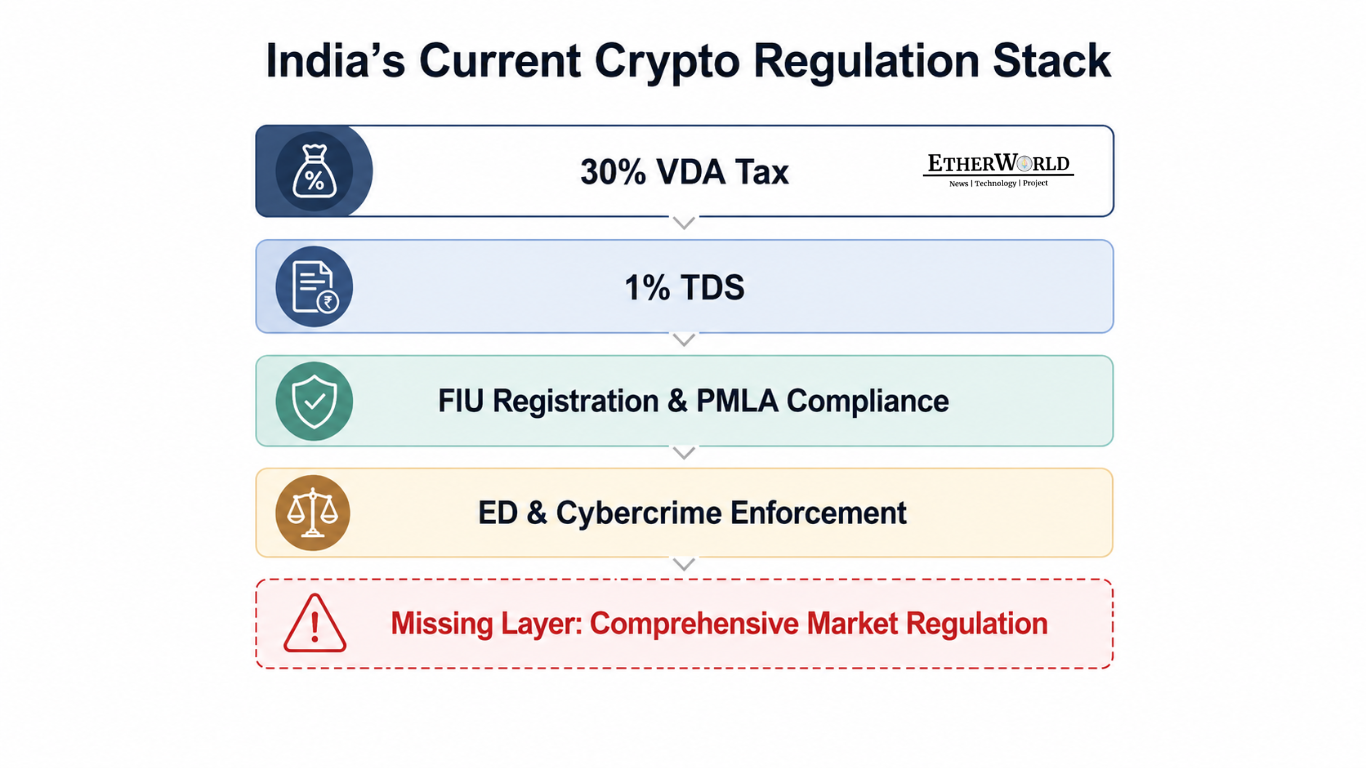
India’s crypto policy is attempting to control a large market without creating a complete market-regulation system. The country imposes a 30% tax on income from VDAs, while a 1% Tax Deducted at Source applies to many qualifying transfers. Losses from one VDA generally cannot be offset against gains from another under the specialised tax framework.
Budget 2026 did not deliver the relief the industry had requested, continuing the hard-line tax position covered in No Tax Relief for Crypto in India’s Budget 2026. At the same time, VDA service providers operating in India are expected to register with the Financial Intelligence Unit and comply with anti-money-laundering obligations. These include customer verification, suspicious-transaction reporting and record retention.
The problem is that tax and AML compliance address only limited parts of the market. India’s market has continued expanding despite this uncertainty. Coinbase’s leadership recently described India as one of crypto’s largest opportunities, a development discussed in India Is Crypto’s Largest Market, Says Coinbase CEO.
International exchanges are also rebuilding INR infrastructure. Coinbase has introduced BTC-INR trading support and USDC-INR trading, demonstrating that compliant access to Indian liquidity remains commercially valuable. However, participation does not necessarily equal protection.
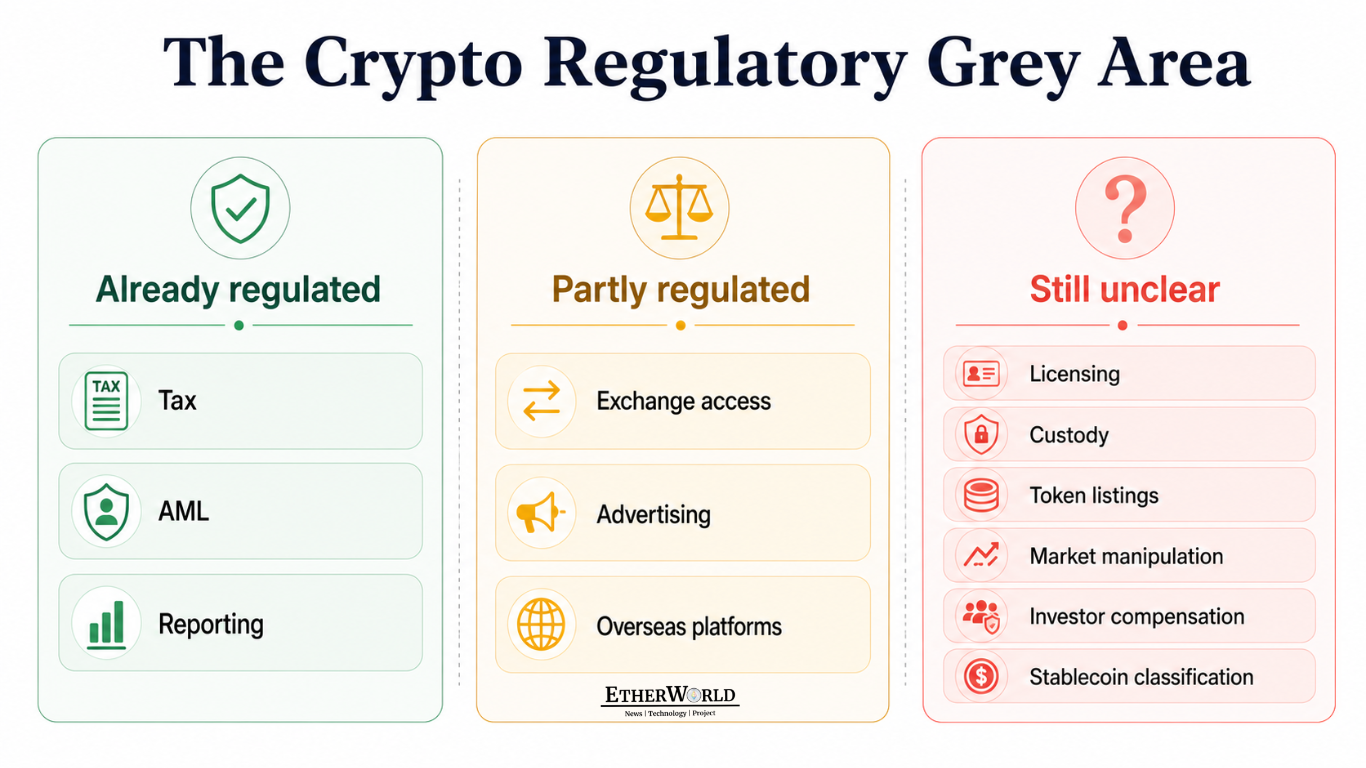
FIU registration is primarily an AML requirement. It should not automatically be interpreted as a government guarantee of solvency, cybersecurity, custody quality, liquidity or customer-asset recovery. EtherWorld’s analysis, After CoinDCX: Where Should Indian Crypto Users Actually Trade?, similarly argued that users must evaluate proof of reserves, cold-storage arrangements, insurance, transparency and operational controls.
What an Interim Crypto SRO Could Actually Change
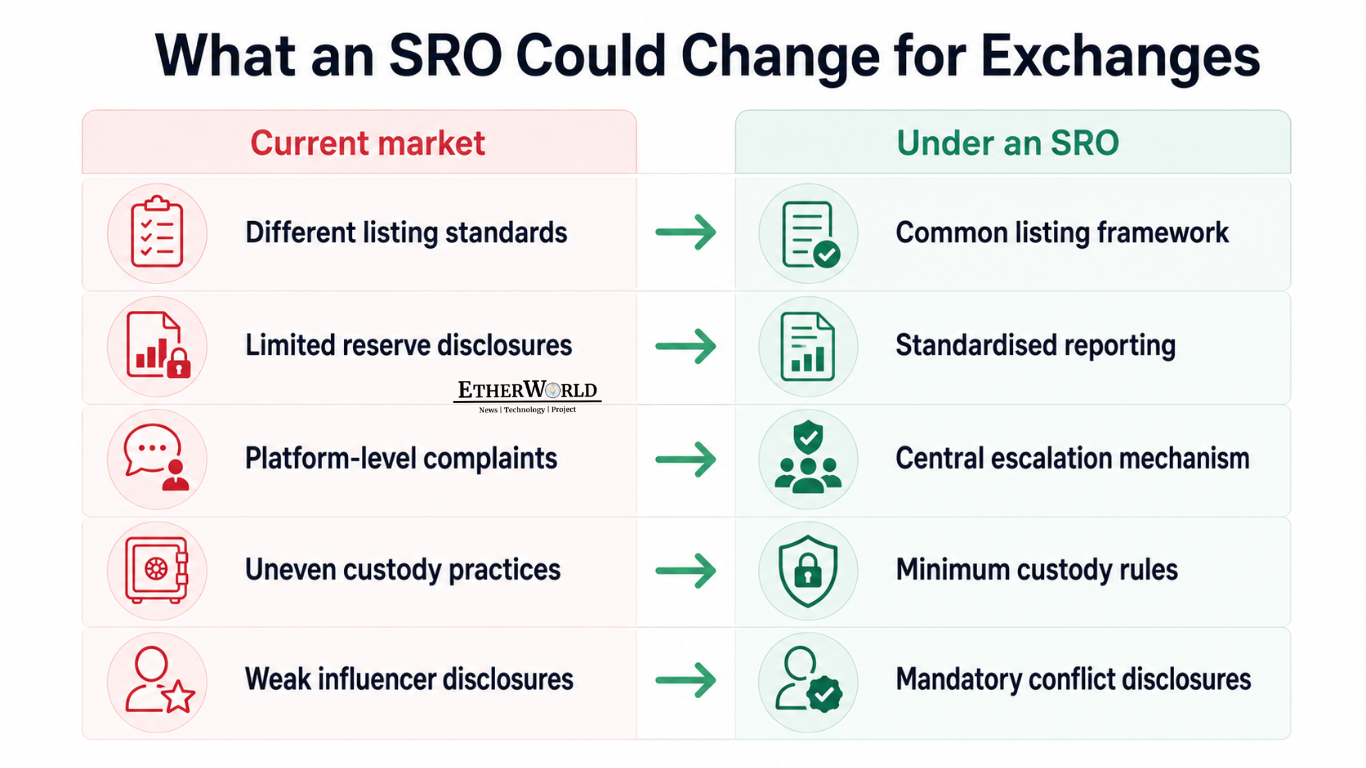
A Self-Regulatory Organisation is sometimes misunderstood as an industry association that merely publishes voluntary guidelines. The framework envisioned by the Committee would need to be substantially stronger. A recognised crypto SRO would operate under the oversight of a designated public regulator.
Its rules could be approved by the regulator, and member entities could be required to comply with common standards as a condition for continuing to serve Indian customers. The Committee specifically identifies minimum standards involving governance, transparency, disclosure, investor protection, grievance redressal, codes of conduct and regulatory oversight.
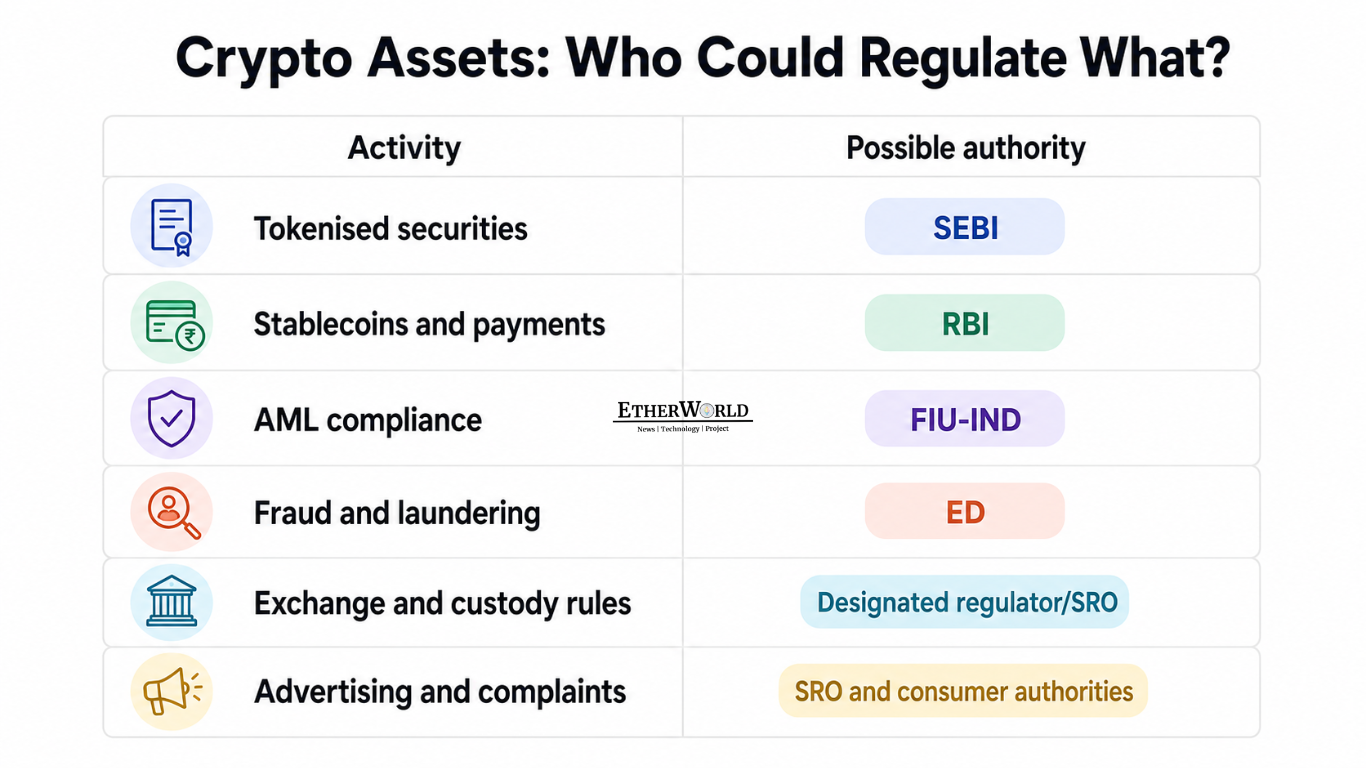
The difficult question is which regulator would supervise the SRO. SEBI is a logical candidate for tokenised securities, investment schemes and products resembling derivatives. The FIU already supervises AML compliance. The RBI remains concerned with stablecoins, payments, capital flows and monetary sovereignty.
This is also consistent with India’s growing interest in tokenisation. The Asset Tokenisation Regulation Bill, 2026 seeks a separate framework for blockchain-based representations of real-world assets, while Maharashtra’s DELTA Act could create a state-level pathway for blockchain-based property systems.
The $35 Million OTC Case Shows Where Regulation May Tighten First
The Enforcement Directorate’s July investigation in Bengaluru demonstrates why private and OTC crypto markets are likely to face the earliest regulatory tightening. According to the ED’s press release, the investigation originated from a complaint filed by a Dutch entity concerning alleged OTC transactions in multiple VDAs. The agency named tokens including MultiversX, Kava, BEAM, GRASS, SUI, VANA and AGLD.
Investigators alleged that the accused presented themselves as influential figures within the crypto industry and promoted access to discounted private token allocations.
The alleged model followed a familiar confidence-building sequence:
- Investors were offered access to discounted or private token allocations.
- Smaller transactions were initially fulfilled.
- Successful early deliveries were used to build trust.
- Investors were encouraged to commit substantially larger amounts.
- Token delivery allegedly stopped when market conditions changed.
- Funds were allegedly transferred through wallets for personal and business purposes.
BREAKING: 🇮🇳 ED uncovers $35 million OTC crypto investment scam, seizes 8,700 USDT during raids. pic.twitter.com/NyHYAllPtJ
— Crypto India (@CryptooIndia) July 21, 2026
The ED said searches conducted on July 18 and 19 resulted in the recovery of incriminating digital evidence and the seizure of 8,700 USDT. The agency estimated the wider value of the alleged scheme at approximately $35 million, compared with approximately $10 million mentioned in the original complaint.
This case overlaps directly with the FIU’s increased interest in high-value OTC activity. EtherWorld previously reported that the FIU sought information on crypto OTC trades above $10,000, including beneficial ownership and transaction records.
India’s concern is not that every OTC transaction is illegal. OTC markets are commonly used by high-net-worth investors, institutions and businesses that need to execute large transactions without causing major price movements on public order books. The risk arises when OTC activity occurs through personal wallets, unverifiable intermediaries, informal messaging groups and claims of privileged token access.
Recent cases show a broader enforcement pattern. In India’s ED Exposes ₹285 Crore Crypto Driven Scam, alleged fraud networks used Telegram, WhatsApp and other communication channels to attract users with promises of commissions and investment returns.
Another investigation covered in India’s ED Raids 19 Locations, Seizes ₹3.35 Crore in Crypto involved multiple wallets, bank accounts and suspected laundering activity. These cases demonstrate the limitations of enforcement-only regulation. The Prevention of Money Laundering Act can help identify, freeze or seize suspected proceeds of crime after an offence has occurred.
An interim SRO could require member exchanges to flag or restrict transfers connected with unregistered brokers, maintain records of institutional OTC desks, identify beneficial owners and provide warnings when customers transfer funds to personal wallets associated with investment promotions.
What Parliament Could and Probably Will Not Deliver This Session
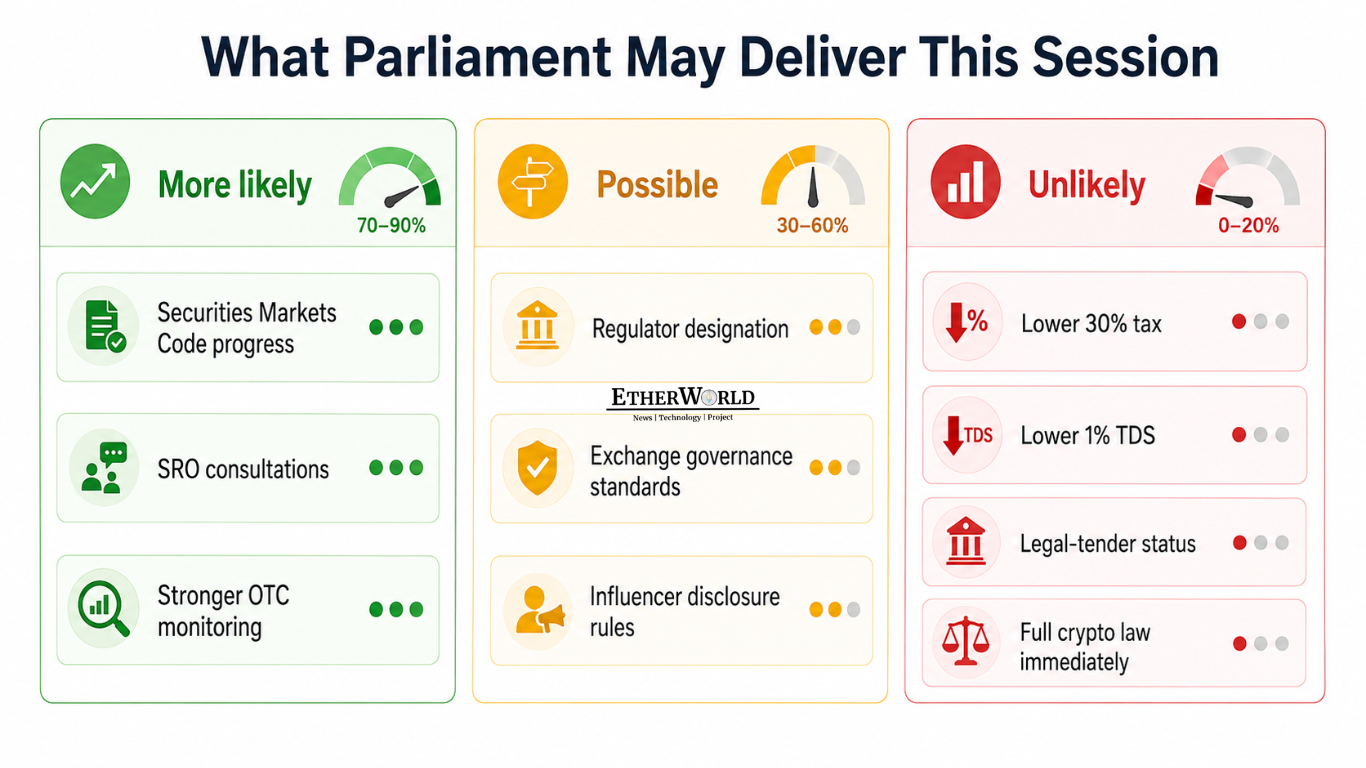
First, Parliament could advance the Securities Markets Code. Its technology-neutral framework would strengthen the regulation of securities, including securities represented on blockchain infrastructure.
Second, the government could accept the SRO proposal in principle. This may lead to stakeholder consultations involving exchanges, the FIU, SEBI, RBI, industry associations, legal experts and consumer-protection bodies.
Third, regulators could strengthen OTC and influencer-related compliance. The combination of the Finance Committee report, FIU data requests and ED cases provides a strong basis for tighter record-keeping and disclosure rules.
Fourth, the government could begin separating VDA categories. Bitcoin-like assets, stablecoins, tokenised securities, utility tokens, NFTs and investment schemes present different risks. A single definition may not be sufficient.
A reduction in the 30% VDA tax or the 1% TDS appears unlikely to emerge directly from the Securities Markets Code debate. The Committee’s recommendation concerns market governance and investor protection, not tax reform. Legal-tender status is also highly unlikely. The RBI has repeatedly raised concerns about privately issued cryptocurrencies, monetary sovereignty, financial stability and capital flows.
BREAKING: 🇮🇳 India's Parliamentary Finance Committee recommends an interim crypto regulatory framework through Self-Regulatory Organisations (SROs) instead of waiting for a comprehensive law.
— Crypto India (@CryptooIndia) July 23, 2026
Key points:
• Recommends industry-led SROs under the oversight of a designated…
A fully operational licensing regime is unlikely to appear immediately. The government would need to determine regulatory jurisdiction, define covered entities, establish transition periods and decide how to treat offshore platforms. A comprehensive stablecoin law is also unlikely in the immediate session, although stablecoin liquidity is becoming impossible to ignore. In June, India’s USDT premium reportedly exceeded 8.5%, with USDT trading around ₹102.88 against an official USD-INR rate near ₹94.65.
EtherWorld examined this dislocation in India USDT Premium Jumps Above 8.5% and later analysed how currency-market intervention could influence domestic stablecoin pricing in RBI Defends Rupee: Will India’s Stablecoin Premium Rise?. These premiums show that crypto regulation is also becoming a liquidity and foreign-currency issue—not merely a question of speculative trading.
The Most Likely Outcome for India’s Crypto Industry
The most likely outcome of the Monsoon Session is neither a crypto ban nor full legal clarity. India appears to be moving towards a layered transition.
- The first layer is already in place, i.e., taxation, FIU registration, PMLA compliance, TDS reporting and enforcement against suspected fraud or laundering.
- The second layer could emerge through an interim SRO. This would introduce baseline standards for exchanges and other intermediaries without requiring Parliament to immediately resolve every question involving decentralised finance, stablecoins, offshore platforms and token classification.
- The third layer would be a comprehensive VDA law built after inter-regulatory consultation.
The Parliamentary Standing Committee on Finance has released its report on the Securities Markets Code, 2025. It has a lot of good developments for the future of Indian crypto.
— Sumit Gupta (CoinDCX) (@smtgpt) July 24, 2026
Recognizing that comprehensive legislation takes time, they have recommended an incredibly pragmatic… pic.twitter.com/vckCGjpq0g
For exchanges, this transition would bring higher compliance costs but greater legitimacy. Platforms may need to strengthen reserves reporting, custody controls, listing reviews, surveillance, customer-support processes and disclosures.
For investors, it could create a clearer distinction between supervised intermediaries and informal operators. However, SRO membership would not eliminate market risk, guarantee returns or protect users who send assets to private wallets controlled by unknown promoters.
For OTC desks and influencers, the direction is more uncomfortable. Private token-allocation claims, referral networks, undisclosed compensation and high-value wallet transfers are likely to face increased monitoring.
For Web3 builders, the outcome could be constructive if India distinguishes open blockchain development from unregulated financial intermediation. A developer building decentralised infrastructure should not automatically be regulated like an exchange taking custody of customer funds.
The broader policy choice was explored in EtherWorld’s data-driven analysis, What Happens If India Bans Crypto?. A ban would not necessarily eliminate activity; it could push users towards offshore platforms, peer-to-peer markets and informal networks with even less regulatory visibility.
To promote your Web3 articles, events, and projects, you may reach out anytime via EtherWorld PR for submissions and collaboration.
Related Articles
- India Intensifies Crypto Oversight as ED Freezes ₹4,190 Crore and Sends 44,057 Tax Notices
- India’s RBI Rejects Crypto Legal Status Before Finance Panel
- Parliament Finance Panel to Meet RBI Over Crypto Regulations
- India Needs Clear Crypto Rules, Says GNLU Report
- What Happens If India Bans Crypto?
To follow blockchain news, track Ethereum protocol progress, and read our latest stories, subscribe to our weekly today.
Join the EtherWorld & Avarch Internship Program and build your career in blockchain, content, social media, video, podcast editing, or operations. Send your resume and brief introduction to contact@etherworld.co.
Disclaimer: The information contained in this website is for general informational purposes only. The content provided on this website, including articles, blog posts, opinions, & analysis related to blockchain technology & cryptocurrencies, is not intended as financial or investment advice. The website & its content should not be relied upon for making financial decisions. Read full disclaimer & privacy policy.
To stay updated on blockchain news, Ethereum protocol progress, and our latest stories, subscribe to our weekly digest and YouTube channel for ELI5 content.
To promote your Web3 articles, events, project updates, and Press Releases, reach out anytime via EtherWorld PR for submissions and collaboration. For other queries, email contact@etherworld.co.
If you’d like to support our work, share the content and consider donating at avarch.eth.
Join our community on Discord and follow us on Twitter, Facebook, LinkedIn & Instagram.

 ×
×

Author

Yash Kamal Chaturvedi is a Blockchain Content & Ops Specialist at Avarch LLC, writing on Ethereum & governance since 2021. Covers ACD/ACDE calls, EIPs, upgrades, staking, security & ecosystem trends.