Coinbase Wants Employees to Build AI Models Without Writing Code
Coinbase is using fine tuned Qwen3.5 9B to improve fraud detection, cut AI latency and costs, and explore how employees could build specialized AI systems.

Brian Armstrong, CEO of Coinbase, has said that companies can use AI differently. After improving Qwen3.5 9B on private data for fraud prevention, the company found that the specialised model performed better on the task, at lower cost and with faster replies, than the top general-purpose models.
Armstrong added that Coinbase is making it simpler for staff members to fine-tune internally. The more important question is whether businesses will start developing their own AI systems rather than buying all of its capabilities from outside suppliers.
Coinbase's Experiment: Building AI Without Starting From Scratch
Coinbase is not developing an AI model from the bottom up. It is using its own fraud data to adapt an existing open-weight model, Qwen3.5 9B, to a specific business issue. This distinction is important since most organisations cannot afford the resources needed to train a foundation model from scratch. They can more effectively modify an existing model to fit their needs by fine-tuning it.
Coinbase described how it created, assessed, and post-trained an AI agent for fraud detection on its Onramp service in its three-part Owning Intelligence series. In addition to an existing machine learning model and rules, the system examines transaction context. When compared to the current system alone, the addition of the agent decreased fraudulent transactions by 30% and fraud value by 22% in an online experiment.
After that, the company compared several frontier models to their own fraud benchmark. Its conclusions demonstrated that more recent models did not always yield superior outcomes for this specific task. This prompted Coinbase to investigate whether it could use outcome-based training and proprietary transaction data to enhance a smaller open-weight model.
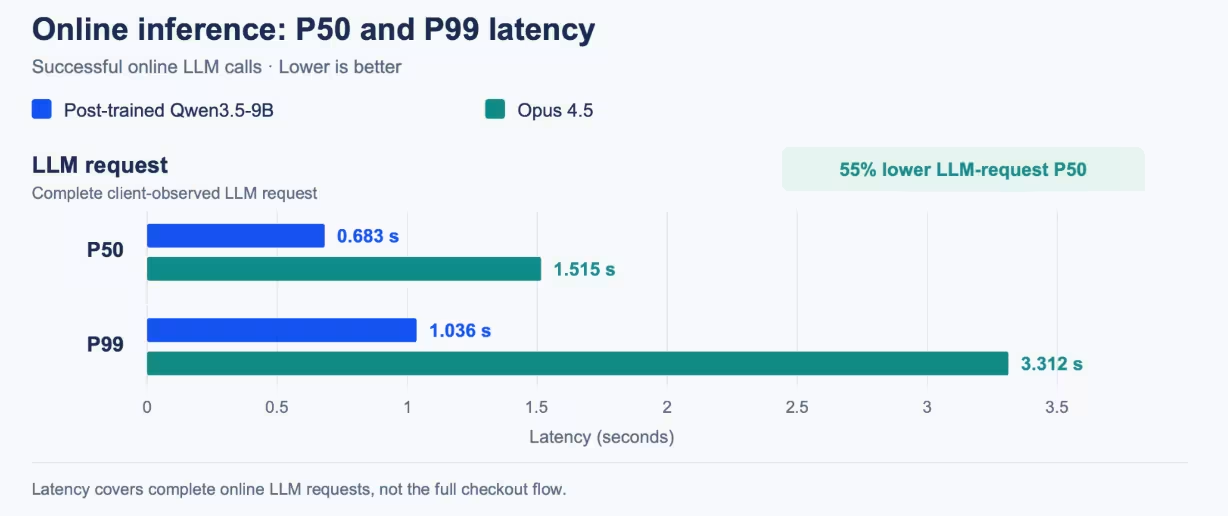
According to Coinbase, their post-trained Qwen model scored better than Claude Opus 4.5 in all four fraud detection measures it assessed, including an improvement in F1 score of 9.6%. Additionally, the company observed a 55% reduction in production serving end-to-end inference latency.
These findings do not prove that smaller models are superior in every way. They demonstrate how a business might occasionally obtain greater value by tailoring a model to a specific activity rather than continuously upgrading to a more potent general-purpose system.
When AI Starts Doing the Developer's Job
Armstrong's remarks go beyond preventing fraud. According to him, Coinbase has established a specialised talent in its internal development environment and is facilitating internal model fine-tuning for staff members. Instead of requiring employees to do each technical step on their own, an employee can ask to refine and serve a model for a task like payments risk evaluation.
This strategy might alter the process of developing internal software. These days, an employee who comprehends a commercial issue can require technical assistance to transform it into a useful product. An employee might assist with training data preparation, model specialisation, testing, and deployment with less hands-on engineering effort in a well-designed AI development environment.
The crucial distinction is between eliminating the need for developers and simplifying development. Decisions about data quality, system architecture, security, testing, and production reliability cannot be replaced by a simple interface. When real money, client accounts, or sensitive information are involved, someone still needs to make sure the model operates appropriately.
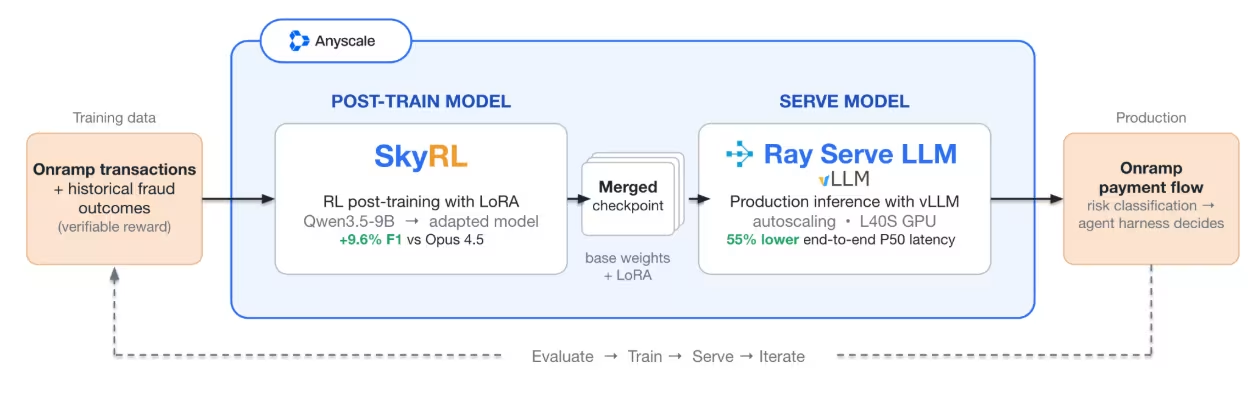
Instead, the developer's job may shift to developing the frameworks that enable other staff members to securely produce practical AI applications. This comprises deployment infrastructure, evaluation tools, reusable training routines, and controls that stop a model from acting outside of its designated purpose.
These boundaries are important, as shown by Coinbase's fraud agent. The application code implements the decision policy, and the model generates a risk classification. The model does not carry out payment actions on its own. Giving AI complete control over corporate operations is not necessary to make it more user-friendly.
We were able to fine tune an open weight model (Qwen3.5-9B) on proprietary internal data at @coinbase, and it out performed frontier models, at much lower cost and speed, for a specialized task (fraud prevention in this case).
I think we'll see more of this pattern inside companies. The frontier models are amazing generalists. But increasingly you'll see specialist models out perform on more narrow tasks, either working on teams, or by themselves.
We're making it easy to fine tune models internally for our employees. We even have a skill for it in our internal harness that makes it easy to spin these up and start training them:
"/fine-tune-and-serve-llm I want to fine-tune Qwen for payments risk review. help me get started"
I imagine we'll have some backend services that could be replaced entirely by this new architecture.
— Brian Armstrong (@brian_armstrong) October 11, 2026
Why Build With Expensive AI When Smaller Models Can Do the Job?
Frontier models are still useful since they don't require a lot of expertise to do a wide range of jobs. However, companies don't necessarily require that depth. A fraud review system has a clear role, access to relevant transaction background, and quantifiable results that can be used to evaluate its choices.
Purchasing a general-purpose model might not be the best option for these kinds of activities. According to Coinbase, the median end-to-end inference latency for its post-trained Qwen model was 0.683 seconds, while Opus 4.5's was 1.515 seconds. The latency at the 99th percentile was 1.036 seconds, as opposed to 3.312 seconds.
In addition, the training cost was low compared to the building of huge models. According to Coinbase, it post-trained Qwen3.5 9B with a single NVIDIA RTX PRO 6000 GPU, and the Anyscale training workload cost less than $100. This was not the expense of creating a whole foundation model or continuously running a production system; rather, it was a specific training experiment.
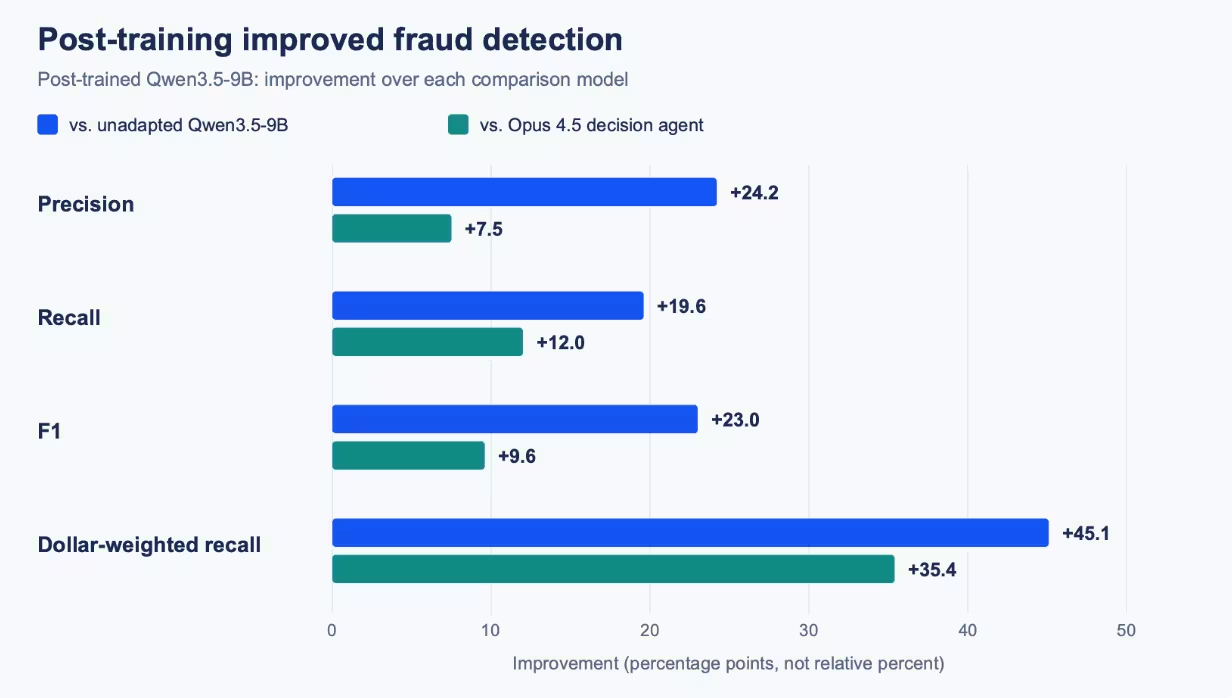
A cost-effective model is not the only basis for the business case. While improved fraud detection can stop financial losses, quicker reactions can also cut down on transaction review delays. According to Coinbase's announced benchmark findings, specialisation can enhance the effectiveness and quality of a certain AI application.
Companies shouldn't, however, believe that careful tuning will always outperform a commercial model. The task, the evaluation approach, the accessible data, and the system maintenance costs all affect the result. A model that works effectively today needs to be continuously tested and retrained since fraud patterns change.
This presents a distinct competitive issue for AI vendors. Selling access to increasingly powerful general-purpose models might continue to be profitable, but clients would use specialised open-weight systems for routine, high-volume work and save those models for challenging jobs. Instead of competing just on raw capabilities, the market may increasingly reward suppliers for creating models that are flexible, effective, and simple to use.
Are We Moving Toward Companies That Build Their Own AI Workforce?
According to Armstrong, this strategy may eventually replace some backend services. Businesses frequently rely on specialised software for judgments that are specific, repetitive, and strongly related to internal data; thus that possibility deserves attention. An organisation may have less need to rely on a distinct external service for each function if it can modify and run a model that successfully completes one of these tasks.
This does not imply that software stacks will be abruptly replaced by AI agents. Existing services frequently offer crucial assurances regarding uptime, audit trails, permissions, and predictable behaviour. It takes more than just a good model benchmark to replace them; there must be proof that the new system can satisfy those requirements.
The question of who owns the resulting technology is another. Companies have greater flexibility to modify model parameters and select the location of inference with open-weight models. Additionally, critical transaction context can be kept out of external model APIs by self-hosting. However, the company takes on more responsibility for infrastructure, updates, security, and monitoring.
Enterprise software firms and developers may be impacted differently by the move. Developers might devote more time to building evaluation systems, integrating models, and managing their behaviour rather than implementing routine components. When their products carry out operations that clients may replicate internally using a specialised model, software companies may come under pressure.
However, companies that lack robust data, technological expertise, or the ability to maintain models will still require outside suppliers. Having access to an open-weight model won't be the only benefit. It will emerge from integrating practical proprietary data with a well-defined task, reliable evaluation, and the capacity to execute the outcome in production.
Coinbase's experiment provides a useful example of that strategy. Its model was deployed through a serving system intended for production traffic after being trained for a particular fraud detection decision and evaluated against confirmed results. By making those tools available to more workers, the organisation may be able to address more internal issues without needing a separate engineering effort for each one.
If you find any issues in this article or notice missing information, please feel free to reach out at team@etherworld.co for clarifications or updates.
To promote your Web3 articles, events, and projects, you may reach out anytime via EtherWorld PR for submissions and collaboration.
Related Articles
- Coinbase’s New Perps Put the S&P 500 on 24/7 Trade
- Coinbase Wins $150K SEC Settlement Over Missing Gensler Texts
- India Is Crypto’s Largest Market, Says Coinbase CEO
- Coinbase AI Coding Hits 100% as Base Leadership Shifts
- Coinbase Chief Legal Officer Paul Grewal Steps Down After Six Years
To follow blockchain news, track Ethereum protocol progress, and read our latest stories, subscribe to our weekly today.
Join the EtherWorld & Avarch Internship Program and build your career in blockchain, content, social media, video, podcast editing, or operations. Send your resume and brief introduction to contact@etherworld.co.
Disclaimer: The information contained in this website is for general informational purposes only. The content provided on this website, including articles, blog posts, opinions, & analysis related to blockchain technology & cryptocurrencies, is not intended as financial or investment advice. The website & its content should not be relied upon for making financial decisions. Read full disclaimer & privacy policy.
To stay updated on blockchain news, Ethereum protocol progress, and our latest stories, subscribe to our weekly digest and YouTube channel for ELI5 content.
To promote your Web3 articles, events, project updates, and Press Releases, reach out anytime via EtherWorld PR for submissions and collaboration. For other queries, email contact@etherworld.co.
If you’d like to support our work, share the content and consider donating at avarch.eth.
Join our community on Discord and follow us on Twitter, Facebook, LinkedIn & Instagram.

 ×
×

Author

Nidhi Kumari is a Web3 content writer at EtherWorld.co, tracking ecosystem developments, funding activity, and market trends shaping the crypto space.