Gnosis Chain Activates Ethereum Fast Confirmation Rule
Gnosis Chain activates Ethereum Fast Confirmation Rule on xDAI Bridge and Omnibridge, cutting deposit confirmation times to 12 seconds with a finality fallback.

Ethereum's Fast Confirmation Rule has been activated on Gnosis Chain's xDAI Bridge and Omnibridge, cutting the wait time for Ethereum deposits to about 12 to 13 seconds. In earlier days, users had to wait for Ethereum to reach complete finality, which usually takes 13 minutes.
With the change, bridge validators can respond to earlier confirmation signals while maintaining a backup to normal finality in the event of a network outage. Additionally, the change supports Gnosis Chain's more comprehensive goals for deeper Ethereum integration.
Gnosis Chain Introduces Faster Ethereum Bridge Confirmations
On October 8, 2026, Gnosis Chain announced that its xDAI Bridge and Omnibridge were the first production systems to use Ethereum's Fast Confirmation Rule on the Ethereum mainnet.
The change addresses a specific delay in transferring assets from Ethereum to Gnosis Chain. In earlier days, bridge validators executed transfers only after Ethereum transactions were fully finalised. Once the source block has adequate validator support and passes the necessary confirmation checks, FCR can take action.
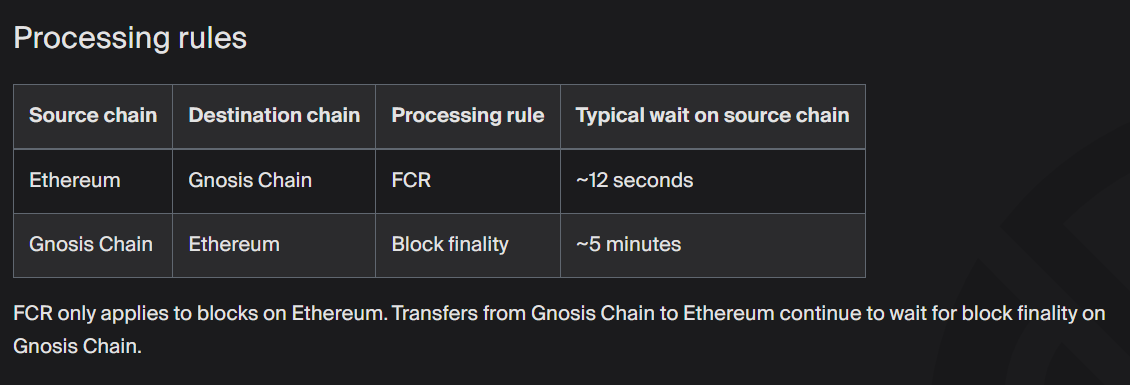
As a result, the average confirmation wait is shortened from roughly 13 minutes to one Ethereum slot, or 12 to 13 seconds. Existing bridge contracts are unaffected, and users do not need to change their interactions with either bridge.
The improvement applies to transfers originating on Ethereum. Transfers moving in the opposite direction, from Gnosis Chain to Ethereum, continue to depend on Gnosis Chain’s standard block finality.
Gnosis bridges are now the first production system to act on FCR on Ethereum mainnet.
Starting today, the xDAI bridge and Omnibridge use Ethereum's Fast Confirmation Rule (FCR). Deposits from Ethereum are confirmed in about one slot, instead of waiting for finality.
Bridging from Ethereum to Gnosis Chain just got MUCH faster, and it's a big step on Gnosis Chain's path to @etheconomiczone.
Here's why it matters.
— Gnosis Chain (@gnosischain) October 8, 2026
How Ethereum’s Fast Confirmation Rule Works
Every 12 seconds or so, Ethereum generates a new block. A freshly proposed block does not, however, immediately reach complete finality. Finality takes at least 13 minutes under normal circumstances.
FCR determines if a recent Ethereum block has obtained enough robust support to be deemed confirmed using real-time validator attestations. Applications can exploit this earlier confirmation signal rather than waiting for complete finality when the necessary participation and network conditions are satisfied.
The security presumptions are significant. FCR depends on an honest, participatory majority holding at least 75% of Ethereum's total stake and on the timely delivery of validator attestations. A speedy confirmed block is anticipated to reach finality under these circumstances.
Blocks might not get quick confirmation if Ethereum is weak or network synchronisation fails. The Gnosis bridges resort to waiting for normal finality in that case. This implies that instead of moving on automatically based on an unreliable confirmation signal, transfers take longer.
The distinction is important since full finality and speedier confirmation do not offer the same level of security assurance. Instead of doing away with the requirement to control settlement risk, FCR shortens waiting times under certain circumstances.
Validators & Security Remain Central to the Upgrade
Before executing transactions on the Gnosis Chain, bridge validators are in charge of ensuring that Ethereum deposits have attained the necessary confirmation state. They can act on qualifying deposits considerably more quickly when FCR is activated.
Hopr and Kleros, two well-known ecosystem validators who are currently signing transactions under the revised procedure, have been highlighted by Gnosis Chain as participating. Their involvement shows that the change is being implemented within the bridge architecture rather than just being a suggested enhancement.
Additionally, rather than relying solely on third-party RPC providers, the design needs validators to run their own Ethereum nodes in order to determine quick confirmation. It is less likely that a single client defect will result in the bridge accepting an inaccurate confirmation when many consensus client implementations are used.
Additionally, Gnosis Chain offers a special FCR monitor that keeps track of quickly verified and completed blocks. It can identify instances in which rapid confirmation is removed in favour of normal finality or in which a previously confirmed block is substituted. These inspections give insight into the circumstances in which the quicker process functions.
How Faster Bridging Supports the Ethereum Economic Zone
Through the Ethereum Economic Zone, a project aimed at facilitating asset and application interaction between participating networks, Gnosis Chain hopes to strengthen its ties to Ethereum. This upgrade helps achieve this goal.
For users and apps that rely on transferring assets between chains, Ethereum transfers become more responsive as the confirmation wait is reduced. Additionally, it can assist developers in creating workflows that need deposits to be confirmed more quickly before further actions are taken.
Atomic cross-chain transactions have been detected by Gnosis Chain as an additional step in this direction. These kinds of transactions might enable an Ethereum smart contract to call a Gnosis Chain contract and utilise the outcome that was returned within the same transaction workflow.
There would be more to that capability than just shifting items more quickly. Atomic cross-chain transactions are still a different development from the FCR activation, but it could support applications that require coordinated execution across networks.
The quicker processing of Ethereum deposits across the two bridges is currently the confirmed change. Making cross-chain exchanges more closely coordinated while upholding unambiguous security guarantees is the next milestone.
If you find any issues in this article or notice missing information, please feel free to reach out at team@etherworld.co for clarifications or updates.
To promote your Web3 articles, events, and projects, you may reach out anytime via EtherWorld PR for submissions and collaboration.
Related Articles
- Zama & Zcash Push Crypto Privacy Forward
- OKXICE Moves Toward 24/7 Tokenized Stock Trading
- Aave Founder Stani Criticises ECB MiCA Rules
- MetaMask Exits Validators Holding $1.4B
- SEC Proposes New Crypto Rules for Advisers & Funds
To follow blockchain news, track Ethereum protocol progress, and read our latest stories, subscribe to our weekly today.
Join the EtherWorld & Avarch Internship Program and build your career in blockchain, content, social media, video, podcast editing, or operations. Send your resume and brief introduction to contact@etherworld.co.
Disclaimer: The information contained in this website is for general informational purposes only. The content provided on this website, including articles, blog posts, opinions, & analysis related to blockchain technology & cryptocurrencies, is not intended as financial or investment advice. The website & its content should not be relied upon for making financial decisions. Read full disclaimer & privacy policy.
To stay updated on blockchain news, Ethereum protocol progress, and our latest stories, subscribe to our weekly digest and YouTube channel for ELI5 content.
To promote your Web3 articles, events, project updates, and Press Releases, reach out anytime via EtherWorld PR for submissions and collaboration. For other queries, email contact@etherworld.co.
If you’d like to support our work, share the content and consider donating at avarch.eth.
Join our community on Discord and follow us on Twitter, Facebook, LinkedIn & Instagram.

 ×
×

Author

Nidhi Kumari is a Web3 content writer at EtherWorld.co, tracking ecosystem developments, funding activity, and market trends shaping the crypto space.