Crypto Exchange Volumes Sink to Lowest Levels Since 2023
Crypto exchange spot trading volume falls to its lowest level since 2023 as exchanges expand into gold, stocks, and commodity-linked perpetual products.
The trading activity on centralised cryptocurrency exchanges is at an all-time low. April 2026 saw the lowest monthly amount of spot trade volume since October 2023, at $679 billion. The drop is indicative of a general downturn in the cryptocurrency market, as spot and perpetual futures trading activity has drastically decreased from prior highs. Major exchanges are going beyond standard cryptocurrency products and adding perpetual contracts linked to assets, including stocks, market indexes, gold, silver, and oil, as retail involvement continues to decline. The way exchanges create trading volume and draw in market players is changing as a result.
- Spot Trading Volume Drops to Its Lowest Level Since October 2023
- Perpetual Futures Trading Also Shows Major Weakness
- Binance & Gate Expand Into TradFi-Style Perpetual Products
- TradFi Perpetual Volume Reaches $450 Billion as Precious Metals Lead Demand
Spot Trading Volume Drops to Its Lowest Level Since October 2023
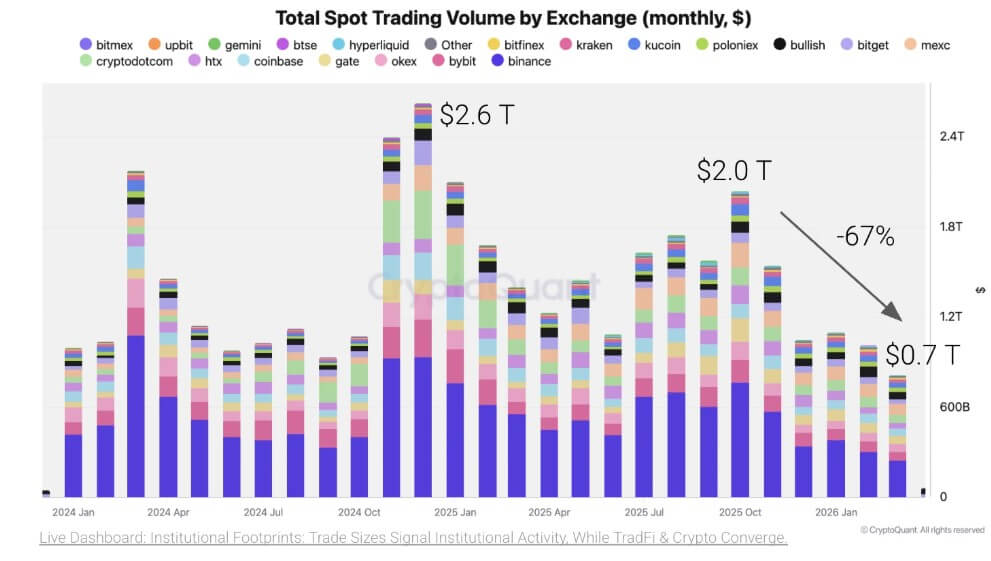
For centralised cryptocurrency exchanges, April 2026 was a noteworthy but unfavourable turning point. At $679 billion, spot trading volume dropped to its lowest point in almost two years.
The decrease demonstrates how much the market's retail trading activity has decreased. Spot trading volume was 46% lower than the same period last year. When contrasted to the market's strongest era, the numbers are even more startling, with volume declining 67% from the October 2025 peak.
A significant decline in trading activity implies that many traders have either stopped trading or are holding off on making a comeback until there are more potent market drivers. Many centralised trading platforms have seen a decrease in transaction activity and an impact on overall liquidity as a result of the slowdown.
Reduced spot market participation poses a problem for exchanges that rely significantly on trading fees. Exchanges are increasingly searching for substitute products that can consistently generate activity and revenue when fewer deals occur.
Perpetual Futures Trading Also Shows Major Weakness
The derivatives industry is also vulnerable, in addition to spot markets. Trading volume for perpetual futures has also significantly decreased, dropping 53% from its previous high.
Traditionally, one of the most traded products in the cryptocurrency market has been perpetual contracts. Traders looking for leveraged exposure to market swings have been the main drivers of their popularity. But according to the most recent data, speculative trading activity has significantly decreased.
The decline in perpetual futures volume demonstrates that casual spot traders are not the only ones with lower participation. Lower overall market activity seems to be the result of even aggressive derivatives traders adopting a more cautious strategy.
Perpetual futures have traditionally been a significant source of income for centralised exchanges, which makes this trend especially significant. Exchanges are being compelled to broaden their offerings and look for fresh growth prospects as trading activity in both the spot and futures markets diminishes.

Binance & Gate Expand Into TradFi-Style Perpetual Products
Several exchanges have started branching out into goods connected to conventional financial markets in an effort to counteract the decline in cryptocurrency trading volumes.
Exchanges are now providing permanent contracts tied to gold, silver, crude oil, equities, and major market indices instead of restricting traders to digital assets. With these products, consumers can continue to participate in the cryptocurrency exchange ecosystem while speculating on conventional asset price changes.
The approach marks a significant change in the commercial model of the sector. Exchanges are expanding their focus and presenting themselves as platforms that provide exposure to many asset classes rather than solely depending on cryptocurrency trading activity.
In addition to generating new sources of trading volume, this strategy draws traders who are interested in commodities, stocks, and macroeconomic developments. Expanding into traditional financial products offers exchanges that are dealing with dwindling cryptocurrency participation a chance to keep users engaged and create more market activity.
Changing trader preferences are also reflected in this move. Nowadays, a lot of market players desire to be able to access a greater variety of assets without switching between multiple trading platforms.
TradFi Perpetual Volume Reaches $450 Billion as Precious Metals Lead Demand
Traditional financial everlasting products are becoming more and more popular, and this is already having a major impact. In March 2026, the monthly trading volume for these items was around $450 billion, indicating a high level of demand from exchange users.
Precious metals constituted the vast majority of this activity. The most popular items in the category were gold and silver contracts, which made up over 90% of the peak-month TradFi permanent trading volume.
The predominance of gold and silver indicates that traders are looking for exposure to assets that are frequently thought of as stores of value amid erratic market conditions. Many players seem to be spreading their trading methods across many asset classes rather than concentrating only on cryptocurrency.
The quick expansion of TradFi permanent products is indicative of a larger trend occurring in the exchange sector. Traditional asset-linked contracts are becoming a more significant source of trading activity while cryptocurrency spot and futures volumes are still declining. Products linked to stocks, commodities, and indexes are becoming more prevalent in the trading environment as exchanges adjust to shifting market conditions.
If you find any issues in this article or notice missing information, please feel free to reach out at team@etherworld.co for clarifications or updates.
To promote your Web3 articles, events, and projects, you may reach out anytime via EtherWorld PR for submissions and collaboration.
Related Articles
- BIS Moves Blockchain Payments Into Live Testing
- Gnosis Pay Exploit Hits Delay Module, Users Reimbursed
- BlackRock Expands Ethereum Push With Tokenized Treasury Funds
- Alipay Launches AI Wallet & Token Pay for AI Payments
- EF President Aya Miyaguchi Outlines New EF Direction
To follow blockchain news, track Ethereum protocol progress, and read our latest stories, subscribe to our weekly today.
Disclaimer: The information contained in this website is for general informational purposes only. The content provided on this website, including articles, blog posts, opinions, & analysis related to blockchain technology & cryptocurrencies, is not intended as financial or investment advice. The website & its content should not be relied upon for making financial decisions. Read full disclaimer & privacy policy.
To stay updated on blockchain news, Ethereum protocol progress, and our latest stories, subscribe to our weekly digest and YouTube channel for ELI5 content.
To promote your Web3 articles, events, project updates, and Press Releases, reach out anytime via EtherWorld PR for submissions and collaboration. For other queries, email contact@etherworld.co.
If you’d like to support our work, share the content and consider donating at avarch.eth.
Join our community on Discord and follow us on Twitter, Facebook, LinkedIn & Instagram.