Crypto Projects Raised Millions. Why Are They Still Shutting Down?
Fundraising made headlines, but survival proved harder. Discover why crypto projects with millions in backing are still shutting down in 2026.
Raising millions has long been seen as the closest thing to a success guarantee in the cryptocurrency space. A successful investment round inspires ambitious expansion plans, demonstrates investor confidence, and persuades users that a business is long-term. However, 2026 has given the industry a reality check that it can no longer ignore. Businesses that previously raised tens or even hundreds of millions of dollars are closing their doors, winding down their activities, or simply vanishing from the market. Their demise highlights an issue that merits much more attention than the funding announcements ever did; if funding was insufficient to sustain these programs, what went wrong?
The Growing Wave of Crypto Shutdowns
It has long been acknowledged in the cryptocurrency industry that not every project will be successful. Risk is a natural aspect of innovation, and any new market must be built via failures. This year, the quantity and calibre of the participating companies seem to be different, because projects are ending. In the past, several of them were regarded as serious participants with seasoned teams, vibrant communities, and substantial financial support.
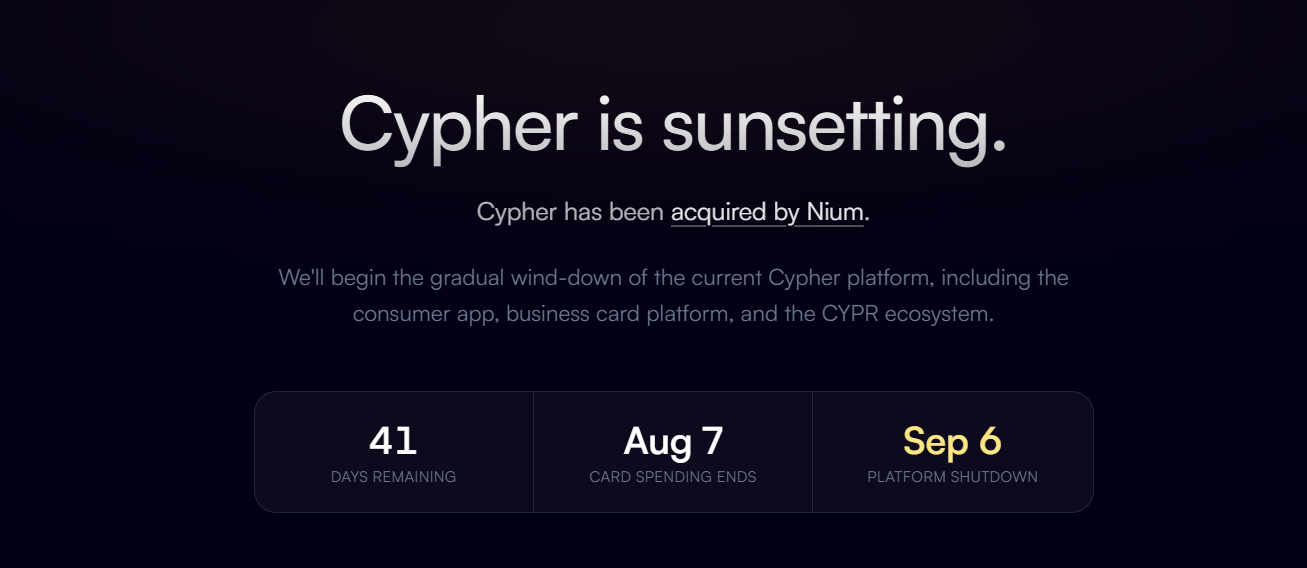
Nearly every area of the ecosystem has experienced recent closures. Layer-1 networks, NFT markets, bridges, DeFi platforms, wallets, exchanges, and lending protocols have all been impacted. Several projects, including BitMEX, BitMart, Dango, Odos Protocol, Across Protocol, Moonbeam, Exchange Art, Ctrl Wallet, Cypher, ICON Network, and NFTfi, have either ceased operations or declared they will do so in 2026. When you look at that list, it is hard to claim that these are isolated events. Rather, they indicate a more extensive change in the economics of the sector.
Because of the disparity between the amount of money raised and the result, one example has received special attention. According to reports, AscendEX raised $63.7 million, Movement Labs raised $141.4 million, Dango raised $3.9 million, and BitMart raised $23.7 million. However, due to low liquidity, all four were said to have closed in July. Regardless of the specifics of each organisation, those figures instantly prompted the same concern in the cryptocurrency community, i.e., how can companies with millions of supporters yet run out of space to operate?
A single error is unlikely to be the solution. Rather, it is a result of business choices, shifting market dynamics, and a sector that frequently prioritises fundraising over long-term viability.
Projects that shut down or disappeared in 2026
— StarPlatinum (@StarPlatinum_) July 26, 2026
BitMEX - Exchange
BitMart - Exchange
Dango - DeFi
Odos Protocol - DEX Aggregator
Across Protocol - Bridge
Moonbeam - L1
Exchange Art - NFT Marketplace
Ctrl Wallet - Wallet
Cypher - Wallet
ICON Network - L1
NFTfi - NFT Lending…
Where Did the Millions Go?
The initial response is typically suspicion whenever a cryptocurrency company closes its doors after obtaining significant capital. Many believe the money must have been misappropriated or vanished. Even while each business has a unique story, that explanation is frequently far too basic.
Funding is intended to assist businesses in their growth. Hiring engineers, designers, security experts, compliance teams, customer service, marketing campaigns, partnerships, office costs, cloud infrastructure, audits, legal work, and daily operations are all covered. Regardless of whether the market is expanding or contracting, these expenses are ongoing each month.
For a number of years, the cryptocurrency sector grew rapidly, which inspired numerous firms to expand quickly. Businesses increased staff, ventured into untapped regions, started costly advertising campaigns, sponsored conferences, and made significant investments in user acquisition. When trade volumes were high and investor confidence was high, it was easier to defend those actions.
When growth slowed, the trouble started. Raising new cash became much more difficult, trading activity became less predictable, and user interest decreased for many platforms. Companies that had anticipated continuous growth were suddenly forced to sustain enormous operations with far less revenue than anticipated.
Such issues are exacerbated by low cash, which has been blamed for a number of recent shutdowns. In the absence of sufficient market activity, DeFi platforms lose customers, exchanges find it difficult to draw traders, and goods lose appeal due to a lack of players. In the cryptocurrency space, liquidity is more than simply a business indicator; it has a direct impact on users' decisions to stay or go.
When seen in that light, the millions weren't just languishing in corporate accounts. They wasted time attempting to expand companies that, in the end, were unable to provide enough sustainable activity to maintain themselves when market conditions shifted.
Why Funding Could Not Guarantee Survival?
One of the most common misconceptions about cryptocurrency is that a successful fundraising round immediately lowers business risk. Raising money actually just lengthens the runway. It allows entrepreneurs more time to demonstrate their product's viability without continuously depending on outside funding.
Because investments are based on future hopes rather than promised results, this distinction is important. Investors support concepts they think have the potential to succeed as businesses. Although such a belief is worthwhile, it does not always result in devoted clients or consistent income.
Additionally, fundraising announcements now attract nearly as much attention as product debuts in the cryptocurrency industry. Investment rounds of millions of dollars make headlines, are celebrated on social media, and are frequently viewed by communities as proof that a project has already been successful. Fundraising is really just the start of a much more difficult road.
Instead of focusing on business principles, many projects have spent years optimising for growth indicators. All of these factors, such as community size, token popularity, social media engagement, and ecosystem partnerships, are important, but they cannot take the place of steady product demand. The business becomes more challenging to maintain if consumers quit coming back after incentives disappear or market enthusiasm fades.
This explains how businesses with wildly different financial amounts can reach the same goal. Even while Dango raised less than $4 million and Movement Labs supposedly garnered more than $141 million, neither company could be guaranteed to survive on its own. The ability of the underlying company to survive shifting market conditions was more important than the size of the investment.
Although money can generate opportunity, it cannot address every structural flaw. Every startup eventually reaches a stage where consumers, not investors, decide if it should stay in business.
Tough times (again)! At least, it appears to be an orderly wind down where users can withdraw their assets.
— CZ 🔶 BNB (@cz_binance) July 26, 2026
Pro tip:
Self custody if you know how to keep your seedphrase safe (@trustwallet)
Or use the largest exchange (@binance) with staying power. https://t.co/nLXYMUXctm
Regulation, Competition and Weak Revenue
Compared to a few years ago, the environment that cryptocurrency businesses must operate in today is far more demanding. Major markets' regulations are always changing, requiring businesses to invest additional resources in legal compliance, licensing, reporting requirements, and operational adjustments. These advancements are essential for an industry that is evolving, but they also raise expenses, particularly for smaller companies with fewer resources.
There is now just as much competition. Launching an exchange, wallet, or DeFi platform in the early days of cryptocurrency meant joining a comparatively open market. Users have an abundance of options today. Larger consumer bases, better financial reserves, deeper liquidity, and well-known brands are all advantages for the biggest platforms. The difficulty of persuading users to leave those environments has increased dramatically.
Among all the challenges, revenue has become the most significant. Low fees, substantial incentives, and enticing rewards were used by many cryptocurrency companies to draw in customers. Although these tactics aided in the rapid expansion of projects, they frequently failed to create steady revenue streams that might sustain long-term operations. It became more challenging to sustain those business structures as market activity slowed.
This explains why the list of closures is no longer limited to one category but rather spans several sectors. Blockchain networks, wallets, bridges, loan platforms, NFT marketplaces, and exchanges are all having difficulties. Poor technology is not always the common thread. It is the difficulty of transforming consumer interest into a long-term company that can last beyond advantageous market cycles.
> Bitmart raised $23.7 million
— Deestar (@Deestar) July 26, 2026
> Movement labs raised $141.4 million
> Dango raised $3.9 million
> AscendEX raised $63.7 million
all 4 shutdown in July due to low liquidity
what happened to the millions raised?? https://t.co/jwcnHFuITG pic.twitter.com/rAj5Hsiblw
Should Bigger Crypto Companies Step In?
Naturally, the increasing number of shutdowns has sparked another discussion, i.e., should bigger cryptocurrency companies begin purchasing failing companies rather than letting them go out of business?
When concerns surfaced regarding Binance's potential to buy smaller, financially troubled exchanges in the future, the conversation gained momentum. It is not an impractical notion. Conventional industries sometimes combine amid challenging economic times. Instead of letting those assets disappear, larger businesses frequently buy promising technology, skilled teams, or existing clientele.
There are definite benefits to this strategy. Employees get new possibilities, users encounter fewer disruptions, and beneficial products might continue to develop rather than be permanently shut down. Acquisitions can protect innovation that might otherwise be lost to the larger ecosystem.
However, acquisitions cannot be the industry's go-to course of action. Big businesses have obligations to their consumers, investors, and shareholders. Only transactions that will benefit their company will be pursued. It wouldn't make much financial sense to purchase every faltering exchange or protocol just because it had previously generated revenue.
Longer-term issues also exist. The industry runs the risk of losing its competitiveness if only a few powerful firms survive after absorbing lesser rivals. Many of the most significant developments in cryptocurrency were first made by smaller enterprises that were open to trying out concepts that bigger companies had first rejected.
Expecting industry leaders to save every failing project is not the healthiest course of action. It's fostering an atmosphere where more startups grow into long-lasting companies before they need to be saved.
What Future Projects Must Do Differently?
The recent number of closures shouldn't be seen as an indication that cryptocurrency has failed. Rather, it ought to inspire communities, investors, and innovators to reconsider what success truly means.
Raising money should no longer be seen as the end goal for founders. Disciplined expenditure, practical expansion strategies, and products that continue to address real user issues long after market enthusiasm wanes are necessary for sustainable success. Building slowly frequently results in stronger enterprises even though it may not produce huge headlines.
Additionally, investors have the chance to change the discussion. Customer retention, recurring revenue, prudent financial management, and open communication should receive more attention than the largest investment rounds. Although these metrics are rarely popular on social media, they frequently predict a company's survival five years later.
Additionally, communities play a part. Token prices, partnerships, and fundraising announcements are commonly used by cryptocurrency users to assess projects. The story is not fully revealed by those numbers.
Tougher inquiries about a project's revenue generation, user retention, and strategies for challenging markets could contribute to better expectations throughout the ecosystem.
A reminder that money alone cannot create long-lasting businesses is provided by the shutdowns that occurred during 2026. A successful business model cannot be replaced by money, even while it can be used to launch products, hire people, and speed up growth. The projects with the biggest funding rounds won't always be the ones with the best chances of success as cryptocurrency develops. They will be the businesses that understand how to convert investment into long-term value, adjust to shifting markets, and gain enough user trust to endure long after the news has moved on.
If you find any issues in this article or notice missing information, please feel free to reach out at team@etherworld.co for clarifications or updates.
To promote your Web3 articles, events, and projects, you may reach out anytime via EtherWorld PR for submissions and collaboration.
Related Articles
- BitMart Is Shutting Down, Trading Ends August 26
- Coinbase Wins $150K SEC Settlement Over Missing Gensler Texts
- BitMEX to Shut Down After 11 Years
- Why did Malaysia Shut Down Balaji Network School Hub?
- Telegram Launches Gram Wallet for 1 Billion Users
To follow blockchain news, track Ethereum protocol progress, and read our latest stories, subscribe to our weekly today.
Join the EtherWorld & Avarch Internship Program and build your career in blockchain, content, social media, video, podcast editing, or operations. Send your resume and brief introduction to contact@etherworld.co.
Disclaimer: The information contained in this website is for general informational purposes only. The content provided on this website, including articles, blog posts, opinions, & analysis related to blockchain technology & cryptocurrencies, is not intended as financial or investment advice. The website & its content should not be relied upon for making financial decisions. Read full disclaimer & privacy policy.
To stay updated on blockchain news, Ethereum protocol progress, and our latest stories, subscribe to our weekly digest and YouTube channel for ELI5 content.
To promote your Web3 articles, events, project updates, and Press Releases, reach out anytime via EtherWorld PR for submissions and collaboration. For other queries, email contact@etherworld.co.
If you’d like to support our work, share the content and consider donating at avarch.eth.
Join our community on Discord and follow us on Twitter, Facebook, LinkedIn & Instagram.

 ×
×

Author

Nidhi Kumari is a Web3 content writer at EtherWorld.co, tracking ecosystem developments, funding activity, and market trends shaping the crypto space.