Ethereum Protocol Update: ACDC #184
Ethereum’s ACDC #184 advanced Glamsterdam Devnet 8 toward public testing while closing Hegota’s proposal window for faster slots, issuance reform and validator upgrades.
Ethereum developers closed the first major proposal window for the Hegota upgrade during All Core Developers Consensus Call #184, opening the next phase of evaluation for faster slots, new data-propagation designs, validator reforms and a controversial change to ETH issuance.
No Hegota proposal was approved for implementation during the call. The submissions were placed at the Proposed for Inclusion stage, allowing client teams and researchers to begin evaluating their benefits, risks and implementation requirements before any Considered for Inclusion or Scheduled for Inclusion decision.
Glamsterdam Devnet 8 Will Launch as a Public Testnet
Glamsterdam Devnet 8 is now expected to launch early in the week following ACDC #184 rather than immediately after the call. Developers had initially targeted the first week of August. However, unresolved Devnet 7 issues, incomplete client readiness and open questions around several specifications made a short delay the safer option.
A tentative Tuesday launch was discussed, depending on client coordination and final specification work. The more important decision concerns the form Devnet 8 will take. Unlike previous development networks primarily used for controlled client interoperability testing, Devnet 8 will operate as a named, temporary public testnet.
Client teams may publish releases with the network configuration already included, making it easier for external operators to participate. Validators will generally join by making deposits through a public deposit interface rather than being added directly to the genesis validator set.
The launch builds on the progress reported in Ethereum Protocol Update: ACDC #183, where developers moved the full Devnet 7 proposal set to Scheduled for Inclusion and began preparing for broader testing. Developers also agreed that Beacon API PR #630 should be merged for Devnet 8 because no client team raised an objection.
Most execution clients had not objected, but concerns remained around how the custody field would be carried through the API. Client teams were given until the next testing call to produce a counterproposal. Without a stronger objection, the existing design is expected to enter Devnet 8.
The progression from Devnet 6 to Devnet 8 can also be followed through ACDC #181 and Ethereum ACD Monitor #1. Users can additionally follow individual proposal stages through EIPsInsight’s Glamsterdam upgrade tracker.
Hegota Proposal Window Closes Without Inclusion Decisions
The August 6 deadline for Hegota’s non-headliner proposals has now passed, formally ending the upgrade’s initial submission phase. Developers repeatedly clarified that proposals submitted before the deadline have not been approved for Hegota. Proposed for Inclusion, or PFI, only places an EIP into the upgrade’s evaluation pipeline.
The next stage requires client teams to study each design, review specifications, estimate engineering costs and determine whether the proposal complements Hegota’s existing scope. Only proposals that develop sufficient support can later move to Considered for Inclusion and Scheduled for Inclusion.
This distinction is particularly important because Hegota already has a major consensus-layer commitment. FOCIL was selected as its headliner during ACDC #175, making censorship-resistant transaction inclusion the upgrade’s primary objective.
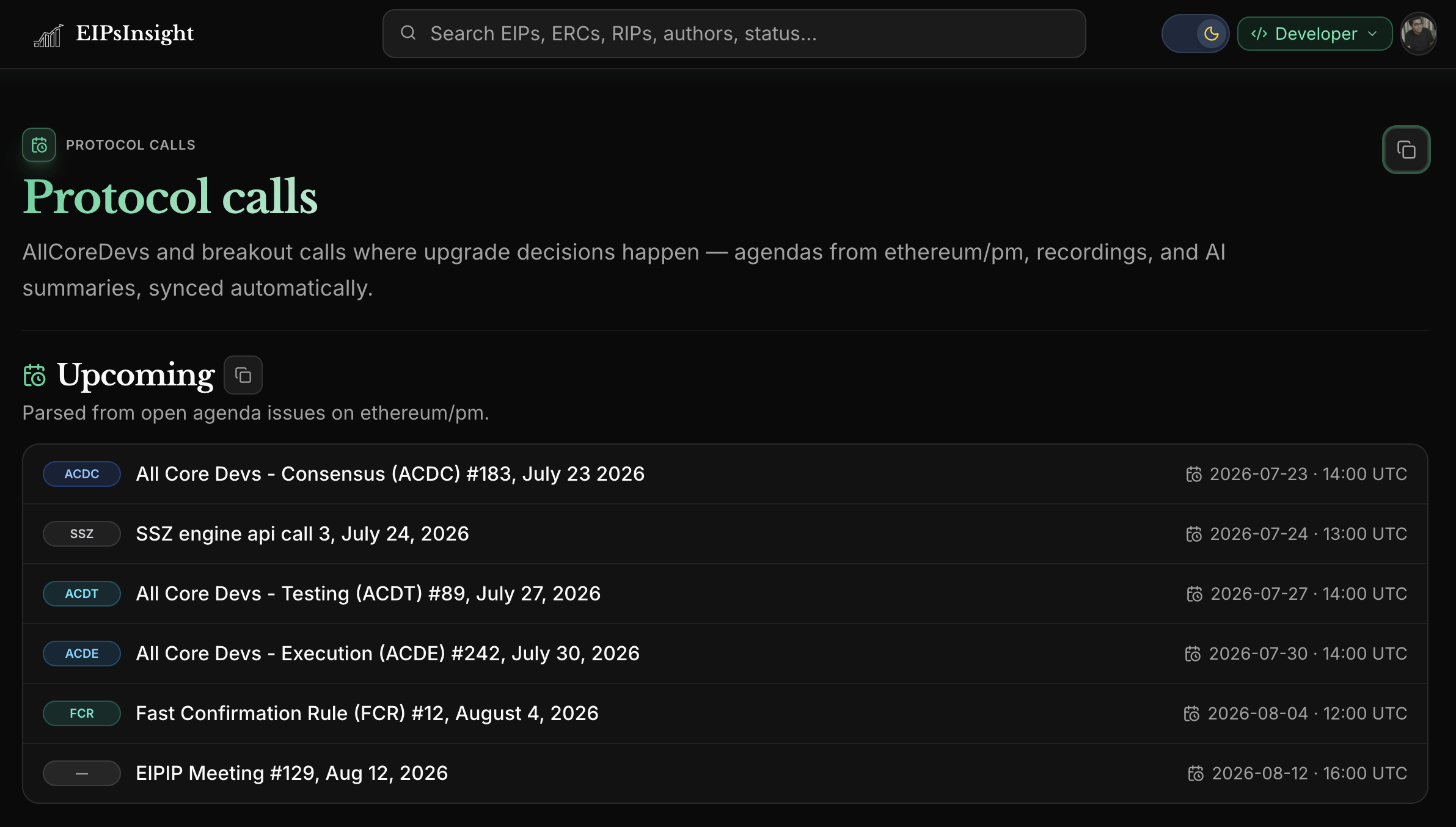
Follow all Ethereum protocol calls and updates here.
The newly submitted proposals significantly broaden the potential scope.
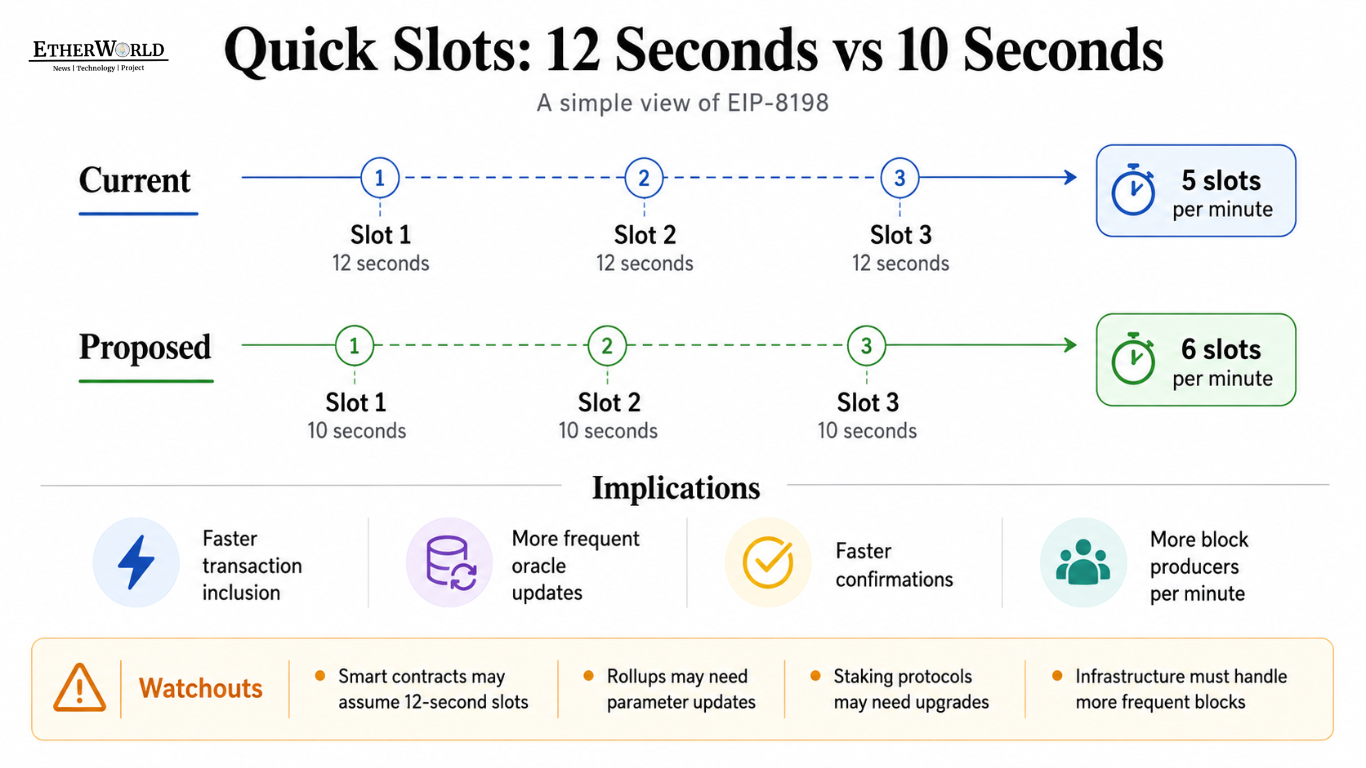
- EIP-8198, Quick Slots, proposes removing Ethereum’s fixed 12-second slot assumption and reducing slot duration to approximately 10 seconds. Shorter slots could improve transaction inclusion, refresh onchain prices more frequently, accelerate confirmations and increase the number of block producers participating over a given period.
Several networking proposals also entered the evaluation pipeline.
- EIP-8142 would use PeerDAS columns to propagate execution payloads rather than depending on a separate payload gossip mechanism. EIP-8371, RowDAS, would distribute blob reconstruction work across multiple nodes, reducing reliance on supernodes for computationally intensive reconstruction.
- EIP-8359 would add an informational beacon block field through which validators could report their consensus client, execution client and operating setup. The field would not affect consensus but could provide more reliable information about client diversity than node crawlers or validator graffiti.
Together, these submissions suggest Hegota could extend beyond censorship resistance into latency, networking efficiency and validator observability. EtherWorld’s State of Upgrade – Hegota Edition #1 provides the earlier context behind this expanding scope. The evolution of Hegota’s candidate list has also been tracked through ACDC #180, ACDC #182 and ACDE #241.
EIP-8363 Remains a Proposal as Issuance Debate Intensifies
EIP-8363, Tapered Issuance Burn, was accepted only as a proposal for evaluation. Developers made no decision to include the mechanism in Hegota. The proposal would gradually deduct and burn part of validators’ idealized rewards as the percentage of staked ETH rises. Net consensus-layer issuance would decline with the staking ratio and reach zero when 50% of ETH supply is staked.
Ethereum may be about to rethink staking rewards completely.
— Yash Kamal Chaturvedi | Avarch (@YashKamalChatu1) August 5, 2026
A new proposal could push protocol-issued staking rewards close to 0% once roughly half of all ETH is staked.
Sounds extreme. But the reasoning behind it is even more controversial. 🧵👇#Ethereum #ETH… https://t.co/exyYhks7UX
Its primary objective is to prevent the protocol from continuously incentivising stake growth beyond that level. The authors argue that Ethereum’s current issuance curve never fully turns off staking incentives. Even as rewards decline, validators continue receiving a positive protocol yield. Whether staking growth stops therefore depends on outside factors, including opportunity costs, operating risks and alternative sources of yield.
Critics argued that EIP-8363 appeared shortly before the Hegota deadline, leaving insufficient time for alternative designs and independent economic analysis. A change to Ethereum’s issuance system could also dominate an upgrade cycle containing many technical proposals that have been under development for significantly longer.
Concerns were also raised about who could remain profitable as rewards decline. Large operators may combine economies of scale with external revenue, while smaller independent validators could face greater pressure.
The disagreement continues Ethereum’s long-running debate over how much issuance is required to secure the network without encouraging unnecessary concentration. EtherWorld previously examined these tensions in Ethereum’s 1% Issuance Plan Sparks Staking Debate and Ethconomics: Navigating Ethereum’s Infinite Endgame.
Validator Reforms Move Forward for Further Evaluation
Developers left two additional validator reforms open for continued research rather than making final inclusion decisions.
The first was an updated version of EIP-7716, which would increase penalties when validators fail alongside a large portion of the network. Ethereum’s existing penalties do not strongly differentiate between an isolated validator outage and a correlated failure affecting a major client, staking provider or cloud platform.
EIP-7716 attempts to make concentrated failures more expensive, encouraging operators to diversify clients and infrastructure. The updated design focuses on missed source and target attestations rather than head-vote accuracy. This change is intended to avoid penalizing validators for builder or ePBS failures beyond their control.
The second reform concerns validators still using legacy 0x00 BLS withdrawal credentials. Approximately 9,000 such validators remain on Ethereum. Because they do not have execution-layer withdrawal addresses, their balances cannot be swept through the same process used by newer validators.
This creates a future problem for Ethereum’s post-quantum transition. If validators are eventually required to register new credentials, inactive 0x00 validators cannot be cleanly removed while preserving the existing withdrawal process.
One proposal would stop accepting new 0x00 deposits and force-exit the remaining validators. They could still recover their ETH by submitting a BLS-to-execution credential change.
A second stage proposed gradually reducing the balances of validators that never update their credentials. Several developers considered this unnecessary and preferred a simpler path based on ending new deposits and force-exiting the remaining legacy validators.
Both validator discussions remain unresolved. They will require further specification work and client feedback before Hegota’s scope is narrowed. The next calls will determine which proposals can progress beyond PFI, which require substantial redesign and which would place too much complexity or controversy into a single upgrade.
If you find any issues in this blog or notice any missing information, please feel free to reach out at yash@etherworld.co for clarifications or updates.
To promote your Web3 articles, events, and projects, you may reach out anytime via EtherWorld PR for submissions and collaboration.
Related Articles
- Highlights from the All Core Developers Consensus (ACDC) Call #179
- Highlights from the All Core Developers Consensus (ACDC) Call #178
- Highlights from the All Core Developers Consensus (ACDC) Call #177
- Highlights from the All Core Developers Consensus (ACDC) Call #176
- Highlights from the All Core Developers Consensus (ACDC) Call #175
To follow blockchain news, track Ethereum protocol progress, and read our latest stories, subscribe to our weekly today.
Join the EtherWorld & Avarch Internship Program and build your career in blockchain, content, social media, video, podcast editing, or operations. Send your resume and brief introduction to contact@etherworld.co.
Disclaimer: The information contained in this website is for general informational purposes only. The content provided on this website, including articles, blog posts, opinions, & analysis related to blockchain technology & cryptocurrencies, is not intended as financial or investment advice. The website & its content should not be relied upon for making financial decisions. Read full disclaimer & privacy policy.
To stay updated on blockchain news, Ethereum protocol progress, and our latest stories, subscribe to our weekly digest and YouTube channel for ELI5 content.
To promote your Web3 articles, events, project updates, and Press Releases, reach out anytime via EtherWorld PR for submissions and collaboration. For other queries, email contact@etherworld.co.
If you’d like to support our work, share the content and consider donating at avarch.eth.
Join our community on Discord and follow us on Twitter, Facebook, LinkedIn & Instagram.

 ×
×

Author

Yash Kamal Chaturvedi is a Blockchain Content & Ops Specialist at Avarch LLC, writing on Ethereum & governance since 2021. Covers ACD/ACDE calls, EIPs, upgrades, staking, security & ecosystem trends.