Highlights from the All Core Developers Consensus (ACDC) Call #179
Ethereum developers focus on Glamsterdam devnet stability, SSZ Engine API decisions, and validator-focused Hegota EIPs including EIP-8148, EIP-8061, and EIP-8080.
Ethereum core developers continue to make steady progress toward the network's next major upgrades, Glamsterdam and Hegota, while balancing ambitious feature development with the realities of client stability and cross-team coordination. Discussions during recent All Core Devs Coordination (ACDC) calls focused heavily on stabilizing Glamsterdam Devnet 4, preparing the roadmap for Devnet 5 and Devnet 6, resolving Engine API architecture debates, and evaluating several validator-focused proposals targeted for inclusion in Hegota.
Although no major upgrade scope expansions were approved, developers reached several important decisions that will shape Ethereum's near-term roadmap.
Glamsterdam Updates
The primary focus of the latest discussions was the state of Glamsterdam Devnet 4, which has experienced instability since launch. Developers are still investigating the root cause, but the issues have already influenced the roadmap for future testing.
To avoid introducing additional complexity, developers agreed that Devnet 5 will relaunch with the same specification as Devnet 4. No new features will be added until the network demonstrates at least two weeks of stable operation. This reflects a growing preference for stabilizing existing functionality before expanding upgrade scope.
As a result, several planned features have been pushed further down the roadmap. Most notably, Produce Block V4 and Builder API changes are now expected to arrive in Devnet 6, after Devnet 5 has successfully demonstrated stability.
Another important milestone is the integration of target gas limit handling through prepare_payload, which has now been merged into both execution and consensus specifications. The change improves coordination between Ethereum's layers and represents another step toward future protocol upgrades.
A major architectural decision was also finalized regarding the SSZ Engine API. For months, developers had been evaluating two competing approaches. One proposal focused on introducing REST and SSZ support for significant performance gains, while the other proposed a broader redesign of the Engine API architecture.
After review, developers decided to adopt PR #793, Marius's SSZ Engine API redesign. The previously discussed PR #764 was officially closed. The decision provides a clearer long-term path toward JSON-RPC deprecation while establishing a more maintainable architecture for future development. Client teams have now been asked to implement the new specification.
Client stability investigations also revealed a confirmed Lodestar fork-choice bug. The issue originated from a missing payload availability check inside the should_extend_payload logic, which could cause self-reorganizations under certain conditions.
Meanwhile, developers are also examining the role of Watchtower in the Devnet 4 failures. Early findings suggest that simultaneously rolling all client images may have amplified network instability. Work is underway to improve deployment procedures and prevent similar incidents.
Testing capabilities continue to improve as well. The newly introduced Disruptor tool has been merged into Kurtosis and now allows developers to simulate:
- Short-range reorganizations
- Long-range reorganizations
- Network forks
- Adverse network conditions
Another area of investigation involves a potential cross-client PTC attestation bug. Developers observed scenarios where some clients may not correctly set data availability flags before required deadlines. While research continues, the issue highlights the importance of ensuring consistent behavior across all Ethereum clients.
Overall, Glamsterdam discussions reflected a cautious approach. Developers appear determined to establish stable infrastructure and reliable testing environments before introducing additional protocol changes.
Hegota Updates
While Glamsterdam discussions focused on infrastructure and testing, Hegota conversations centered on validator operations, withdrawal mechanisms, and staking efficiency improvements.
One of the most notable developments was progress on EIP-8148: Custom Sweep Threshold for Validators. The proposal allows operators of 0x02 validators to configure automatic withdrawal thresholds between 32 ETH and 2048 ETH.
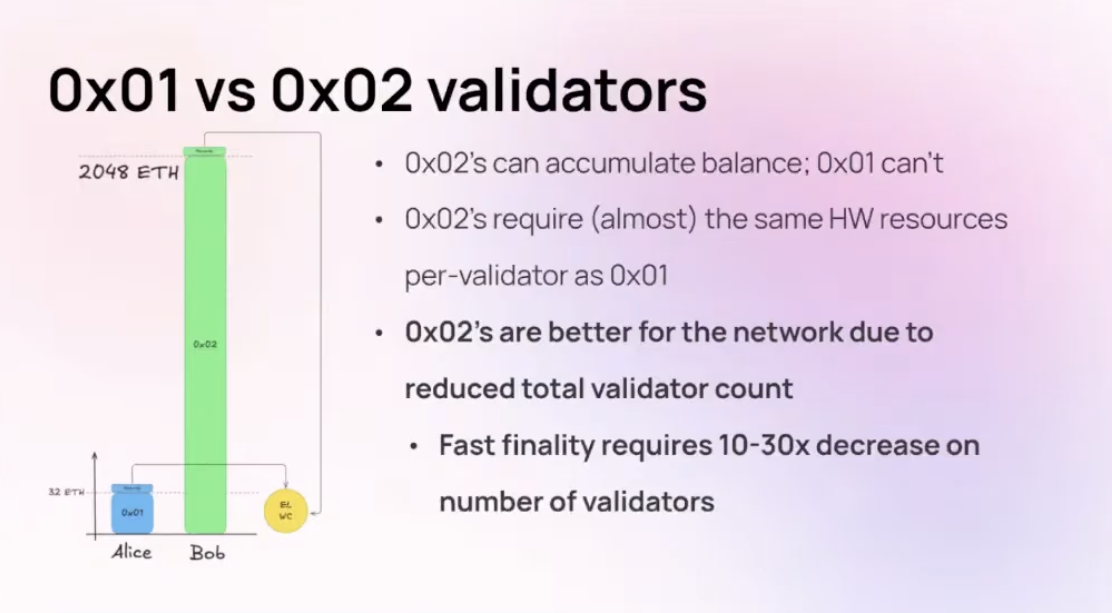
Rather than relying on fixed withdrawal behavior, validators would gain greater flexibility over when balances are automatically swept. Developers agreed to move the proposal forward, advancing EIP-8148 to Proposed status for Hegota. Client teams and staking providers are expected to review implementation details before final inclusion decisions are made.
Another proposal under discussion was EIP-8080: Exits Use Consolidation Queue. The proposal seeks to simplify validator exits by routing them through the consolidation queue. Supporters argue that this could reduce complexity and streamline validator operations.
However, developers decided additional review is needed before making a final decision. The proposal's Decision for Inclusion (DFI) discussion has therefore been postponed until a future ACDC meeting.
Attention also remains focused on EIP-8061, which proposes increasing exit and consolidation churn limits. As Ethereum's validator set continues to grow, more efficient queue processing becomes increasingly important.
The proposal has already been implemented and tested since the earliest Hegota devnets, giving developers confidence in its maturity. An Intent to SFI decision is expected during the next ACDC cycle, making EIP-8061 one of the leading candidates for future inclusion.
Developers also reviewed the status of EIP-7688: SSZ Stable Containers. Stable Containers aim to improve Ethereum's handling of serialized data structures while creating more predictable development patterns across the protocol stack. Although interest remains strong, the proposal continues to remain at the Call for Inclusion (CFI) stage.
Developers agreed that Stable Containers should not advance further until stable devnet environments have been achieved. This dependency highlights how closely upgrade planning is tied to successful testing outcomes.
The group also discussed potential changes to validator deposit limits. No immediate action was taken. Instead, developers chose to wait for additional progress on Stable Containers before reconsidering any deposit-related adjustments.
Two additional proposals continue to attract attention.
- EIP-7684, which addresses returning deposits for distinct credentials, remains under review and may become an important part of future validator management discussions.
- Meanwhile, EIP-8243: Batching Attestations at Source seeks to improve network efficiency by aggregating attestations earlier in the process, potentially reducing bandwidth requirements and simplifying validator communication.
Beyond technical proposals, developers highlighted the upcoming launch of Ethereum Protocol Fellowship (EPF) Cohort 7, encouraging contributors to submit project ideas and participate in protocol research. The group also agreed to experiment with an earlier meeting schedule for ACDC #180 to better accommodate participants in Australian time zones.
Taken together, Hegota discussions demonstrate Ethereum's ongoing effort to improve validator experience without introducing unnecessary complexity. Most proposals focus on refining existing systems, improving operational flexibility, and supporting Ethereum's growing validator ecosystem.
If you find any issues in this blog or notice any missing information, please feel free to reach out at yash@etherworld.co for clarifications or updates.
To promote your Web3 articles, events, and projects, you may reach out anytime via EtherWorld PR for submissions and collaboration.
Related Articles
- Highlights of Ethereum's All Core Devs Meeting (ACDC) #153
- Highlights of Ethereum's All Core Devs Meeting (ACDE) #207
- Highlights of Ethereum's All Core Devs Meeting (ACDC) #152
- Highlights of Ethereum's All Core Devs Meeting (ACDE) #206
- Highlights of Ethereum's All Core Devs Meeting (ACDE) #205
To follow blockchain news, track Ethereum protocol progress, and read our latest stories, subscribe to our weekly today.
Disclaimer: The information contained in this website is for general informational purposes only. The content provided on this website, including articles, blog posts, opinions, & analysis related to blockchain technology & cryptocurrencies, is not intended as financial or investment advice. The website & its content should not be relied upon for making financial decisions. Read full disclaimer & privacy policy.
To stay updated on blockchain news, Ethereum protocol progress, and our latest stories, subscribe to our weekly digest and YouTube channel for ELI5 content.
To promote your Web3 articles, events, project updates, and Press Releases, reach out anytime via EtherWorld PR for submissions and collaboration. For other queries, email contact@etherworld.co.
If you’d like to support our work, share the content and consider donating at avarch.eth.
Join our community on Discord and follow us on Twitter, Facebook, LinkedIn & Instagram.

 ×
×

Author

Yash Kamal Chaturvedi is a Blockchain Content & Ops Specialist at Avarch LLC, writing on Ethereum & governance since 2021. Covers ACD/ACDE calls, EIPs, upgrades, staking, security & ecosystem trends.