Vitalik Buterin’s 2026 Vision for Ethereum Foundation
Vitalik Buterin explains why the Ethereum Foundation is reducing central control to preserve decentralization, censorship resistance & Ethereum’s long-term identity.
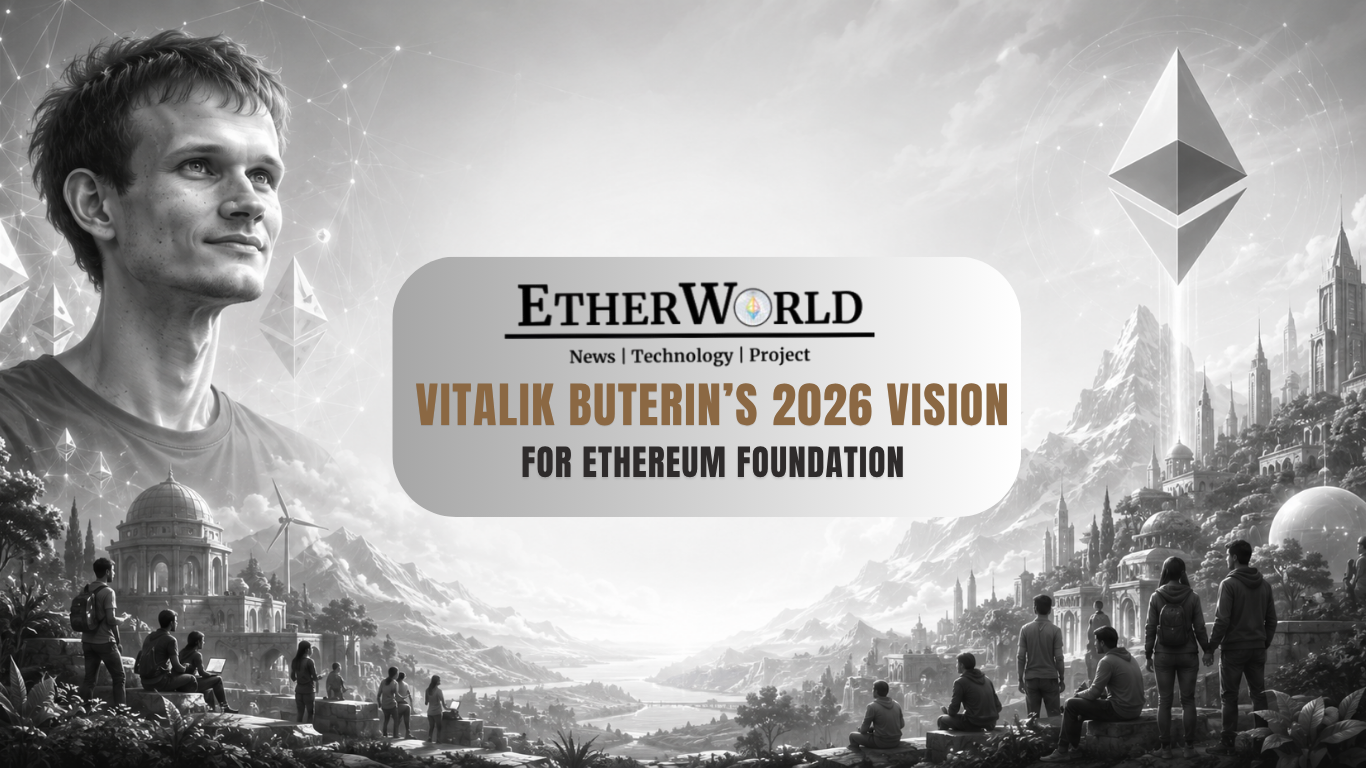
Vitalik Buterin has provided one of the most lucid answers to date regarding the direction of the Ethereum Foundation and the reasons behind its deliberate reduction in its role within the larger Ethereum ecosystem. His remarks highlight a significant conceptual and technological change that prioritises maintaining Ethereum's long-term identity as a decentralised, censorship-resistant network over central coordination.
Buterin stressed that the Ethereum Foundation should function as "one node among many" rather than as the hub of Ethereum. This distinction is essential to the organisation's 2026 transition plan. He asserts that Ethereum's future hinges on avoiding the route followed by numerous IT firms, which progressively abandoned their core principles in favour of corporate expansion and centralised power.
- Ethereum Foundation Wants Longevity Over Control
- Vitalik Buterin Pushes Ethereum Toward “CROPS” Values
- Ethereum Scaling Will Focus on Decentralization First
- ETH Remains the Most Valuable Product in Ethereum
Ethereum Foundation Wants Longevity Over Control
The Ethereum Foundation no longer wants to function as a powerful governing body, which is one of Buterin's most crucial statements. He clarified that the EF's stakes are significantly smaller than those of the foundations behind other rival blockchains, controlling only about 0.16% of the entire ETH supply.
Now, a distinct approach is being shaped by that restricted treasury. The EF intends to save resources and concentrate solely on projects that directly improve Ethereum's decentralisation, privacy, security, and resistance to censorship rather than broadening its reach. This also clarifies why the foundation is allegedly selling fewer ETH than it used to.
Buterin admitted that many skilled academics, developers, and ecosystem leaders might work outside of the EF instead of within it as a result of this strategy. That, in his opinion, is a need rather than a weakness. Only when independent builders and organisations can secure outside funding and function independently of the foundation will Ethereum's ecosystem continue to be decentralised.
This is a significant change from the way many cryptocurrency ecosystems operate today, where governance influence, ecosystem direction, and treasury allocation are managed by central foundations.
Vitalik Buterin Pushes Ethereum Toward “CROPS” Values
Buterin frequently mentioned the "CROPS" dimension in his remarks. Although he did not provide a precise definition for the acronym in the remark, the context clearly links it to security, privacy, openness, and opposition to censorship.
Buterin believes that Ethereum shouldn't compete only on headline TPS figures or raw transaction speed. At the expense of decentralisation, he openly denounced the rush toward ultra-fast blockchains that aim for 1 million TPS and ultra-low latency.
Rather, he said that Ethereum has to become "deeply impressive" in areas that other chains overlook.
A provably bug-free Ethereum infrastructure using AI-assisted formal verification is one of the most notable examples. Only months ago, Buterin said, cybersecurity researchers would have dismissed this idea as unfeasible, but advancements in artificial intelligence are making it feasible. His goal is for Ethereum to overtake other blockchains in the field of mathematically validated security mechanisms.
"Available chain consensus," where Ethereum retains both conventional Byzantine Fault Tolerance guarantees and Bitcoin-style resilience amid network synchronisation concerns, is another top target. In contrast to previous blockchains, Buterin identified this as one of Ethereum's most distinctive technical advantages.
Ethereum's continuous efforts to reduce intermediaries were also noted in his remarks. He took issue with the present reliance on third-party services for privacy tools, wallet infrastructure, and transaction inclusion. The goal of initiatives like FOCIL, EIP-8141, and account abstraction enhancements is to lessen the need for centralised intermediaries and increase the autonomy of Ethereum users.
Some of my perspective on where the @ethereumfndn is going.
First of all, this is only my own view. The board is not just me, and I have no extra special powers on the board that the other board members do not. @aerugoettinea is the one executing much of this transition. My…— vitalik.eth (@VitalikButerin) May 24, 2026
Ethereum Scaling Will Focus on Decentralization First
Buterin stated unequivocally that Ethereum is still dedicated to growing, but not at the price of its fundamental values. He maintained that Ethereum will eventually become mediocre if it were only "slightly more decentralised" than rivals.
Rather, the goal of Ethereum's scaling strategy is to increase throughput while preserving decentralisation. In particular, he cited studies on erasure-coded peer-to-peer networking enhancements, reduced slot times, and state scaling.
Layer-2 networks continue to play a significant role in this approach. Buterin, however, presented L2s as specialised infrastructure rather than as a substitute for Ethereum's foundation layer goal. For domains like high-volume trading and privacy-focused behaviour, he recommended application-specific L2s.
This viewpoint supports Ethereum's long-term positioning as a fundamental security and settlement layer as opposed to just another fast blockchain competing only on performance measures.
ETH Remains the Most Valuable Product in Ethereum
Buterin also emphasised that Ethereum's most significant financial product is still ETH. He pointed out that Ethereum today has a value of about $250 billion and made the case that the network's best features will eventually make the asset stronger.
Remarkably, he disclosed that about 90% of his personal wealth is still in Ethereum. He added that the majority of the remaining funds had already been used for biotech projects, open-source hardware, and software.
However, Buterin conceded that the Ethereum Foundation cannot continue to be the only entity responsible for promoting ETH use and expansion. He said that going forward, other companies and significant ETH holders will have to take on more responsibility.
That seems to be one of the most obvious indications that the Ethereum Foundation wants to become less dominating in ecosystem coordination, more specialised, and leaner. The EF is presenting itself as a long-term defender of Ethereum's founding ideals rather than growing into a permanent governing body.
If you find any issues in this article or notice missing information, please feel free to reach out at team@etherworld.co for clarifications or updates.
To promote your Web3 articles, events, and projects, you may reach out anytime via EtherWorld PR for submissions and collaboration.
Related Articles
- Vitalik Buterin Outlines Ethereum’s 2025–2027 Roadmap at Devconnect
- Vitalik’s ZK API Proposal Aims to Make Ethereum the Home for AI
- Vitalik Rethinks the Role of Ethereum Layer 2s
- Vitalik Pushes Back on “Sovereign AI” as Web4 Essay Sparks Debate
- Vitalik Buterin Bets on Privacy Pools, A New Chapter for Ethereum Privacy?
To follow blockchain news, track Ethereum protocol progress, and read our latest stories, subscribe to our weekly today.
Disclaimer: The information contained in this website is for general informational purposes only. The content provided on this website, including articles, blog posts, opinions, & analysis related to blockchain technology & cryptocurrencies, is not intended as financial or investment advice. The website & its content should not be relied upon for making financial decisions. Read full disclaimer & privacy policy.
To stay updated on blockchain news, Ethereum protocol progress, and our latest stories, subscribe to our weekly digest and YouTube channel for ELI5 content.
To promote your Web3 articles, events, project updates, and Press Releases, reach out anytime via EtherWorld PR for submissions and collaboration. For other queries, email contact@etherworld.co.
If you’d like to support our work, share the content and consider donating at avarch.eth.
Join our community on Discord and follow us on Twitter, Facebook, LinkedIn & Instagram.

 ×
×

Author

Nidhi Kumari is a Web3 content writer at EtherWorld.co, tracking ecosystem developments, funding activity, and market trends shaping the crypto space.