Vitalik Wants Open Crypto Chip Blueprints
Vitalik Buterin explains why open source software is not enough to secure crypto keys and calls for transparent chip designs, open GDS files and hardware verification.
Ethereum co founder Vitalik Buterin is pushing for greater transparency in hardware security, arguing that open source software cannot guarantee complete security when the chips running it remain closed.
In a blog post published on November 26, he explains how chip designs move from code to physical silicon and why manufacturers should make their hardware blueprints publicly available. He also explores how independent inspections could help verify that devices holding sensitive crypto keys work as intended.
Open Source Software Cannot Guarantee Hardware Security
Buterin argues that software transparency has a major limitation when the underlying hardware cannot be independently examined. Even if a hardware wallet runs completely open source software, users still have limited ways to verify whether the physical chip follows the published design.
This matters because hardware can contain hidden components or modifications that compromise private keys without changing the device's visible behaviour. Buterin points to existing attacks involving spy implants with eSIM capabilities inserted into hardware wallets before they reach consumers. Such implants can extract seed phrases as soon as someone starts using the device.
He also warns about more advanced possibilities, including replacing genuine chips with modified versions that look identical and perform the expected functions while secretly introducing malicious capabilities.
From Verilog Code to Physical Silicon
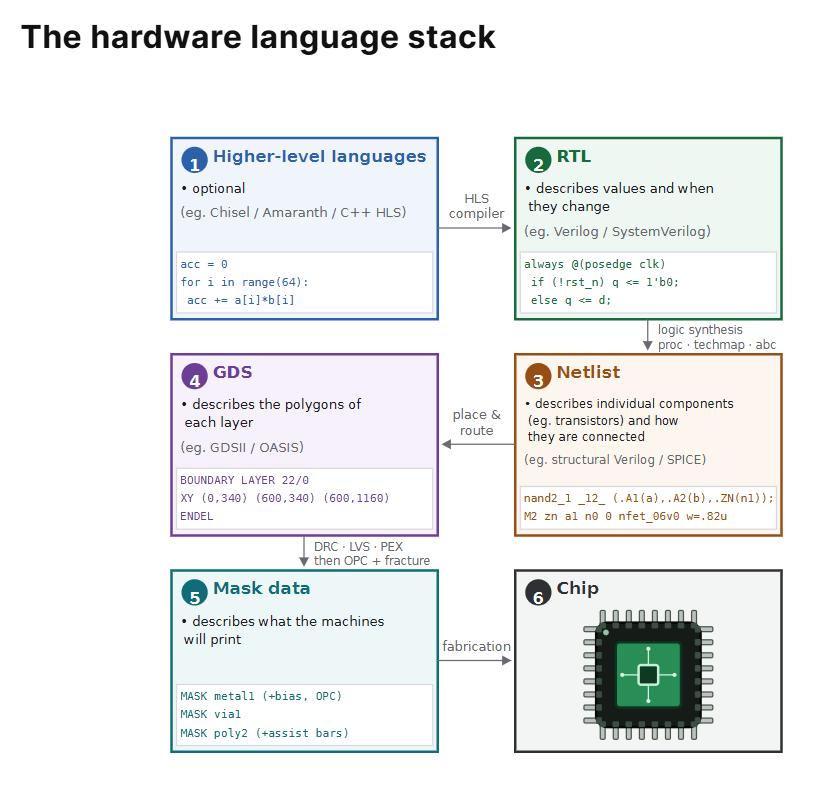
Buterin explains the chip manufacturing process through a simple example written in Verilog, a hardware description language. His demonstration uses an eight bit circuit that repeatedly multiplies a stored value by three, showing how a relatively straightforward piece of code becomes a physical chip.
The design first passes through tools such as Yosys and OpenROAD, which convert the Verilog description into a netlist containing individual components and their connections. The next stages translate this information into increasingly detailed physical layouts.
One important format is DEF, which describes the placement and routing of connections across different metal layers. The process eventually produces a GDS file, which contains the physical geometry of the chip, including the shapes and positions of its individual components.
Buterin stresses that this distinction matters for verification. Verilog explains what a chip should do, while GDS provides a much closer representation of what should actually be manufactured.
Why Open GDS Files Matter for Chip Verification
For Buterin, publishing Verilog alone does not provide enough transparency. A manufacturer could produce a chip that performs the expected functions while incorporating changes that are difficult to identify through software testing.
Open GDS files give independent auditors a physical reference against which manufactured chips can be examined. Buterin discusses microscope based inspection methods, including IRIS, which uses reflected light at different wavelengths to identify suspicious differences in chip structures.
More sophisticated attacks, such as malicious changes to semiconductor doping, may require destructive examination. Techniques such as focused ion beam scanning electron microscopy can inspect individual layers after the chip has been taken apart.
He does not suggest that every consumer should inspect their own hardware. Instead, professional auditors, journalists and civil society organisations could use these methods to examine manufacturers and distributors.
A shallow dive into open-source chip design:
— vitalik.eth (@VitalikButerin) November 26, 2026
Open Foundries & the Road Ahead
Buterin identifies publicly accessible process design kits as an important part of making hardware development more transparent. These kits provide the technical information needed to design chips for particular manufacturing processes.
He highlights GlobalFoundries' GF180 process in Singapore, SkyWater's SKY130 process in Minnesota and IHP's 130 nanometre process in Frankfurt as examples of foundries supporting open chip development. These options allow developers to access design information and publish chip layouts without signing restrictive confidentiality agreements.
However, open manufacturing comes with limitations. Smaller fabrication processes offer better performance and efficiency, while openly accessible options generally involve compromises. Buterin also explains that the manufacturing process includes adjustments that are not fully public, making complete physical verification more complicated.
He identifies several areas needing improvement, including open source chip design tools, accessible manufacturing processes, better inspection methods and hardware designs that are easier to examine.
His broader argument is that crypto self sovereignty cannot stop at software. As he puts it, the principle of not your keys, not your coins needs another layer of protection. Without ownership and verification of the silicon handling those keys, users cannot fully establish trust in their hardware.
If you find any issues in this article or notice missing information, please feel free to reach out at team@etherworld.co for clarifications or updates.
To promote your Web3 articles, events, and projects, you may reach out anytime via EtherWorld PR for submissions and collaboration.
Related Articles
- Vitalik Endorses LeanPCS for EIP-8288 to Scale Ethereum
- Vitalik Buterin Backs EIP 8288 for Ethereum
- Vitalik Buterin Tests Private AI Agents With Tor & zkAPI
- Vitalik Buterin on ZKsync's Faster Ethereum Proofs
- Vitalik Warns Ethereum About a Cryptographic Threat
To follow blockchain news, track Ethereum protocol progress, and read our latest stories, subscribe to our weekly today.
Join the EtherWorld & Avarch Internship Program and build your career in blockchain, content, social media, video, podcast editing, or operations. Send your resume and brief introduction to contact@etherworld.co.
Disclaimer: The information contained in this website is for general informational purposes only. The content provided on this website, including articles, blog posts, opinions, & analysis related to blockchain technology & cryptocurrencies, is not intended as financial or investment advice. The website & its content should not be relied upon for making financial decisions. Read full disclaimer & privacy policy.
To stay updated on blockchain news, Ethereum protocol progress, and our latest stories, subscribe to our weekly digest and YouTube channel for ELI5 content.
To promote your Web3 articles, events, project updates, and Press Releases, reach out anytime via EtherWorld PR for submissions and collaboration. For other queries, email contact@etherworld.co.
If you’d like to support our work, share the content and consider donating at avarch.eth.
Join our community on Discord and follow us on Twitter, Facebook, LinkedIn & Instagram.

 ×

Author

Nidhi Kumari is a Web3 content writer at EtherWorld.co, tracking ecosystem developments, funding activity, and market trends shaping the crypto space.