Ethereum Foundation Reveals Its New Playbook for Ethereum’s Future
Ethereum Foundation outlines a bold new strategy centered on privacy, censorship resistance, anti-MEV infrastructure, staking decentralization, & self-sovereignty across Ethereum.

A newly published statement from the Ethereum Foundation-affiliated account aerugoettinea has offered a detailed view into how the Ethereum Foundation plans to translate its mandate into action. The statement places Ethereum’s long-term direction around self-sovereignty, censorship resistance, privacy, open-source infrastructure, staking decentralization, anti-MEV measures, and resistance to institutional or state capture.
- Ethereum Foundation Reframes Its Core Mandate
- MEV, Privacy & Staking Become Key Defensive Priorities
- Ethereum’s Long-Term Opportunities: Quantum Resistance, ETH as Digital Cash & AI Agents
- Departures, Spinouts & the Future of EF Funding
Ethereum Foundation Reframes Its Core Mandate
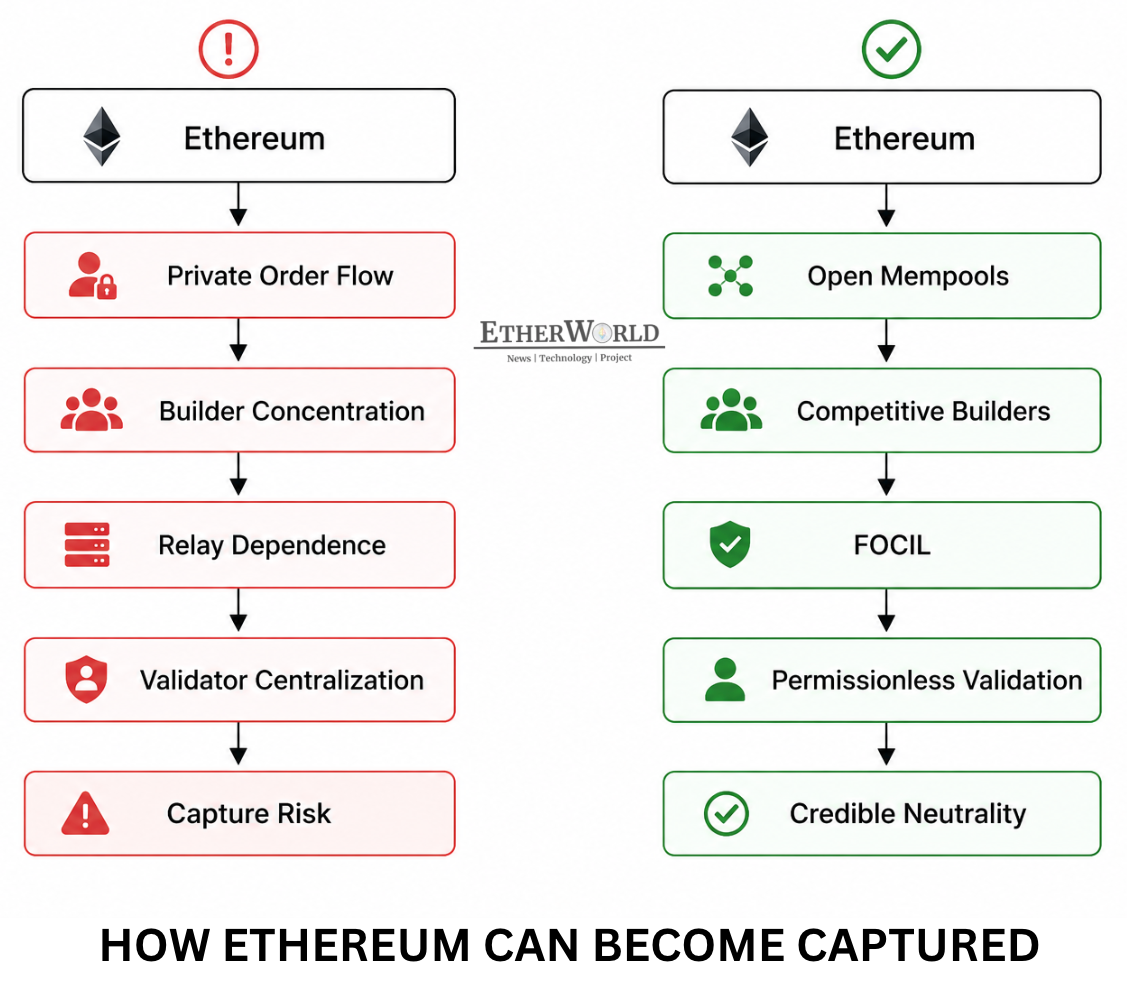
The Ethereum Foundation’s latest statement marks a clearer and more assertive explanation of what the organization believes it is meant to do. Rather than acting as a general ecosystem promoter, startup accelerator, marketing body, or institution designed to satisfy short-term market expectations, the EF is positioning itself as a defensive steward of Ethereum’s most important properties.
According to the statement, the Foundation exists to ensure that Ethereum “is, becomes, and remains” real permissionless infrastructure for self-sovereignty. This includes censorship resistance, capture resistance, open-source development, privacy, security, and the ability to support coordination at scales where trusted institutions have historically been unavoidable.
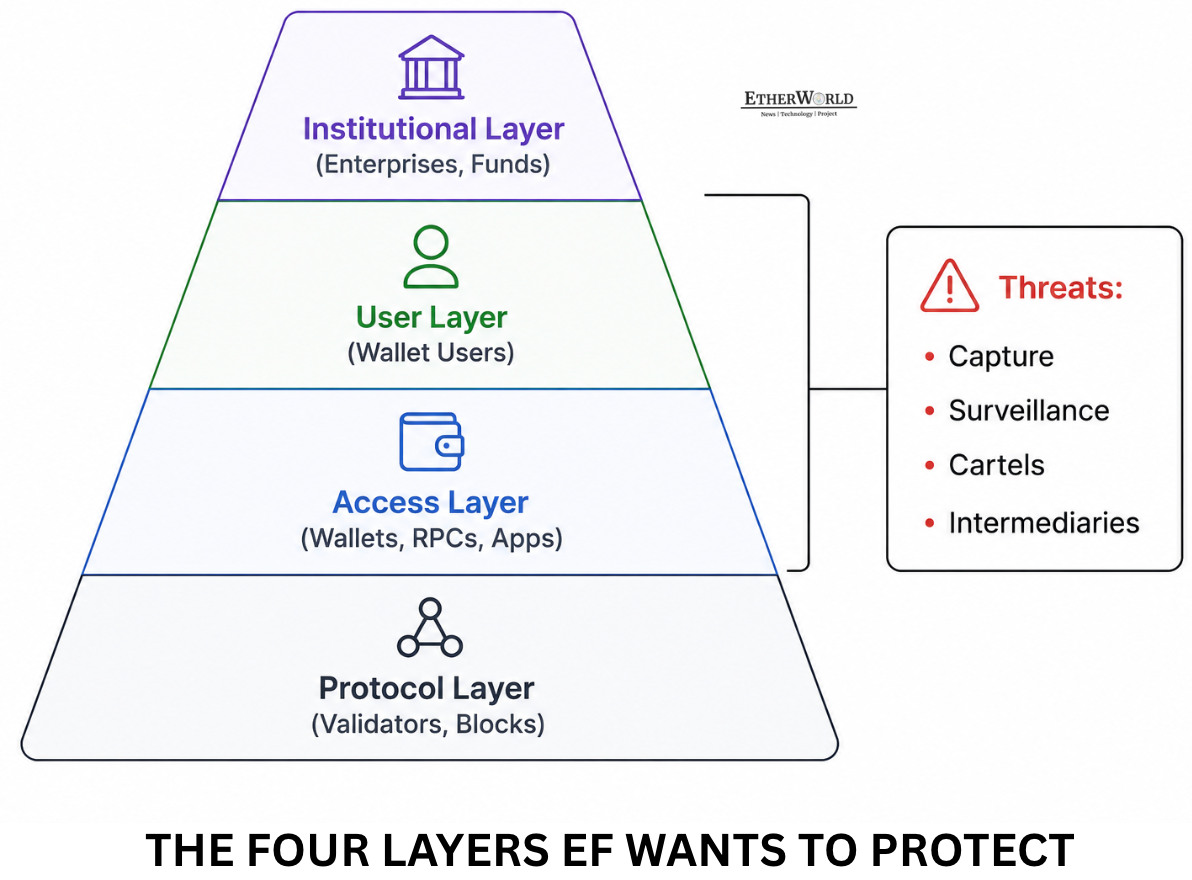
The new statement strongly suggests the latter. It argues that the EF is not here to optimize for its own importance, corporate or political appeal, ecosystem popularity, speculative price movements, or entertainment value for private industry circles. Instead, it is here to identify and reduce weaknesses that could make Ethereum extractive, vulnerable to cartels, susceptible to state capture, or usable as infrastructure for surveillance and coercion.
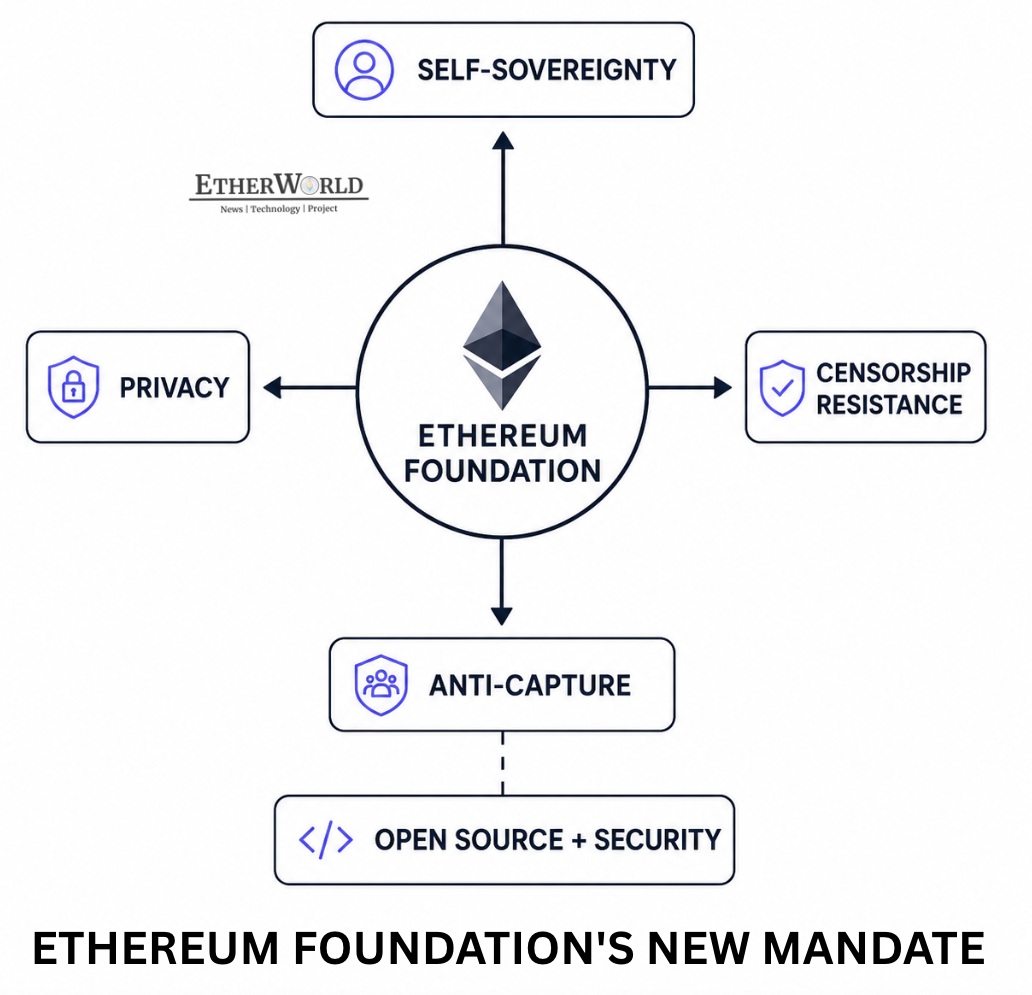
This distinction matters because Ethereum is no longer an experimental network operating only at the margins of crypto culture. It is increasingly discussed as settlement infrastructure, coordination infrastructure, financial infrastructure, and eventually even civilizational infrastructure. As Ethereum grows, the risks around capture also grow.
A major operational shift is also mentioned. The EF plans to move compensation and major financial relationships toward ETH and mandate-compliant Ethereum-native stablecoins where legal and operational conditions allow. This is not presented as a symbolic purity test, but as a way to force the organization to live within the systems it wants others to use.
If Ethereum wallets remain difficult, if stablecoin assumptions are unclear, if privacy is weak, if payments are inconvenient, or if recovery is fragile, EF contributors should feel those problems directly. The statement argues that those shaping Ethereum’s future should not be insulated from the user-facing limitations of the ecosystem.
This connects with EtherWorld’s earlier coverage of the Ethereum Foundation’s treasury policy, which also emphasized privacy, decentralization, self-custody, and permissionless access as guiding values for EF capital deployment.
MEV, Privacy & Staking Become Key Defensive Priorities
The strongest part of the statement focuses on Ethereum’s defensive priorities. Three areas stand out: MEV, privacy, and staking.
First, the EF identifies toxic MEV capture as core Foundation work. This is important because MEV is often treated as a technical market-structure issue, separate from Ethereum’s social mission. The statement rejects that separation. It argues that transaction supply, ordering, inclusion, block construction, propagation, and settlement are all part of Ethereum’s neutrality boundary.
If users must rely on privileged private order flow, centralized builders, trusted relays, opaque routing systems, or a narrow validator supply chain, Ethereum may still appear permissionless at the protocol level while becoming intermediated at the moment value moves. That would weaken one of Ethereum’s most important promises: replacing extractive middlemen with credibly neutral infrastructure.
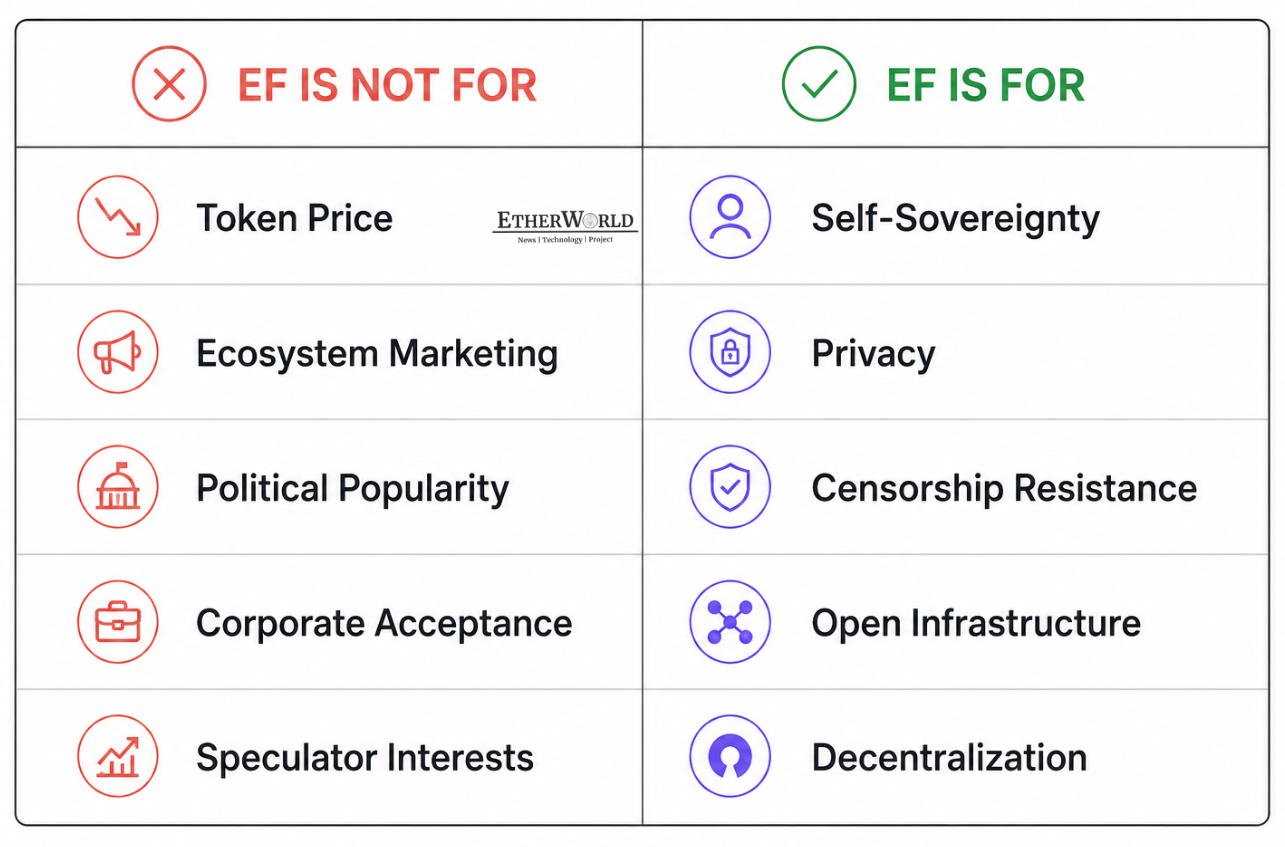
This concern directly overlaps with Ethereum’s ongoing upgrade debates around ePBS, FOCIL, and encrypted mempools. EtherWorld has previously covered why Hegotá should complete the holy trinity of censorship resistance by combining enshrined proposer-builder separation, fork-choice enforced inclusion lists, and encrypted mempools.
The Foundation’s statement is careful, however, not to treat any one mechanism as a perfect fix. It notes that FOCIL can improve censorship resistance but may introduce new MEV dynamics. ePBS can reduce reliance on trusted relays, but its implementation must avoid entrenching builder dominance. Encrypted mempools can reduce pre-execution transparency, but some designs may introduce new privileged actors or additional protocol complexity.
This is why the statement calls for solving the extraction problem at the whole-system level. MEV cannot be addressed only by patching one part of the transaction pipeline. Ethereum needs competitive transaction routing, stronger inclusion guarantees, lower barriers to block building and validation, and clearer trust assumptions for users.
Second, the statement treats privacy as fundamental rather than optional. It argues that a public ledger without serious privacy defaults risks becoming a surveillance substrate with settlement guarantees. That is a powerful framing because it challenges the idea that transparency alone is always a virtue.
The EF’s position is that unconditional privacy should come first, while selective disclosure, compliance logic, proofs, auditability, identity, reputation, and governance constraints should be layered on top by user choice. In this model, privacy is not something users should assemble manually through fragile combinations of wallets, bridges, RPC providers, apps, and operational habits. It should become a robust part of the Ethereum experience.
This direction is consistent with Ethereum’s wider push toward safer user interfaces and stronger trust assumptions. EtherWorld recently covered WYRIWE: What You Read Is What You Execute, which explores how cryptographic attestations can help users verify what input an AI system actually received. While WYRIWE focuses on AI input provenance, it fits within the same broader movement: making trust assumptions visible, verifiable, and harder to exploit.
1. Intro
— Aerugo (@aerugoettinea) June 22, 2026
Vitalik recently wrote about where the EF should go; Aya added a note to explain how we got here, and why. I’ll write about the execution.
We now have enough clarity to stop treating “what is the EF for?” as an open-ended question. Our mandate is clear: The EF exists…
Third, the statement identifies staking as a protocol infrastructure risk, not merely a yield product. This is an important distinction. Liquid staking markets, validator operators, DeFi collateral systems, and governance influence can become tightly connected. If these areas concentrate around a small set of issuers or operators, Ethereum’s security layer may become vulnerable through the economic layer around it.
The EF says it will support research and designs that keep staking permissionless, private where possible, plural in operation, and resistant to permanent intermediary control. This aligns with EtherWorld’s broader coverage of Ethereum staking mechanics, including proposals such as EIP-7044 on perpetually valid signed voluntary exits, which aimed to simplify validator operations and improve staking UX.
Together, these priorities show that the EF is thinking about decentralization beyond slogans. It is not enough for Ethereum to be technically open if users are practically forced into centralized defaults.
Ethereum’s Long-Term Opportunities: Quantum Resistance, ETH as Digital Cash & AI Agents
The statement does not only focus on defensive work. It also outlines several opportunities the Foundation believes Ethereum should seize.
One of the most ambitious is making Ethereum the first quantum-resistant global infrastructure. The statement argues that Ethereum researchers should lead post-quantum cryptographic migration before the threat becomes urgent. Waiting until quantum risk becomes a governance emergency would leave too little room for careful design.
This long-horizon thinking matters because Ethereum’s core infrastructure is expected to last for decades. If the network is meant to become a settlement layer, coordination layer, and execution substrate for global activity, its cryptographic foundations must evolve before they become vulnerable.
Another opportunity is building a verifiably self-sovereign stack from end to end. The statement describes this stack as covering browsers, wallets, intents, broadcasts, order flow, inclusion, block construction, proposals, proving, exit, and recovery. The goal is not simply to prevent censorship or extraction, but to make credibly neutral execution competitive enough that serious users prefer it.
This connects closely with Ethereum’s upgrade roadmap. Glamsterdam and Hegotá are already shaping discussions around ePBS, FOCIL, validator UX, and transaction inclusion. EtherWorld’s Glamsterdam upgrade tracker has followed how these protocol changes are gradually forming the next stage of Ethereum’s infrastructure.
The statement also presents ETH as “normal digital cash”: private, dignity-respecting, debasement-resistant, surveillance-resistant, and useful as both a medium of exchange and store of value. This is a stronger framing than ETH as only gas, collateral, or an investment asset. It positions ETH as the native asset of private computation and private coordination for humans and agents.
The mention of AI agents is particularly notable. The statement argues that as agents become interfaces for economic and social action, ownership of the wallet, model, memory, policy, and signing authority becomes a sovereignty question. In simple terms: if users do not control the agent making decisions on their behalf, they may not truly control their digital life.
EtherWorld has previously covered related debates around sovereign AI and Ethereum, where Vitalik Buterin pushed back on narratives that celebrate autonomous AI without enough attention to alignment and human control. The EF statement appears to take a similar concern seriously: AI agents may become powerful interfaces, but they must not become new custodians of user sovereignty.
Institutional and enterprise adoption is also discussed, but with an important caveat. The Foundation does not want Ethereum to disappear into invisible backends controlled by intermediaries. It does not want Ethereum to become a compliant fintech rail with Web3 branding. Instead, the goal is for institutions to meet Ethereum users on Ethereum’s terms: credible neutrality, self-custody, exit rights, transparency of assumptions, and reduced dependence on trusted intermediaries.
Finally, the statement highlights security-preserving scaling. L2s and related infrastructure should meet institutional-level needs without relying on closed operators, opaque sequencing, custodial UX, or upgrade committees that users cannot realistically exit. Scale is therefore not just throughput. Scale means self-sovereignty remains available under real-world load.
Departures, Spinouts & the Future of EF Funding
The statement also addresses recent speculation around Ethereum Foundation departures. It confirms that some people resigned, some were terminated, some left because of strategy or role fit, and others decided their best work for Ethereum should happen elsewhere.
However, the EF says it will not litigate individual personnel matters publicly. The statement argues that former contributors deserve dignity and should not have their employment history turned into factional content. Where public claims materially mislead people about the Foundation’s direction or mandate, EF may correct the record at the level of policy, process, or institutional facts, but it will not turn personal files into public spectacle.
This part of the statement is important because Ethereum governance is unusually public. Disagreements often play out on X, forums, podcasts, and community calls. While that openness can improve accountability, it can also turn organizational changes into social-layer conflict. The EF appears to be drawing a boundary between legitimate debate about direction and inappropriate speculation about individuals.
The statement also discusses spinouts. Some work currently inside the Foundation may leave in the months ahead. But the EF warns that spinouts should not become an excuse for undisciplined spending or abdication of responsibility.
Not every former EF project should automatically receive EF funding. The key question is whether the work is mandate-critical, whether EF would do it internally if it had capacity, whether there is a better natural home, whether the external party can execute without increasing capture risk, and whether funding reduces Ethereum’s dependence on EF over time.

This is a significant governance signal. The EF is saying that former affiliation does not create an automatic claim on legitimacy, funding, or endorsement. External funding may be appropriate when it supports essential mandate work, protects Ethereum’s core properties, advances self-sovereignty, and can be reviewed without creating permanent dependency. It is not appropriate as a friendship payment, continuity payment, reputational hedge, or way to avoid difficult decisions.
This is a more disciplined and opinionated EF than some may have expected. It is less focused on broad ecosystem popularity and more focused on protecting Ethereum from becoming captured while still appearing decentralized.
For Ethereum users, developers, validators, researchers, and institutions, the message is clear. The Foundation wants Ethereum to remain usable when counterparties fail, platforms censor, governments overreach, intermediaries extract, and trusted systems can no longer coordinate fairly. That means Ethereum’s next era will not be defined only by scaling or adoption numbers. It will be defined by whether self-sovereignty survives at scale.
To promote your Web3 articles, events, and projects, you may reach out anytime via EtherWorld PR for submissions and collaboration.
Related Articles
- New Leadership at Ethereum: A Fresh Start for the Blockchain Community
- Hsiao-Wei Wang Joins Ethereum Foundation Leadership Team
- Highlights from the All Core Developers Consensus Call #180
- State of Upgrade – Hegota Edition #1
- Vitalik Buterin’s 2026 Vision for Ethereum Foundation
To follow blockchain news, track Ethereum protocol progress, and read our latest stories, subscribe to our weekly today.
Disclaimer: The information contained in this website is for general informational purposes only. The content provided on this website, including articles, blog posts, opinions, & analysis related to blockchain technology & cryptocurrencies, is not intended as financial or investment advice. The website & its content should not be relied upon for making financial decisions. Read full disclaimer & privacy policy.
To stay updated on blockchain news, Ethereum protocol progress, and our latest stories, subscribe to our weekly digest and YouTube channel for ELI5 content.
To promote your Web3 articles, events, project updates, and Press Releases, reach out anytime via EtherWorld PR for submissions and collaboration. For other queries, email contact@etherworld.co.
If you’d like to support our work, share the content and consider donating at avarch.eth.
Join our community on Discord and follow us on Twitter, Facebook, LinkedIn & Instagram.

 ×
×

Author

Yash Kamal Chaturvedi is a Blockchain Content & Ops Specialist at Avarch LLC, writing on Ethereum & governance since 2021. Covers ACD/ACDE calls, EIPs, upgrades, staking, security & ecosystem trends.