Ethereum’s Funding Debate Raises Bigger Questions for Protocol Sustainability
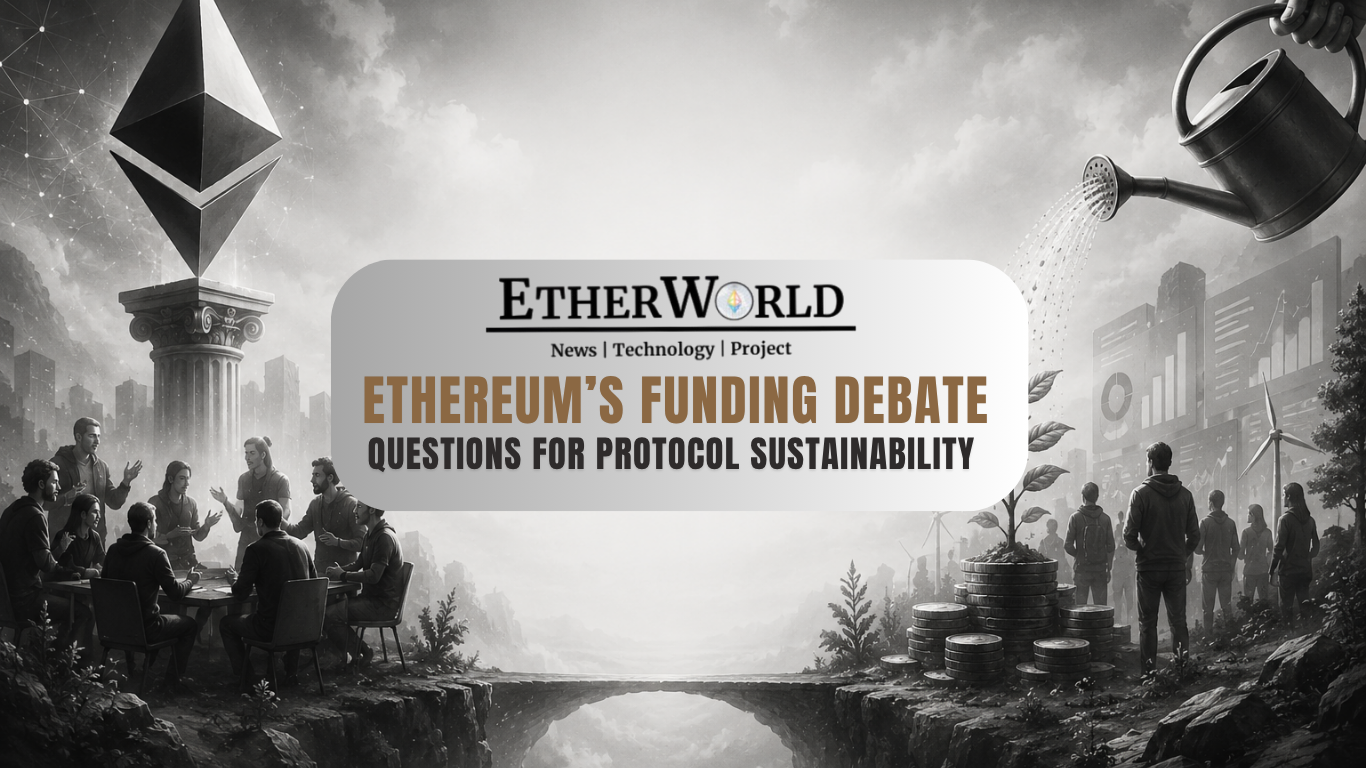
Ethereum’s funding debate intensifies as developers warn of a looming public goods financing gap, raising questions about client sustainability, protocol funding, and Ethereum’s long-term resilience.
 ×
×

Join Our Internship Program
Apply Now →Ethereum’s public goods funding debate has intensified after former Ethereum Foundation core development coordinator Trent Van Epps warned that the ecosystem could face a serious funding gap within the next three to nine months.
Van Epps estimates that more than ten client, research, and coordination teams may require roughly $30 million annually to continue operating at a healthy level. This has triggered a broader ecosystem conversation around protocol funding, validator rewards, client diversity, transparency, and Ethereum’s long-term responsibility toward its own infrastructure.
The issue is no longer whether Ethereum needs public goods. It is whether Ethereum has a sustainable funding model for them.
- Why Ethereum’s Funding Debate Matters Now
- Client Teams, Public Goods & The $30M Question
- Conviction vs Compensation: The Linux Analogy Debate
- What Sustainable Ethereum Funding Could Look Like
Why Ethereum’s Funding Debate Matters Now
Ethereum has always depended on public goods. From execution clients and consensus clients to developer tooling, security research, governance coordination, standards work, and education, much of Ethereum’s foundation is maintained by contributors whose work does not always have a direct business model.
In the early years, this model worked because Ethereum was young, exciting, and full of upside. Developers could contribute to the protocol because participation itself carried reputation, opportunity, and long-term career value. Many early contributors were willing to work with limited compensation because Ethereum felt like one of the most important open-source projects in the world.
Maintaining Ethereum today requires deep expertise in distributed systems, cryptography, networking, formal verification, economics, validator operations, MEV, and client interoperability. These are not tasks that can reliably be handled by volunteers working nights and weekends.
This is why the current funding debate matters. If Ethereum wants to remain neutral, resilient, and credibly decentralized, it must ensure that the infrastructure beneath the ecosystem is not dependent on fragile, short-term grants or the goodwill of a small number of contributors.
EtherWorld has previously covered Ethereum’s public goods funding efforts through initiatives such as TheDAO Security Fund’s first funding round and the Ethereum Security QF Round. Those efforts show that the ecosystem understands the importance of funding shared infrastructure. However, the latest debate suggests that security rounds and temporary grants may not be enough to support core protocol maintenance at scale.
Client Teams, Public Goods & The $30M Question
The most important part of Ethereum’s infrastructure is its client ecosystem. Ethereum does not rely on a single software implementation. Instead, multiple execution and consensus clients independently implement the protocol, helping reduce the risk that one bug or one team failure could threaten the entire network.
Execution clients such as Geth, Nethermind, Besu, and Erigon, along with consensus clients such as Lighthouse, Prysm, Teku, Nimbus, and Lodestar, form the operational backbone of Ethereum. This client diversity is one of Ethereum’s biggest security advantages. It makes the network more resilient, reduces centralization risk, and supports healthier protocol development.
But client diversity is expensive.
Each team needs engineers, researchers, DevOps support, testing infrastructure, security review, coordination time, documentation, and long-term maintenance capacity. They must keep up with every hard fork, every EIP, every devnet, every edge case, and every network-level change. Their work often remains invisible unless something breaks.
Van Epps’ estimate of roughly $30 million annually is significant, but in the context of Ethereum’s economic footprint, it is not unusually large. Ethereum supports a massive settlement layer, powers leading DeFi protocols, anchors rollup ecosystems, and underpins growing institutional tokenization experiments. Compared to the value Ethereum secures, the cost of maintaining a healthy client ecosystem may be relatively modest.
The problem is not only the amount. The problem is predictability.
Core teams cannot hire, retain, and plan long-term if funding arrives through uncertain grants, temporary incentive programs, or one-off donations. Competitive engineers and researchers have alternatives in AI, finance, infrastructure, security, and private crypto companies. If Ethereum cannot provide stable support, some contributors may move elsewhere.
This is where the debate connects directly to Ethereum’s upgrade roadmap. Upcoming upgrades such as Glamsterdam and Hegota require extensive coordination across client teams. EtherWorld’s coverage of Glamsterdam development and Hegota upgrade discussions shows how much ongoing work is required to move Ethereum forward safely. Every major upgrade depends on the same client teams now being discussed in the funding debate.
Without reliable funding, Ethereum does not immediately stop. But protocol progress can slow, client diversity can weaken, security review can become thinner, and contributor burnout can increase. That is the real risk.
it is 2026 and i still have to argue that core devs should be very well paid https://t.co/qZqPR0UuU2
— trent.eth (@trent_vanepps) June 23, 2026
Conviction vs Compensation: The Linux Analogy Debate
A major counterargument in the funding debate is that Ethereum’s real problem may not be funding, but conviction.
Researcher Lorenzo Valente pushed back against the idea that more funding alone can solve Ethereum’s challenges. He compared Ethereum to Linux, arguing that contributors participate in major open-source ecosystems because doing so creates reputation, career capital, and long-term opportunity. In this view, the best way to attract contributors is not necessarily to create more funding mechanisms, but to make Ethereum feel more important, ambitious, and culturally compelling.
This argument has some strength. Ethereum’s early success was powered by conviction. Builders believed they were contributing to a new financial and computational foundation for the internet. That belief attracted developers, researchers, and entrepreneurs even when compensation was limited.
But the Linux analogy also has limits.
Linux kernel development is not maintained purely by unpaid volunteers. Many major contributors are employed by companies whose commercial interests depend on Linux infrastructure. Red Hat, Intel, Google, Microsoft, and other companies have long supported Linux development because the kernel matters to their business models.
Ethereum’s client teams do not always have the same direct commercial backstop. A consensus client maintaining validator software may be essential for Ethereum’s safety, but its value is not always easily captured through a private business model. The work is critical precisely because it is shared infrastructure.
That creates a funding mismatch.
The ecosystem benefits from strong clients, resilient networking, censorship resistance, and secure upgrades. But the teams doing that work may not directly capture the economic upside generated by Ethereum’s growth. This is the classic public goods problem.
The conviction argument also assumes that Ethereum can continue attracting top-tier contributors through mission alone. That may have been more realistic when Ethereum was smaller and less specialized. Today, core protocol work demands full-time focus from highly skilled people. Passion still matters, but passion does not replace salaries, team budgets, audits, infrastructure costs, and long-term planning.
A better framing may be that Ethereum needs both conviction and compensation. Funding without mission alignment can become bureaucratic. Mission without funding can become burnout. Ethereum needs contributors who believe in the protocol, but it also needs mechanisms that allow them to work sustainably.
What Sustainable Ethereum Funding Could Look Like
The current debate has opened several possible paths for Ethereum’s funding future.
One approach is expanded grant funding. The Ethereum Foundation, ecosystem funds, DAOs, and philanthropic supporters could continue funding public goods through grants, quadratic funding, and retroactive rewards. EtherWorld has covered examples of this model through Giveth and TheDAO’s QF approach and other Ethereum security funding initiatives.
This model is useful because it encourages broad participation and community signaling. However, grants alone may not be ideal for long-term protocol maintenance. Client teams need recurring support, not only competitive rounds.
A second approach is protocol-aligned funding. Some community members have discussed redirecting a portion of validator rewards, staking revenue, or protocol-adjacent income toward public goods. This could create a more predictable funding stream for core infrastructure. However, it would also raise governance questions. Who decides where funds go? How are teams evaluated? Would validators support it? Could it create political conflict inside Ethereum?
A third approach is institutional ecosystem funding. As Ethereum becomes more important to stablecoins, tokenized assets, DeFi, and rollups, companies that benefit from Ethereum could contribute more directly to its maintenance. This would mirror parts of the Linux model, where commercial users help support the infrastructure they depend on.
A fourth approach is strengthening independent funding institutions such as Protocol Guild-style mechanisms. These models attempt to reward long-term contributors more directly, while reducing reliance on a single foundation. If designed well, they could provide a more neutral and transparent way to fund Ethereum’s human infrastructure.
The challenge is governance. Ethereum does not have a central authority that can simply impose a funding system. Any durable model must earn legitimacy across client teams, researchers, validators, application developers, ETH holders, and users.
That means transparency will matter. Contributors asking for funding may need to communicate needs more clearly. Funders may need to explain allocation principles. The community may need better visibility into what core protocol maintenance actually costs.
At the same time, Ethereum should avoid turning every funding conversation into a public salary trial. The goal should not be to shame contributors into proving hardship. The goal should be to ensure that Ethereum’s most important infrastructure is maintained by stable, competent, independent teams.
The funding debate is ultimately a maturity test. Ethereum has moved far beyond its experimental stage. It now supports global financial activity and continues to evolve through major upgrades. A mature protocol needs mature funding systems.
Ethereum’s strength has always come from its community, but community alone is not a funding model. The next phase of Ethereum may depend on whether it can turn shared values into sustainable support for the people and teams who keep the protocol alive.
To promote your Web3 articles, events, and projects, you may reach out anytime via EtherWorld PR for submissions and collaboration.
Related Articles
- New Leadership at Ethereum: A Fresh Start for the Blockchain Community
- Hsiao-Wei Wang Joins Ethereum Foundation Leadership Team
- Highlights from the All Core Developers Consensus Call #180
- State of Upgrade – Hegota Edition #1
- Vitalik Buterin’s 2026 Vision for Ethereum Foundation
To follow blockchain news, track Ethereum protocol progress, and read our latest stories, subscribe to our weekly today.
Disclaimer: The information contained in this website is for general informational purposes only. The content provided on this website, including articles, blog posts, opinions, & analysis related to blockchain technology & cryptocurrencies, is not intended as financial or investment advice. The website & its content should not be relied upon for making financial decisions. Read full disclaimer & privacy policy.
To stay updated on blockchain news, Ethereum protocol progress, and our latest stories, subscribe to our weekly digest and YouTube channel for ELI5 content.
To promote your Web3 articles, events, project updates, and Press Releases, reach out anytime via EtherWorld PR for submissions and collaboration. For other queries, email contact@etherworld.co.
If you’d like to support our work, share the content and consider donating at avarch.eth.
Join our community on Discord and follow us on Twitter, Facebook, LinkedIn & Instagram.
Author

Yash Kamal Chaturvedi is a Blockchain Content & Ops Specialist at Avarch LLC, writing on Ethereum & governance since 2021. Covers ACD/ACDE calls, EIPs, upgrades, staking, security & ecosystem trends.