Who's Building for Ethereum's AI Agents?
Explore the key projects building Ethereum's AI agent infrastructure, from identity and payments to verifiable computing, decentralized data, and autonomous execution.

The conversation about AI in cryptocurrencies has rapidly evolved beyond chatbots and AI-powered trading assistants. The next phase is being shaped by autonomous AI agents, software that can make decisions, interact with smart contracts, handle digital assets, collaborate with other agents, and perform on-chain tasks with minimal human intervention. Despite significant advancements over the past year, large language models still lack the infrastructure required to operate independently in decentralised networks. Beyond reasoning, an AI agent must be able to locate trustworthy information, verify its identity, conduct transactions, pay for services, and interact securely with blockchain applications.
Ethereum is becoming a natural foundation in this case. Ethereum is evolving, becoming the coordination layer for a whole new kind of autonomous software because of its developed smart contract ecosystem, decentralised security model, and growing modular design. However, blockchain access alone is not enough to enable AI agents. Decentralised data indexing, verifiable computing, encrypted identity, autonomous execution frameworks, machine-native payment rails, and coordination protocols that enable agents to collaborate safely and at scale are all necessary components of a linked infrastructure stack.
An increasing number of projects have started constructing these foundational layers within the past year. Instead of creating AI models themselves, they are resolving the technological issues that determine the dependability of AI agents in decentralised settings. Some are developing operating systems, marketplaces, payment networks, and coordination frameworks especially for autonomous software, while others are enabling trust-minimised computing through zero-knowledge proofs and making blockchain data instantaneously accessible to agents.
As AI agents become more capable of participating in on-chain economies, the infrastructure supporting them will likely become equally important as the agents themselves. Instead of competing to construct the most advanced AI model, the projects covered in this article are building the infrastructure that will allow intelligent agents to operate safely, independently, and at internet scale throughout Ethereum. The future generation of decentralised applications is being developed thanks to their present innovations.
- The Graph
- Succinct
- WYRIWE
- ElizaOS
- Virtuals Protocol
- Olas
- Bittensor
- OpenServ
- Skyfire
- Arcade.dev
- The Foundation of Ethereum's AI Agent Economy
1. The Graph
As AI agents become more capable of performing on-chain actions independently, their biggest limitation is no longer intellect but rather access to reliable blockchain data. Whether monitoring a lending position, executing a trade, assessing governance recommendations, or collaborating with another agent, all autonomous decisions depend on accurate, current information. Because centralised APIs include latency, trust assumptions, and single points of failure, they are unsuitable for autonomous systems that must operate continuously.
The Graph has grown to be one of Ethereum's most significant infrastructure initiatives because of this. It is developing the decentralised data layer that enables AI agents to obtain, validate, and process blockchain data straight from the network, as opposed to competing to create AI models. This function is becoming more and more crucial as Ethereum's AI ecosystem grows, since autonomous software can only make trustworthy conclusions when the underlying data infrastructure is equally trustworthy.
This more comprehensive vision is reflected in the most recent development roadmap for the protocol. Horizon is a modular data stack that The Graph unveiled in 2026, intending to go beyond conventional indexing. Amp, a blockchain-native SQL database for high-performance analytics, is part of Horizon, along with Horizon Subgraphs, Token API, Substreams, and other data services designed to increase the accessibility of blockchain data for AI applications, developers, and businesses. AI agents may now interact with on-chain state more effectively across numerous networks thanks to these initiatives, which also greatly minimise the complexity of retrieving data.
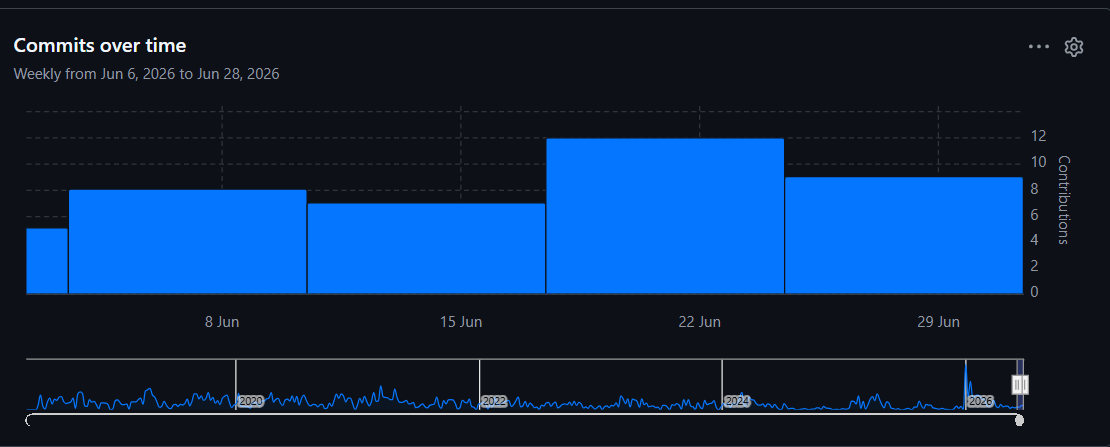
According to the network's most recent metrics, this infrastructure is already functioning at a significant scale. Over 167,781 Delegators have contributed an additional 1.2 billion GRT to bolster network security, while 88 active Indexers have staked 690.2 million GRT to secure the protocol's processing of roughly 9.3 billion queries over the last six months, according to The Graph's Network Dashboard. Infrastructure providers have consistently participated in the ecosystem, as evidenced by the distribution of 363.2 million GRT in Indexer incentives and 428.9 million GRT to Delegators.
2. Succinct
AI agents must demonstrate that their calculations were accurate in addition to carrying out transactions in order to be accepted as trusted Ethereum participants. Succinct is using SP1, its open-source zero-knowledge virtual machine (zkVM), to address this issue. The barrier to creating verifiable apps is greatly reduced by SP1, which enables applications to generate zero-knowledge proofs straight from ordinary Rust programs rather than needing developers to create bespoke circuits. Infrastructure such as SP1 allows AI agents to return cryptographic proofs that can be confirmed on Ethereum without disclosing the underlying computation as they start to execute increasingly complicated tasks off-chain.
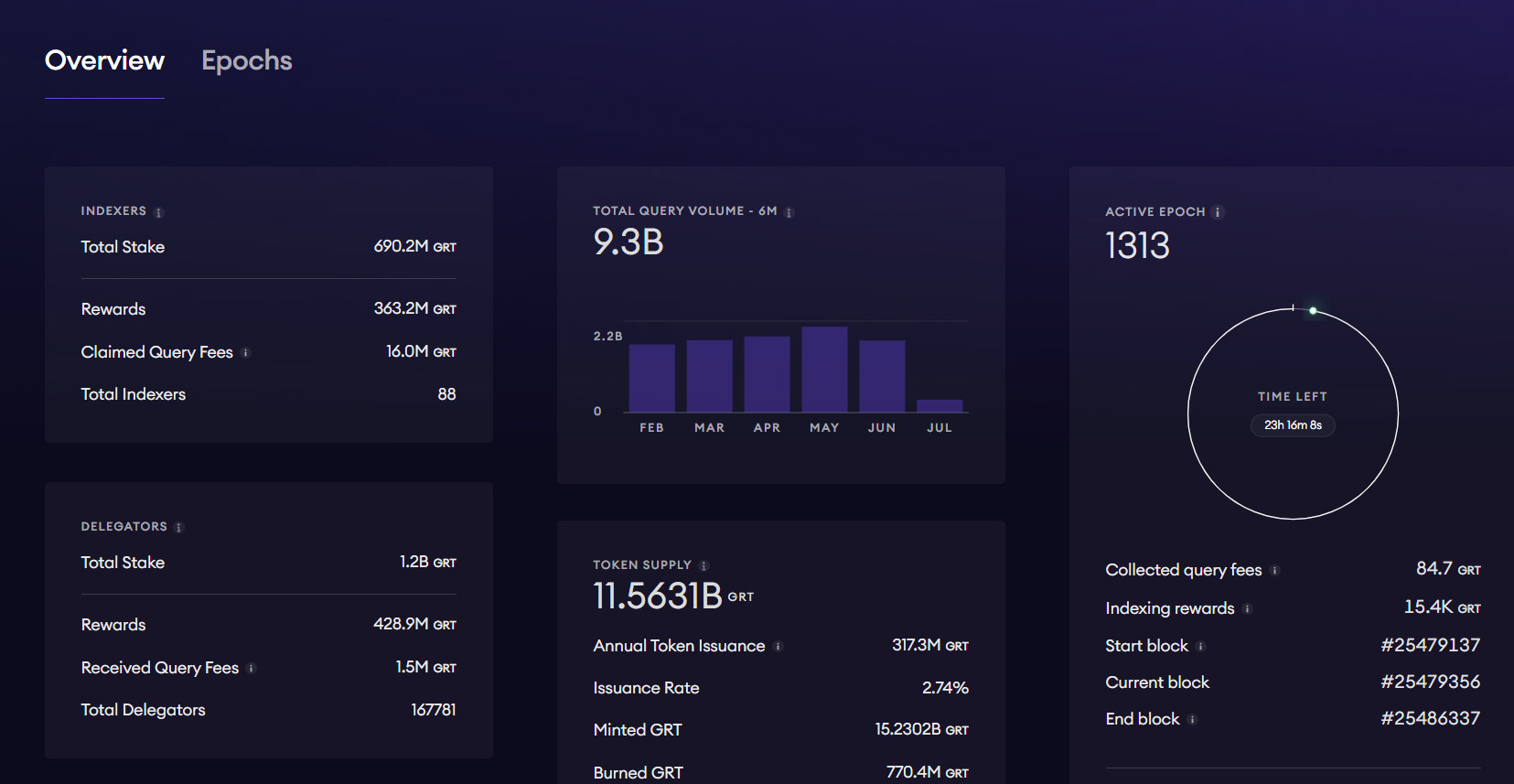
Over the past month, there has been a significant acceleration of development surrounding SP1. The project demonstrated an aggressive release cadence centred on performance and developer tooling by releasing four production updates in June: v6.2.3 (June 1), v6.2.4 (June 8), v6.3.0 (June 20), and v6.3.1 (June 25). The team's ongoing effort on lowering proving latency and enhance scalability is demonstrated by recent upgrades that included DAG-native GPU zero-check proving, zkEVM guest platform support, market-based prover pricing, enhanced GPU optimisation, and other prover reliability improvements.
This impetus is reinforced by the engineering activity of the project. The accompanying GitHub contributor graph demonstrates steady growth throughout June, with contributor activity peaking the week of June 8 and continuing to be active for the remainder of the month. With over 1,700 GitHub stars, more than 660 forks, and more than 60 production releases, the repository itself demonstrates the fast-expanding SP1 development community.
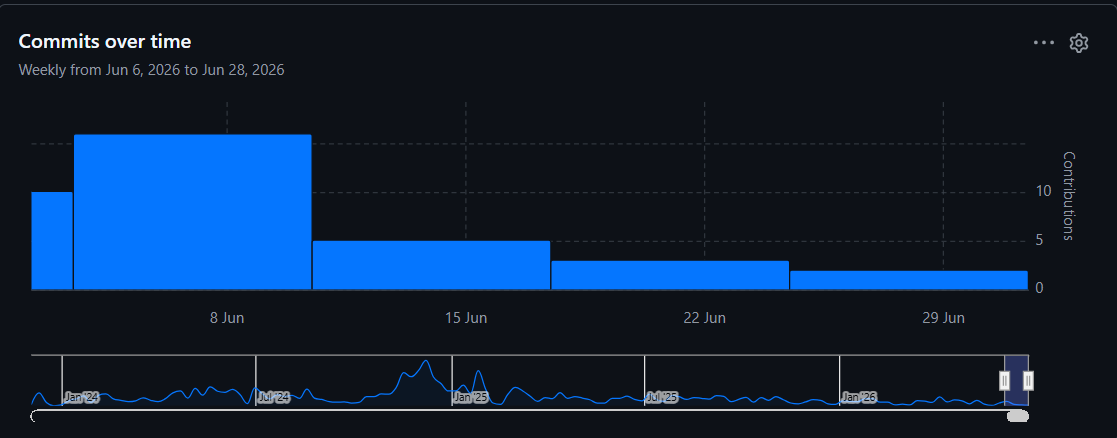
zkVMs like SP1 are becoming a crucial trust layer as AI agents increasingly use off-chain reasoning to settle decisions on Ethereum. Succinct is establishing itself as a key infrastructure supplier for the upcoming generation of autonomous, verified AI applications by fusing regular protocol updates with ongoing engineering work.
3. WYRIWE
As autonomous AI agents gain the ability to manage assets, communicate with smart contracts, and carry out transactions without continuous human supervision, trust is moving from the agent's operator to its actual actions. An AI model's output can be altered with a single hidden prompt adjustment, middleware intervention, or gateway-level rewrite while the end user is unaware of the changes. For Ethereum, where AI agents are anticipated to manage financial transactions, governance involvement, and other high-value on-chain operations, this difficulty is becoming more and more significant.
In order to solve this issue, WYRIWE (What You Read Is What You Execute) introduces a cryptographic architecture that enables users to confirm that the prompt processed by an AI model is precisely the one they initially authorised.
WYRIWE improves the integrity of the inference pipeline instead of concentrating on model performance. In order to provide a verifiable chain of custody from the user's initial prompt to the last command carried out by the AI model, the proposal combines a triple-hash commitment mechanism with EIP-712 signed attestations. Unauthorised changes can be quickly identified since every step of prompt transformation, including formatting, sanitisation, and preprocessing, can be cryptographically checked.
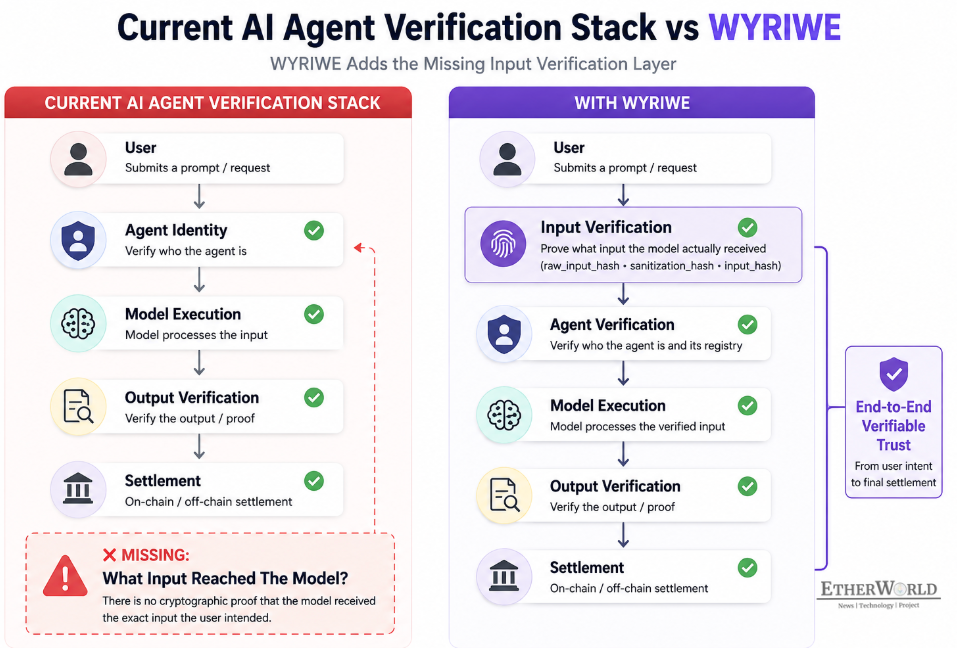
While ERC-8004 concentrates on agent identity, ERC-8126 on AI verification, and ERC-8263 on proof validation, WYRIWE supports these initiatives by guaranteeing the accuracy of the AI's input before any computation.
WYRIWE represents a significant change in Ethereum's AI roadmap, even if it is still in its infancy. It goes beyond merely empowering autonomous agents to make their decision-making process auditable and reliable. The ability to demonstrate that "what the user reads is exactly what the AI executes" may become as essential as identity verification or zero-knowledge proofs as AI agents start coordinating across DeFi, governance, and business apps. WYRIWE is suggesting a security fundamental that reinforces the trust assumptions of Ethereum's developing AI agent economy, as opposed to establishing a new AI framework.
4. ElizaOS
AI agents require a common runtime that allows them to communicate, access external tools, manage memory, and carry out intricate operations independently as they become more adept at interacting with blockchains. By offering an open-source operating system for creating, deploying, and managing AI agents across Web3 applications, ElizaOS is establishing itself as that execution layer. The project is creating the basic foundation that developers may utilise to design autonomous agents that can function in various situations, as opposed to concentrating on a single use case.
Over the past month, development has increased significantly. The project's GitHub activity shows that after another active week of about 2,500 contributions; contributor participation peaked during the week of June 29 with over 4,000 code contributions. The team launched many v2.0.3 beta releases in June, delivering enhancements to the core runtime, CLI tooling, package management, and general developer workflow before the next stable release. This momentum is consistent with an ambitious release cadence. Instead of depending on sporadic feature drops, the quick beta cadence shows a proactive attempt to enhance framework stability.
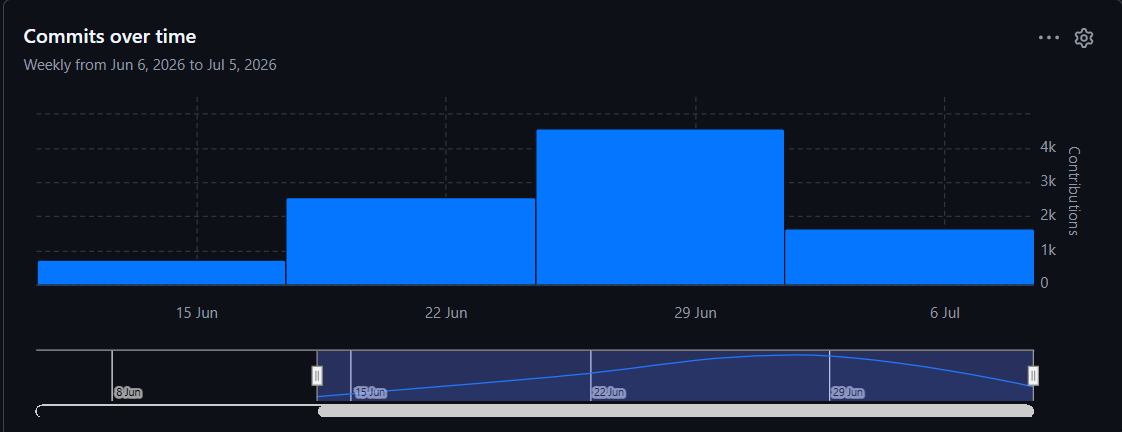
ElizaOS is growing its ecosystem through projects that make agent deployment and upkeep easier, going beyond core development. In order to reduce operational cost for production AI agents, developers may now automatically upgrade both project dependencies and the global runtime with a single command due to a revamped CLI update mechanism.
5. Virtuals Protocol
While many initiatives concentrate on increasing the intelligence of AI agents, Virtuals Protocol is tackling a different problem: how autonomous agents can engage in on-chain economies, own assets, make money, and coordinate with other agents. The infrastructure for agent identity, capital management, permits, payroll, and commerce is provided by its recently released EconomyOS, enabling AI agents to operate as autonomous economic actors as opposed to separate applications.
The most recent stats from the protocol demonstrate the size of this ecosystem. The network presently supports 50,998 AI projects, 45,558 AI agents, and more than 1.48 million on-chain jobs, according to the official Virtuals dashboard. With $31.41 million raised via the platform, roughly $2.27 million in protocol income, and $13.86 billion in 30-day trading volume across its AI economy, builder activity has also resulted in observable economic progress. These numbers show that Virtuals is becoming one of the biggest markets for autonomous AI applications, moving beyond an agent launchpad.
This position has been reinforced by recent ecological expansion. Developers may now deploy and own AI agents directly within Robinhood Chain's ecosystem to support Virtuals' AI agent architecture, which was introduced in July. Additionally, the protocol is improving the Agent Commerce Protocol (ACP), which allows agents to independently find jobs, negotiate tasks, and transact.
Robinhood Chain is integrating Virtuals’ AI agent infrastructure from day one, giving users access to launch, fund, own, and use agents in tokenized markets. https://t.co/R72jEWqsHF pic.twitter.com/YQX5Ran10p
— Virtuals Protocol (@virtuals_io) July 2, 2026
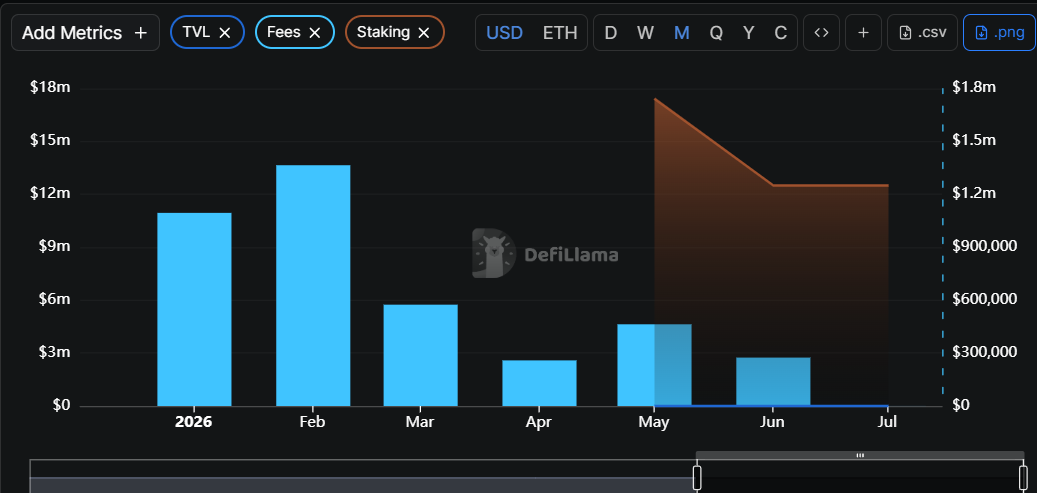
While monthly protocol fees reached a record of about $17 million in May and then stabilised at about $12 million through June and early July, TVL surpassed $13 million in February. The protocol consistently generates fee revenue despite market changes, demonstrating continued usage as its AI agent economy grows.
6. Olas
Olas has spent the past month developing the infrastructure that enables users to own, deploy, and profit from autonomous AI agents rather than merely engaging with them. The biggest shift has been the continued expansion of Pearl, Olas' AI agent marketplace, along with enhancements to its staking strategy and agent economy.
The next phase of Olas Staking, which employs new staking contracts to reduce token emissions to roughly 5% annually while shifting incentives from passive token holders to productive, superior AI agents, was announced by the team on June 28. This is a significant development for the protocol's Proof of Active Agent paradigm, which links rewards more and more to real agent usage and economic activity rather than just money.
The agent marketplace inside the ecosystem has also grown. Olas added Babydegen and Mech into its Agent Economy Explorer during the final week of June, providing developers with more insight into the network's active AI services. The protocol also included Basius, a new autonomous AI agent that can produce insights about the cryptocurrency market, to Pearl's list of agents that are ready for production. These developments show how Olas avoids depending on a single flagship application by consistently expanding the number of specialised agents available through its ecosystem.
This expansion is contextualised by the prior momentum of the protocol. Pearl generated 15.6 million total on-chain transactions, 11.7 million agent-to-agent transactions, and 834 daily active agents during Q1 2026, demonstrating significant real-world usage before the most recent ecosystem upgrades. Olas is establishing itself as one of Ethereum's most complete platforms for deploying, running, and profitably coordinating autonomous AI agents as it keeps improving staking incentives while growing Pearl's marketplace.

Source: Olas
7. Bittensor
Bittensor is developing a decentralised marketplace where AI models, inference providers, and specialised services compete for rewards based on the value they add to the network, whereas the majority of AI infrastructure initiatives concentrate on computation or agent frameworks. It is becoming a crucial infrastructure layer for autonomous AI applications because of its subnet architecture, which enables developers to start separate AI economies while sharing security and incentives through the larger Bittensor ecosystem.
Over the last month, the network has continued to grow quickly. As a result of the increasing number of specialised AI networks being implemented throughout the protocol. According to taostats, Bittensor currently supports over 120 active subnets. Additionally, the ecosystem's market capitalisation of roughly $2.36 billion and its 24-hour trading volume of nearly $119 million highlight ongoing market activity. Approximately 52.8% of the entire supply has already been released since the initial halving in December 2025, with 11.09 million TAO now in circulation out of the network's fixed 21 million TAO supply. The next protocol halving is anticipated to occur in December 2029, at which point block rewards will drop from 0.5 TAO to 0.25 TAO.
Bittensor is growing the underlying market where autonomous AI services can be found, assessed, and profitably rewarded rather than creating a single AI product. The protocol's development as one of the biggest decentralised AI infrastructure networks supporting the upcoming generation of autonomous agents is highlighted by the quick increase in active subnets, which also shows growing developer participation.
8. OpenServ
OpenServ is concentrated on a different layer of the stack, offering a production-grade reasoning engine that enables AI agents to carry out intricate processes in corporate environments, as opposed to competing to develop another AI model. The project has focused on growing its SERV Reasoning infrastructure over the past month, with the impending SERV Reasoning v2.0 being positioned as its biggest product upgrade to date. The update, which is expected to be released in the middle of July, strengthens OpenServ's goal of becoming the foundation for autonomous AI systems rather than just an application layer by introducing a more scalable reasoning engine intended for government, financial, and enterprise deployments.
Additionally, the protocol's Reasoning API, which is interoperable with both OpenAI and Anthropic, is already in private beta, allowing developers to include formal reasoning into their own AI agents. Early production benchmarks, according to OpenServ, demonstrate that when combined with DeepSeek V4 Flash, the SERV engine provides comparable reasoning performance at about one-thirtieth of the price of rival proprietary models, thus lowering infrastructure expenses for enterprise AI workloads. While maintaining collaborations with business and governmental entities to test the platform in real-world settings, the team has concurrently increased liquidity to roughly $2.7 million.
OpenServ is investing in the reasoning layer itself, integrating structured reasoning graphs, validation, privacy, and auditability into a single infrastructure stack, in contrast to agent frameworks that prioritise orchestration.
SERV is designed to free enterprises from depending on any government’s rules.
— OpenServ (@openservai) June 26, 2026
US Commerce directives pulled Fable 5 and gated GPT-5.6.
SERV allows open-source agents, like DeepSeek, to match those models at 90x lower cost.
No government can cut off what you build on SERV. https://t.co/54camYha3y pic.twitter.com/0i6OwOUkqW
9. Skyfire
The incapacity of AI agents to authenticate themselves, access online services, and make payments without human interaction is one of the main obstacles keeping them from functioning autonomously, not intelligence. By creating an Agent Trust Stack that integrates programmable payments, verifiable identification, and permission into a single infrastructure layer, Skyfire is filling this gap. Skyfire allows AI agents to safely access websites, APIs, enterprise platforms, and commercial services using a single framework, eliminating the need for developers to integrate several authentication and payment methods.
With the introduction of its Know Your Agent (KYA) identification framework and Agentic Wallet, two essential elements intended to facilitate autonomous commerce, Skyfire has broadened this vision over the course of the last month. While tokenised card payments, stablecoin transactions, and user-approved spending mandates are made possible by the Agentic Wallet, KYA offers portable identity credentials that enable AI agents to authenticate across websites, applications, and agent protocols.
Through integrations with major identity, security, and payment providers like Visa, Mastercard, Discover, Experian, Okta, Auth0, Akamai, Fastly, Reuters, Getty Images, and Blackhawk Networks, Skyfire claims that its infrastructure is already built to support over 60% of the commercial web.
Instead of creating a new AI framework, Skyfire is addressing a fundamental infrastructure issue by allowing AI agents to authenticate themselves, obtain trusted access, and conduct financial transactions on an internet-scale basis. Skyfire is positioned as a crucial infrastructure layer for Ethereum's developing agent economy since identity verification and machine-native payments are anticipated to become as important as the AI models themselves as businesses use autonomous agents more frequently.
Arcade.dev
Authorisation has emerged as one of the main obstacles to industry adoption as AI agents progress from answering queries to carrying out practical tasks. Authorisation establishes what an agent is permitted to access, alter, or carry out on behalf of a user, whereas identity verifies who the agent is. By offering an authorisation runtime for AI agents, Arcade.dev is filling up this infrastructure gap by allowing developers to safely link agents to databases, enterprise apps, APIs, and productivity tools without disclosing unconstrained user credentials.
When SYN Ventures announced a $60 million Series A fundraising round in June, including participation from Morgan Stanley and Wipro, the company's momentum picked up speed. With the funding, Arcade's authorisation engine will grow, its business integrations will be expanded, and support for open standards like Google's Agent-to-Agent (A2A) protocol and Model Context Protocol (MCP) will be strengthened. In addition to helping enterprises create MCP servers with integrated policy enforcement, auditing, and access restrictions, the platform has made a direct contribution to the open-source MCP specification.
This enterprise focus is supported by Arcade's latest product initiatives. The firm revealed further integration with LangChain's new agent platform at the Interrupt Conference, enabling developers to create and implement AI agents that can safely execute activities across hundreds of third-party services using Arcade's authorisation runtime. Rather than addressing model intelligence, Arcade is tackling one of the most important infrastructure issues that autonomous AI systems face; making sure that all actions are controlled by business security policies and user-approved permissions.
The Foundation of Ethereum's AI Agent Economy
The success of AI agents on Ethereum will depend on far more than advances in artificial intelligence. Autonomous agents require trusted data, verifiable computation, secure identity, payment infrastructure, operating frameworks, and permissioned access before they can participate reliably in on-chain economies. Collectively, the projects featured in this article are building these essential layers, transforming AI agents from experimental tools into autonomous participants capable of interacting with decentralized applications and digital assets.
What makes this ecosystem particularly significant is that its progress is being driven by infrastructure rather than hype. Recent protocol upgrades, new product launches, enterprise integrations, developer activity, and ecosystem expansion all point to a broader shift: the focus is moving from creating smarter AI models to enabling them to operate securely and independently. As Ethereum continues to evolve as the coordination layer for decentralized applications, the infrastructure supporting AI agents will become increasingly critical. The projects leading this transition are not simply enhancing AI capabilities, they are laying the technical foundation for a new generation of autonomous, on-chain applications that can create, transact, and collaborate with minimal human intervention.
If you find any issues in this article or notice missing information, please feel free to reach out at team@etherworld.co for clarifications or updates.
To promote your Web3 articles, events, and projects, you may reach out anytime via EtherWorld PR for submissions and collaboration.
Related Articles
- Vitalik Buterin Outlines Ethereum's Lean Vision
- Europe's Largest Fintech Revolut to Delist USDT by August 31
- Securitize Goes Public With $1.25B NYSE Debut
- Taiko Halts Network After Security Breach
- Ondo Brings BlackRock ETF & Micron Shares Onchain
To follow blockchain news, track Ethereum protocol progress, and read our latest stories, subscribe to our weekly today.
Disclaimer: The information contained in this website is for general informational purposes only. The content provided on this website, including articles, blog posts, opinions, & analysis related to blockchain technology & cryptocurrencies, is not intended as financial or investment advice. The website & its content should not be relied upon for making financial decisions. Read full disclaimer & privacy policy.
To stay updated on blockchain news, Ethereum protocol progress, and our latest stories, subscribe to our weekly digest and YouTube channel for ELI5 content.
To promote your Web3 articles, events, project updates, and Press Releases, reach out anytime via EtherWorld PR for submissions and collaboration. For other queries, email contact@etherworld.co.
If you’d like to support our work, share the content and consider donating at avarch.eth.
Join our community on Discord and follow us on Twitter, Facebook, LinkedIn & Instagram.

 ×
×

Author

Nidhi Kumari is a Web3 content writer at EtherWorld.co, tracking ecosystem developments, funding activity, and market trends shaping the crypto space.