Parliament Finance Panel to Meet RBI Over Crypto Regulations on July 2
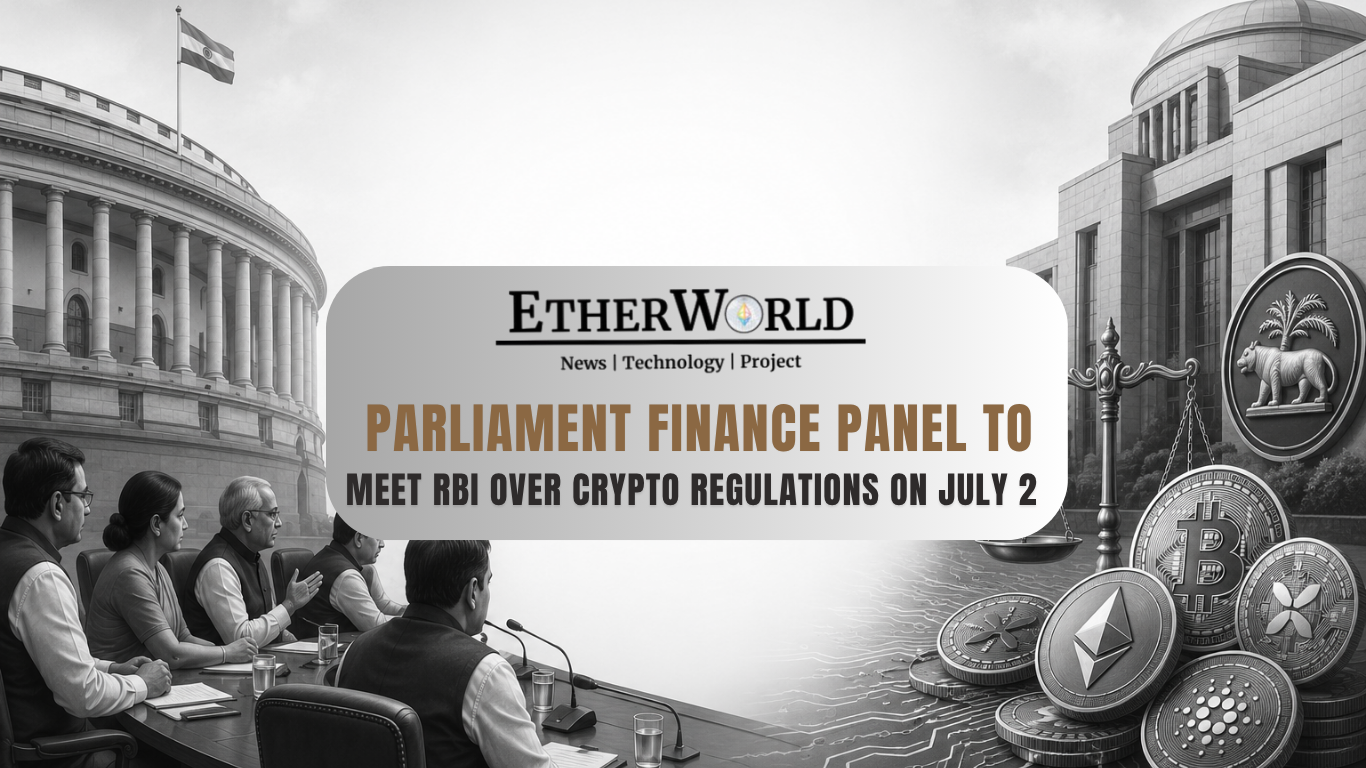
India's Parliamentary Standing Committee on Finance will meet the RBI & ICAI on July 2 to review virtual digital asset (VDA) regulations & discuss the future of crypto policy in India.
 ×
×

Join Our Internship Program
Apply Now →India's cryptocurrency policy debate is set to move back into the parliamentary spotlight as the Standing Committee on Finance has scheduled a sitting with representatives of the Reserve Bank of India (RBI) on July 2, 2026. The meeting will focus on "A Study on Virtual Digital Assets (VDAs) and Way Forward," signalling that lawmakers are once again examining how India should regulate crypto assets, exchanges, stablecoins, taxation, investor protection, and compliance risks.
The timing is important. India has already tightened scrutiny around crypto taxation, anti-money laundering compliance, and high-value transactions. Recently, the Financial Intelligence Unit reportedly moved to monitor over-the-counter crypto transactions above $10,000, a development covered by EtherWorld in India FIU Targets Crypto OTC Trades Above $10K. The July 2 meeting now suggests that Parliament may be looking at the wider regulatory architecture rather than isolated enforcement steps.
- Finance Panel to Hear RBI on Virtual Digital Assets
- Why RBI's View Matters for India's Crypto Policy
- ICAI's Role Highlights Tax, Audit and Accounting Questions
- India's Crypto Regulation Debate Enters a New Phase
Finance Panel to Hear RBI on Virtual Digital Assets
The Standing Committee on Finance is one of Parliament's most important forums for reviewing financial policy, regulatory frameworks, and institutional accountability. By calling RBI officials for oral evidence, the panel is likely seeking clarity on how the central bank views crypto risks, digital asset activity, and the future of India's financial system.
India currently recognizes VDAs mainly through taxation and anti-money laundering obligations. Crypto gains are taxed, certain transactions attract tax deducted at source, and VDA service providers have been brought under compliance reporting frameworks. However, India still does not have a complete crypto law that clearly defines licensing, market conduct, asset classification, stablecoin treatment, custody rules, and investor safeguards.
This gap has become more visible as global markets move toward clearer digital asset regulation. The United States has advanced legislative debates around market structure through measures such as the CLARITY Act, which EtherWorld covered in Senate Advances CLARITY Act for Crypto Regulation. Other jurisdictions are also building dedicated frameworks for exchanges, token issuers, and stablecoin operators.
For India, the question is no longer whether crypto activity exists. It clearly does. The real question is whether the country wants to regulate the market through enforcement and taxation alone, or create a formal rulebook that can support innovation while controlling systemic and consumer risks.
Why RBI's View Matters for India's Crypto Policy
The RBI has historically expressed concern over private cryptocurrencies. Its worries have included volatility, investor losses, capital flow risks, illicit finance, consumer protection, and the possibility that privately issued digital money could weaken monetary control. These concerns become even more serious when stablecoins are involved because they can act like digital versions of foreign currency in domestic markets.
EtherWorld has previously examined India's stablecoin question in Does India Need Stablecoins When UPI Already Works. The key issue is that India already has a highly efficient domestic payment system through UPI. This means stablecoins may not be necessary for everyday local payments. However, they may still matter for cross-border settlement, global commerce, treasury operations, tokenized assets, and dollar liquidity.
That distinction is important for policymakers. A retail payment stablecoin used inside India is very different from an enterprise-grade settlement tool used for international trade. EtherWorld also explored this broader business angle in What Enterprises Need to Know About: Stablecoins, where stablecoins were discussed as financial infrastructure rather than just trading instruments.
RBI's testimony could therefore influence how India separates different categories of digital assets. Not all crypto assets carry the same risk. Bitcoin-like assets, exchange tokens, stablecoins, tokenized securities, real-world asset tokens, and CBDCs all require different treatment.
India has also been exploring central bank digital currency use cases. This adds another layer to the debate because RBI may prefer regulated digital public money over privately issued alternatives. EtherWorld covered India's shifting policy environment in India to Change Crypto Strategy as Global Trends Shift, where CBDCs and global regulatory developments were part of the wider discussion.
🚨BREAKING: 🇮🇳 Parliamentary finance panel to meet RBI over crypto regulations on July 2 pic.twitter.com/6pEB5AtS74
— Crypto India (@CryptooIndia) June 26, 2026
ICAI's Role Highlights Tax, Audit and Accounting Questions
The committee's decision to also invite ICAI is significant. Crypto regulation is not only a question of central banking or exchange supervision. It is also a question of accounting, taxation, audit trails, disclosures, valuation, and corporate reporting.
As more businesses interact with digital assets, accountants and auditors need clearer standards. Companies may hold crypto on balance sheets, receive tokens as payments, use stablecoins for settlement, interact with DeFi protocols, or issue tokenized assets. Each of these activities raises accounting questions.
How should volatile tokens be valued? How should impairment be treated? How should custody risks be disclosed? How should companies record gains, losses, fees, and token-based transactions? What audit evidence is acceptable when assets exist on-chain? These questions are not theoretical anymore.
India's tax authorities have already been active in the sector. EtherWorld covered intensified enforcement in India Intensifies Crypto Oversight as ED Freezes ₹4,190 Cr & 44,057 Tax Notices Sent. That report reflected how tax and enforcement agencies are increasingly tracking crypto-related activity.
The ICAI discussion may help lawmakers understand the practical side of compliance. Even if Parliament or regulators create rules, implementation will depend on proper reporting systems, audit standards, transaction records, and professional guidance. Crypto exchanges, businesses, investors, and auditors all need clarity.
This is especially relevant as tokenization grows. India has already seen discussions around regulated tokenized financial instruments, including tokenized corporate bonds. EtherWorld covered this direction in India's SEBI Plans to Tokenised Corporate Bonds. If tokenized securities become part of India's capital markets, accounting and audit frameworks will become even more important.
India's Crypto Regulation Debate Enters a New Phase
The July 2 meeting should not be seen as an immediate sign of a new crypto bill. Parliamentary committee meetings often function as consultation and evidence-gathering exercises. However, they can shape future recommendations and influence how ministries and regulators think about policy.
That uncertainty affects exchanges, startups, investors, developers, and enterprises. For example, questions around exchange safety became more prominent after major platform failures and security concerns. EtherWorld discussed user protection and platform selection in After CoinDCX: Where Should Indian Crypto Users Actually Trade?. Similarly, exchange access and INR liquidity remain important themes, as seen in Coinbase Introduces USDC-INR Trading for India.
India is also watching global developments. EtherWorld previously covered this in India Studies Global Crypto Regulation Models Amid Growing Capital Outflow, where lawmakers were reportedly examining how other countries are responding to crypto adoption and capital movement. This global comparison matters because crypto markets are cross-border by design.
The July 2 discussion with RBI and ICAI could therefore become an important checkpoint in India's VDA policy journey. RBI can provide the financial stability and payment system perspective, while ICAI can explain accounting, reporting, audit, and compliance challenges. Together, these inputs may help Parliament identify what a more mature Indian crypto framework should include.
For the crypto industry, the meeting is a reminder that regulatory clarity will not come from one agency alone. It will require coordination between Parliament, the Finance Ministry, RBI, FIU, tax authorities, SEBI, accounting bodies, and law enforcement agencies.
India's next crypto policy phase may not be about whether digital assets should be acknowledged. That has already happened through taxation and compliance rules. The next phase is about designing a framework that can distinguish speculation from infrastructure, innovation from risk, and consumer access from systemic exposure.
To promote your Web3 articles, events, and projects, you may reach out anytime via EtherWorld PR for submissions and collaboration.
Related Articles
- India FIU Targets Crypto OTC Trades Above $10K
- India's Crypto TDS Collection Crosses ₹511 Crore in FY25
- India Intensifies Crypto Oversight as ED Freezes ₹4,190 Cr & 44,057 Tax Notices Sent
- Coinbase India INR Rails Comes With a Catch
- RBI's $5B USD/INR Swap Puts Stablecoin Debate Back in Focus
To follow blockchain news, track Ethereum protocol progress, and read our latest stories, subscribe to our weekly today.
Disclaimer: The information contained in this website is for general informational purposes only. The content provided on this website, including articles, blog posts, opinions, & analysis related to blockchain technology & cryptocurrencies, is not intended as financial or investment advice. The website & its content should not be relied upon for making financial decisions. Read full disclaimer & privacy policy.
To stay updated on blockchain news, Ethereum protocol progress, and our latest stories, subscribe to our weekly digest and YouTube channel for ELI5 content.
To promote your Web3 articles, events, project updates, and Press Releases, reach out anytime via EtherWorld PR for submissions and collaboration. For other queries, email contact@etherworld.co.
If you’d like to support our work, share the content and consider donating at avarch.eth.
Join our community on Discord and follow us on Twitter, Facebook, LinkedIn & Instagram.
Author

Yash Kamal Chaturvedi is a Blockchain Content & Ops Specialist at Avarch LLC, writing on Ethereum & governance since 2021. Covers ACD/ACDE calls, EIPs, upgrades, staking, security & ecosystem trends.